
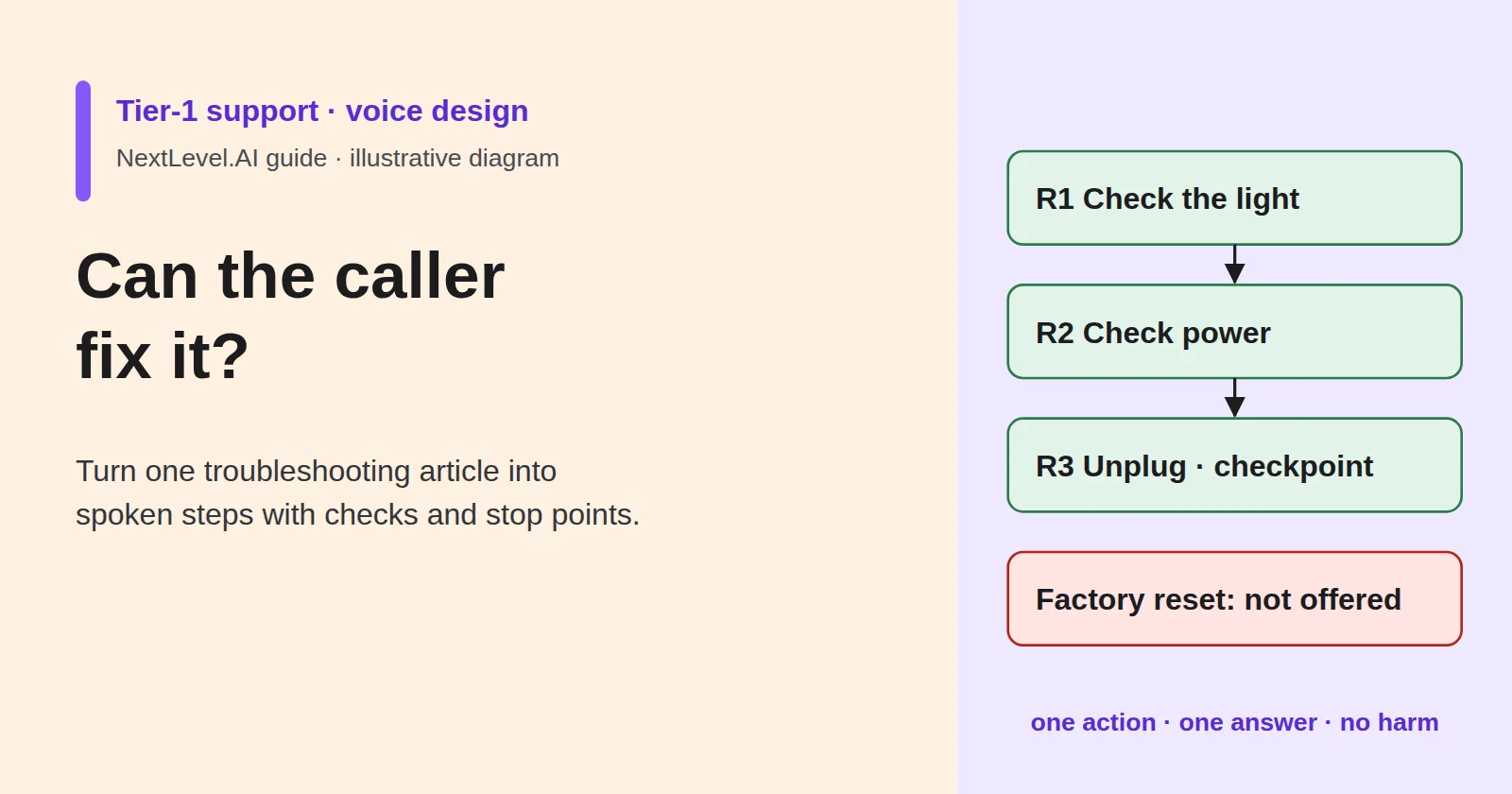
Your knowledge base has a good article on restarting a customer's router. It has nine numbered steps, three screenshots and a note in bold near the bottom. Read aloud by a voice agent, it falls apart. The caller loses track at step four, says "done" without saying what happened, and is transferred to an engineer who starts again from step one.
The fix is not a better voice. It is a different unit of design. A step can be guided by voice when the caller can do one thing, report one result in words, and come to no harm if the step goes wrong. Everything else is a stop point, and the agent hands over with the steps already tried. This guide shows how to rebuild one written article on those terms, using a fictional router-restart flow. NextLevel sells voice agents for contact centers. The example is illustrative, not a customer deployment.
What makes a step safe to guide by voice
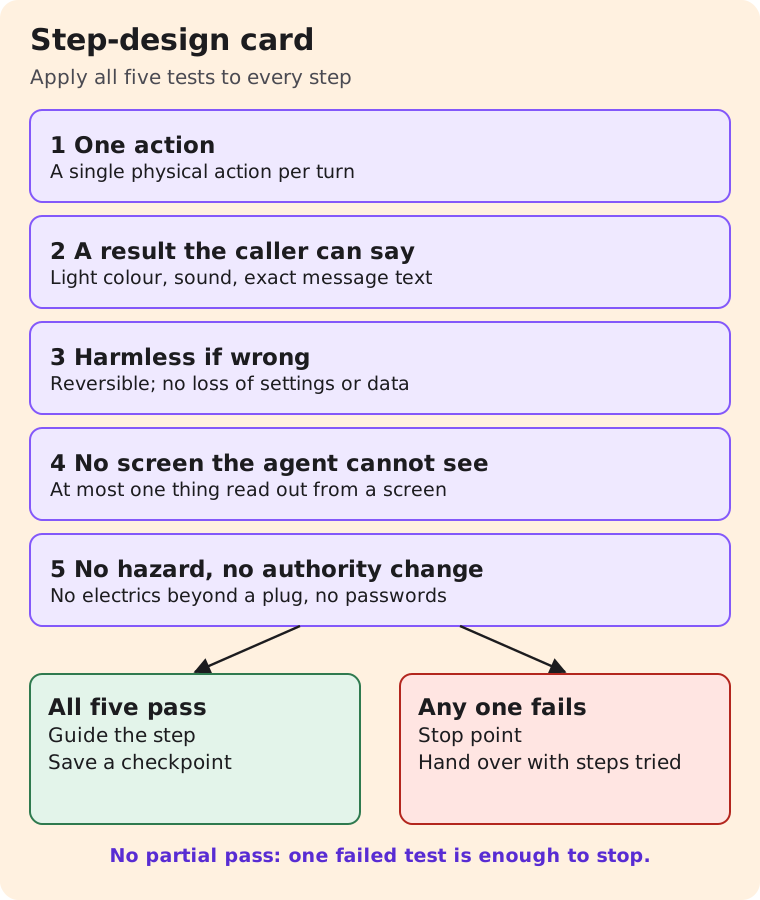
A written article lets the reader scan back, look at a picture and do two things at once. A phone call takes all of that away. The caller holds the phone in one hand, cannot see your screenshot, and remembers about one instruction at a time. So before converting anything, test each step against five questions.
One action. Does the step ask for a single physical action? "Unplug the power cable and wait thirty seconds, then plug it back in and check the lights" is three steps in one sentence.
A result the caller can say. After the action, can the caller report something observable in plain words: a light's colour, whether a sound stopped, the exact text of a message? "Is it working now?" is not observable. "Does the light marked Internet stay on, or is it still flashing?" is.
Harmless if wrong. If the caller does the step badly or on the wrong device, can it be undone without loss? Restarting a router is reversible. A factory reset that erases the customer's settings is not.
No screen the agent cannot see. If the step depends on a screen, the caller must be able to read out one specific thing from it. Steps that require navigating several menus by sight belong with a person or a different channel.
No hazard and no authority change. The step must not involve electrical work beyond pushing in a plug, gas, water near power, passwords, or account changes the caller is not entitled to make.
A step that passes all five can be guided. A step that fails any one becomes a stop point. That is the whole rule, and it is deliberately strict. Guiding a caller through your published procedure is not the same as diagnosing their fault, a boundary NextLevel's telecom customer-service guide also draws. The agent records what the caller saw. It does not conclude what is broken.
Turning a written KB article into spoken steps
Start from the existing article, not a blank page. The article holds knowledge your team has already agreed on, and the conversion should keep that knowledge intact while changing its form.
First, strip the article to actions and checks. Remove the background paragraphs, the screenshots and the "why this works" notes. Keep each instruction and whatever the reader is told to look for afterwards.
Second, split compound steps until each one passes the one-action test. Expect the step count to grow. That is fine: each spoken step is shorter and easier to hold in mind.
Third, replace visual references with spoken landmarks, or with a question. "Press the button shown in Figure 2" means nothing on a call. "Is there a small button on the back, next to where the power cable goes in?" works only if your devices really have one. If the article covers several models, ask the caller to describe what they see before giving the instruction, and stop if the description does not match a known model.
Fourth, write the expected observation and the "if not" branch for every step. This is where most of the design effort goes, because the written article usually only describes the success path.
Fifth, give each step a short ID. The ID becomes the checkpoint the agent saves and the resume point after a dropped call.
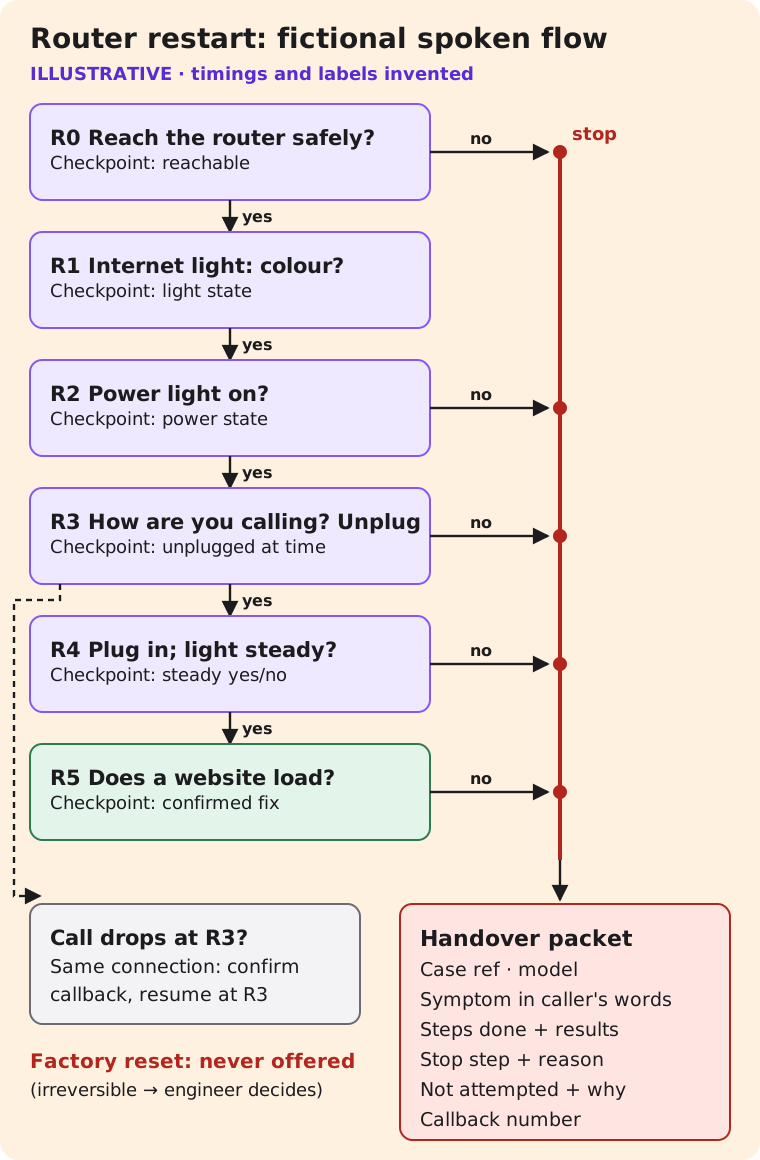
Here is the result for a fictional router restart. Timings and light labels are invented for the example; your product documentation sets the real ones.
| Step | What the agent says | Expected answer | If not | Checkpoint saved |
|---|---|---|---|---|
| R0 | "Can you reach the router safely right now, without moving anything heavy?" | Yes | Offer a callback or a person | Reachable: yes/no |
| R1 | "Look at the lights on the front. Is there one marked Internet, or with a small globe? Is it green, orange, flashing or off?" | Names one of the four | Ask for any lights at all; none lit → R2 | Internet light state |
| R2 | "Is the power light on?" | Yes | Ask whether the plug is pushed fully into the router and the wall socket; damaged cable or burning smell → stop | Power state |
| R3 | "Please unplug the power cable from the back of the router and tell me when it's out." | "It's out" | Ask what they see; unsure which cable → stop | Unplugged at [time] |
| R4 | "Now plug it back in. The lights can take a few minutes to settle. Tell me when the Internet light stops flashing." | Light steady | Still flashing after the documented wait → stop | Light steady: yes/no |
| R5 | "On the device that was offline, try opening a website. Does it load?" | Loads | Stop and hand over | Confirmed fix: yes/no |
The written article also included a factory reset as a last resort. In the spoken flow it does not appear at all. It fails the harmless-if-wrong test, so it becomes an engineer's decision rather than a step the agent offers.
Confirmation, checkpoints and resuming after a drop
"OK" and "done" are not confirmations. They tell you the caller has stopped talking, not what they saw. Each step therefore ends with a closed question that names the options: "Is the light green, orange, or off?" If the caller answers something else, the agent asks once more in different words and then treats the step as failed rather than guessing. The repair ladder in our conversation-design guide covers re-asking in more depth.
Save a checkpoint after every confirmed step, not just at the end. The checkpoint holds the step ID, the caller's observation in their own words and the time. It is the raw material for the handover packet, and it lets you see later where flows break.
Router troubleshooting has a trap that generic conversation-design advice will not warn you about. If the caller is phoning over the same internet connection, through Wi-Fi calling or an internet phone line, restarting the router is likely to drop the call (some mobiles move a Wi-Fi call to the mobile network, many do not). So before R3 the agent asks how they are calling. If it is over the same connection, the agent says so plainly, confirms a number to call back on, and saves R3 as the resume point. A flow that ignores this will record those restarts as abandoned calls, even when the restart worked.
When the caller returns, the agent identifies the open case under your normal identity rules and reads back the last confirmed step: "Last time we got as far as unplugging the router. Is it plugged back in now, and what is the Internet light doing?" It does not start from R0 unless the saved state is missing or the caller says something has changed. Starting again from the beginning throws away the caller's earlier effort and invites them to give up.
Stop conditions and the escalation packet
Write the stop list before you write the happy path. Stop conditions are where voice-guided troubleshooting earns trust, because they show the agent knows the limit of the procedure. For the router flow, the agent stops and hands over when:
- the caller mentions smoke, a burning smell, a damaged cable, water near the device or anything that sounds unsafe. The agent tells them not to touch the device and follows your safety routing;
- the next step would need a password, admin access or an account change;
- the next step is irreversible, such as a factory reset or a firmware change;
- the caller cannot perform or observe the step, for example the device is out of reach or they cannot see the lights;
- the same check fails twice after rephrasing;
- the symptom described does not match any branch of the procedure;
- the caller asks for a person, or sounds distressed.
A stop is only useful if the person who picks up does not start over. The handover packet should carry the case reference, the product and model the caller described, the symptom in the caller's own words, every completed step with its observed result, the step where the flow stopped and the reason, what was deliberately not attempted, and the callback number. The engineer's first sentence can then be "I can see you've already restarted the router and the Internet light is still flashing," which is the moment the caller stops repeating themselves. NextLevel's AI-to-human handoff guide covers transfer modes and failed-transfer recovery in more depth.
NextLevel's published technical-support customer story describes this division of labour for a UAE operator: product-specific agents working from the operator's troubleshooting playbooks, and a warm transfer to an engineer "with full context already loaded" when the playbook runs out. Those are results reported for that deployment, not an inspected outcome, and whether the same pattern carries over to US or UK support teams is a hypothesis to test in your own calls.
Testing the flow and measuring confirmed fixes
Test the conversion before any caller hears it. A useful test set for the router flow covers:
- the happy path from R0 to a confirmed fix;
- every "if not" branch, one at a time;
- a call dropped at R3 and resumed from the checkpoint;
- each stop phrase, including indirect versions such as "it smells a bit hot";
- a caller who says "done" without describing anything;
- a caller who cannot see the lights.
For each case, check three things: did the agent take the right branch, did it save the right checkpoint, and does the handover packet match what was said.
Count outcomes separately rather than in one success rate. A confirmed fix means the caller reported the success check at R5 and did not contact you again about the same issue within a window you choose and keep fixed, for example seven days. A handover at step X is a different outcome, and so is an abandoned call. Reporting handovers by stop step is the quickest way to find the weakest step in the flow. If most handovers happen at R4, the documented wait may be too short, or the light labels may not match the devices in the field. NextLevel's contact-center KPI guide explains why a call that simply ends inside the AI is not the same as a resolved one.
Start with one article
Pick the troubleshooting article your engineers are most tired of repeating, and run it through the five-test card before anything else. If you want to discuss which steps qualify, where the stop points should sit and what your engineers need in the handover packet, bring that article to a scoping call about NextLevel's AI call center.
FAQ
Can a voice agent diagnose network or device faults?
Not in this design. The agent guides published steps and records what the caller observes. Deciding what is wrong stays with your engineers.
What if the caller cannot see the device or reach it?
That fails the step-design card, so the flow stops. The agent offers a person or a callback and passes on what it has already recorded.
Should the agent ever guide a factory reset?
Not in a Tier-1 flow built on these rules. A factory reset is irreversible for the customer's settings, so it is an engineer's decision.
How do we know the flow works?
Count confirmed fixes with no repeat contact within a fixed window, separately from handovers by step and abandoned calls. A finished conversation alone does not tell you the problem was fixed.