
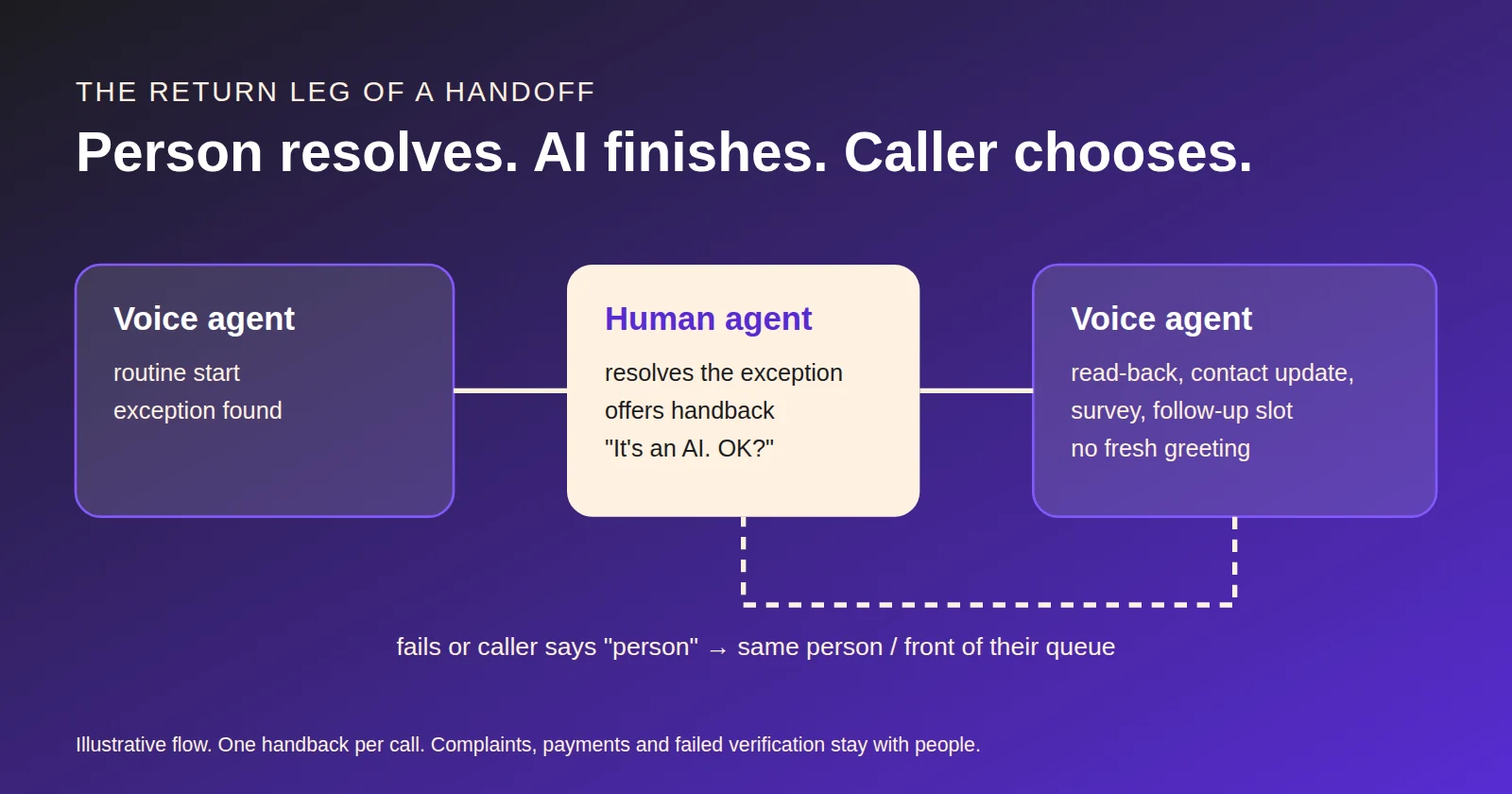
A caller reaches the voice agent, hits an exception, and is transferred to a person. Say the person fixes the problem in three minutes: approves the refund, unlocks the account, reschedules the visit outside the normal rules. Then they spend another four minutes reading back a confirmation number, taking an updated email address and asking the caller to rate the call.
Those last four minutes are routine work, the kind the voice agent already does. Handing the caller back to the agent for them can free the person for the next exception. Done badly, it feels to the caller like being sent back to the start, or like being passed around.
This guide is for the contact-centre designer deciding whether to build that return leg. It covers which finishing tasks may go back to the agent and which must not, what the agent needs to receive, how to tell the caller, and how a failed handback recovers. The forward direction, AI to human, is covered in the AI-to-human handoff guide. This article assumes that path already works.
It is vendor-neutral. Whether a given platform can return a live call from a human to an AI depends on its telephony and routing set-up; confirm it, don't assume it.
What a handback is for
A handback is worth building when three things are true:
- The exception is resolved. The person has made the decision only a person could make, and nothing about it is still open.
- What remains is routine and bounded. Reading back a confirmation, capturing a contact detail, offering a survey, booking a follow-up into available slots.
- The caller agrees. A handback the caller did not choose is a transfer they did not ask for.
If any of the three is missing, the person finishes the call. A handback is an option the person offers, not a rule that fires automatically.
It is also worth being honest about what it saves. A handback saves the person's time on the finishing steps. It adds a transfer, a short wait and a new voice for the caller. For short finishing steps, the person finishing the call is often better for the caller. Measure both sides before scaling it.
Tasks that may and may not go back to the AI
| Finishing task | Handback? | Why |
|---|---|---|
| Read back a confirmation number, date or reference the person created | Yes | Routine; the value is already in the system |
| Capture or update a contact detail (email, preferred callback number) | Yes | Routine capture with chunked read-back and a repair limit |
| Offer a short post-call survey | Yes | Bounded; the caller can decline |
| Book a follow-up into available slots | Yes, if the agent checks live calendar availability | Routine when slots and rules are clear |
| Send a summary by text or email | Yes, with consent | Only to a confirmed address or number, with the caller's agreement |
| Anything the person promised but did not record in a system | No | The agent cannot honour a promise it cannot see |
| Complaints, disputes or an unhappy caller | No | The caller needs a person to own the outcome; never hand back a complaint |
| Payment card details | No | Keep card capture in the payment path your organisation has approved for it |
| Identity verification that failed or was overridden | No | The decision was a person's; the agent must not re-run it |
| Signs the caller is vulnerable, distressed or confused | No | A person stays with the caller |
| The caller asked for a person, or declines the handback | No | The caller's choice wins |
The table is a starting point. Your own list should come from your exception types and your risk owner, and every "yes" should be tested.
Context the AI must receive
When the call returns, the agent should know enough to finish without asking the caller anything they have already said. It must also know what it is not allowed to do.
| Field | Example (fictional) | Why it matters |
|---|---|---|
| Handback reason | "Finish: confirm reschedule and capture new email" | Defines the only task the agent should do |
| Resolution summary | "Visit moved to Thursday 10:00 by supervisor approval" | So the agent can read it back accurately |
| Values to confirm | Booking reference, date, time | The exact strings to read back |
| Verified state and scope | "Identity verified by agent for this call only" | Prevents re-verification and prevents scope creep |
| Do-not-reopen list | "Fee waiver decision: final" | Stops the agent re-negotiating a person's decision |
| Return target | The same person, or their queue at the front | Where the caller goes if anything fails |
| Caller language and preferences | English; prefers text confirmation | Continuity |
| Handback count | 1 | Lets the loop rule work (see below) |
Keep the payload short and structured. A free-text note that mixes facts with the person's guesses invites the agent to present a guess as a fact.
Telling the caller
The caller should hear three things before the handback: what has been done, what the AI will do next, and that they can come back to a person. They should also hear clearly that the next voice is an AI.
A person might say: "Your visit is moved to Thursday at ten. To finish, I can pass you to our AI assistant. It's not a person; it will read back your booking and update your email. If anything's wrong, it will bring you back to me, or to the front of my team's queue if I'm on another call. Or I can finish it with you myself. Which would you prefer?"
The agent then opens with continuity, not a fresh greeting: "Hi, I'm the AI assistant. I can see your visit is moved to Thursday at ten. Let me read back your booking reference."
Rules worth keeping:
- Ask, don't announce. The caller chooses.
- Disclose that it is an AI, every time. Never present the agent as a person. See AI call disclosure and consent.
- Say how to get back. "Say 'person' at any point."
- No new greeting, no new questions the caller already answered.
Testing loops and failed handbacks
Two failures matter most: the caller gets stuck in a loop, and the handback fails and the caller ends up at the back of a queue.
Loop rule. Allow at most one handback per call. If the call comes back to a person after a handback, that person finishes it. A handback count in the payload makes this enforceable.
Failure path. If the agent cannot complete the finishing task, cannot understand the caller, or the caller asks for a person, the call goes back to the same person if available, or to the front of their queue with the context, not to the general queue. The person who receives it should see what the agent finished and what it did not.
If the handback transfer itself fails (no answer, error, dropped leg), the call stays with the person or returns to them. Test that the caller is never left in silence.
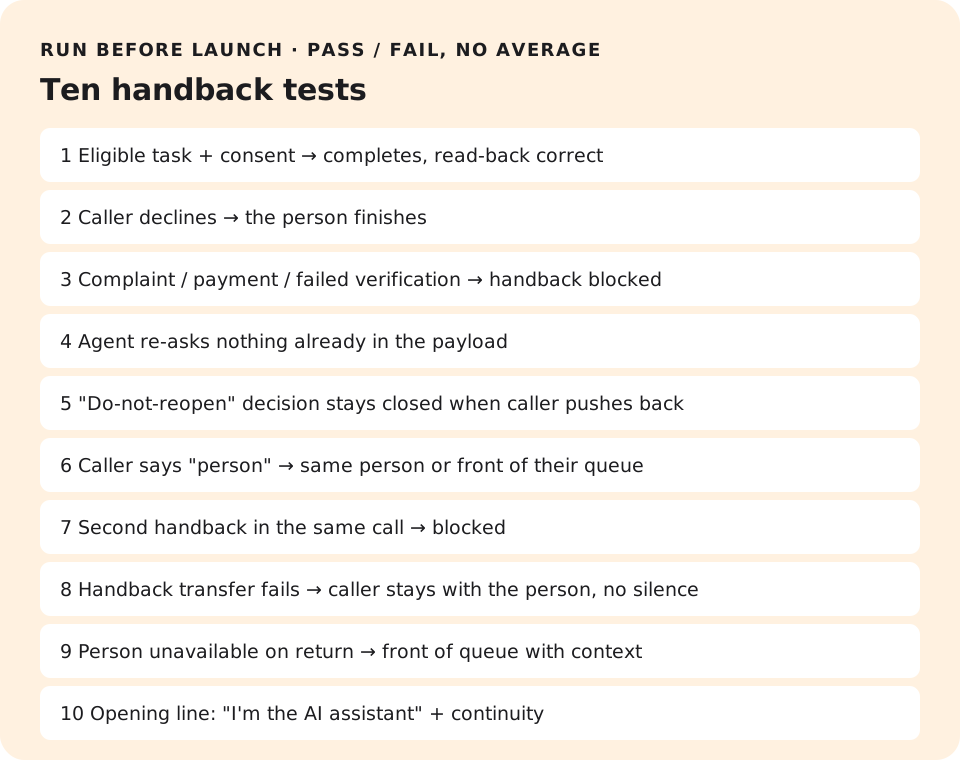
Test cases to run before launch:
- An eligible task with caller consent completes and the caller hears the read-back correctly.
- The caller declines the handback; the person finishes the call.
- An ineligible task (complaint, payment, failed verification) cannot be handed back from the person's desktop.
- The agent receives the payload and does not re-ask any field in it.
- The agent does not reopen a do-not-reopen decision when the caller pushes back.
- The caller says "person" mid-task; the call returns to the same person or the front of their queue.
- A second handback in the same call is blocked.
- The handback transfer fails; the caller stays with the person and is not dropped.
- The person is unavailable on return; the call goes to the front of the queue with context.
- The opening line includes AI disclosure and continuity, and no fresh greeting.
Measure: share of eligible calls offered a handback, share accepted, share completed by the agent, share returned to a person, and the person's time saved, against caller satisfaction for handed-back calls. If the returns are high, the eligibility list is wrong.
Where NextLevel fits
NextLevel.AI builds voice agents that hand callers to people with context; see AI call transfer. Whether a return leg from a person back to the agent fits your telephony and routing is confirmed on a scoping call for your platform, not claimed here.
Next step: map your handoff and handback flow on a scoping call booked from the pricing page. Bring your top exception types and the finishing steps your people repeat most.
Frequently asked questions
What is a human-to-AI handback?
The return leg of a handoff: after a person resolves an exception, they pass the caller back to the voice agent to finish routine steps, with the caller's agreement.
Should complaints ever be handed back to the AI?
No. A complaint needs a person to own the outcome. Keep complaints with people from start to finish.
How do we stop callers bouncing between AI and humans?
Allow one handback per call, carry a handback count in the payload, and send any return to the same person or the front of their queue.
Does the caller have to agree?
Yes, in this design. The person offers the handback, says it is an AI, and the caller chooses.
Sources
- NextLevel AI-to-human handoff guide, read 9 Nov 2026 (forward direction; context payload and failed-transfer recovery).
- NextLevel AI call transfer, read 9 Nov 2026.
- NextLevel AI call disclosure and consent, read 9 Nov 2026.