
Your team has agreed that complaints stay with people. Then the voice agent goes live, and complaints arrive anyway, often in the middle of what started as a routine call. "Where's my order?" becomes "This is the third time it's been late, and nobody has called me back." What should the agent do in that moment?
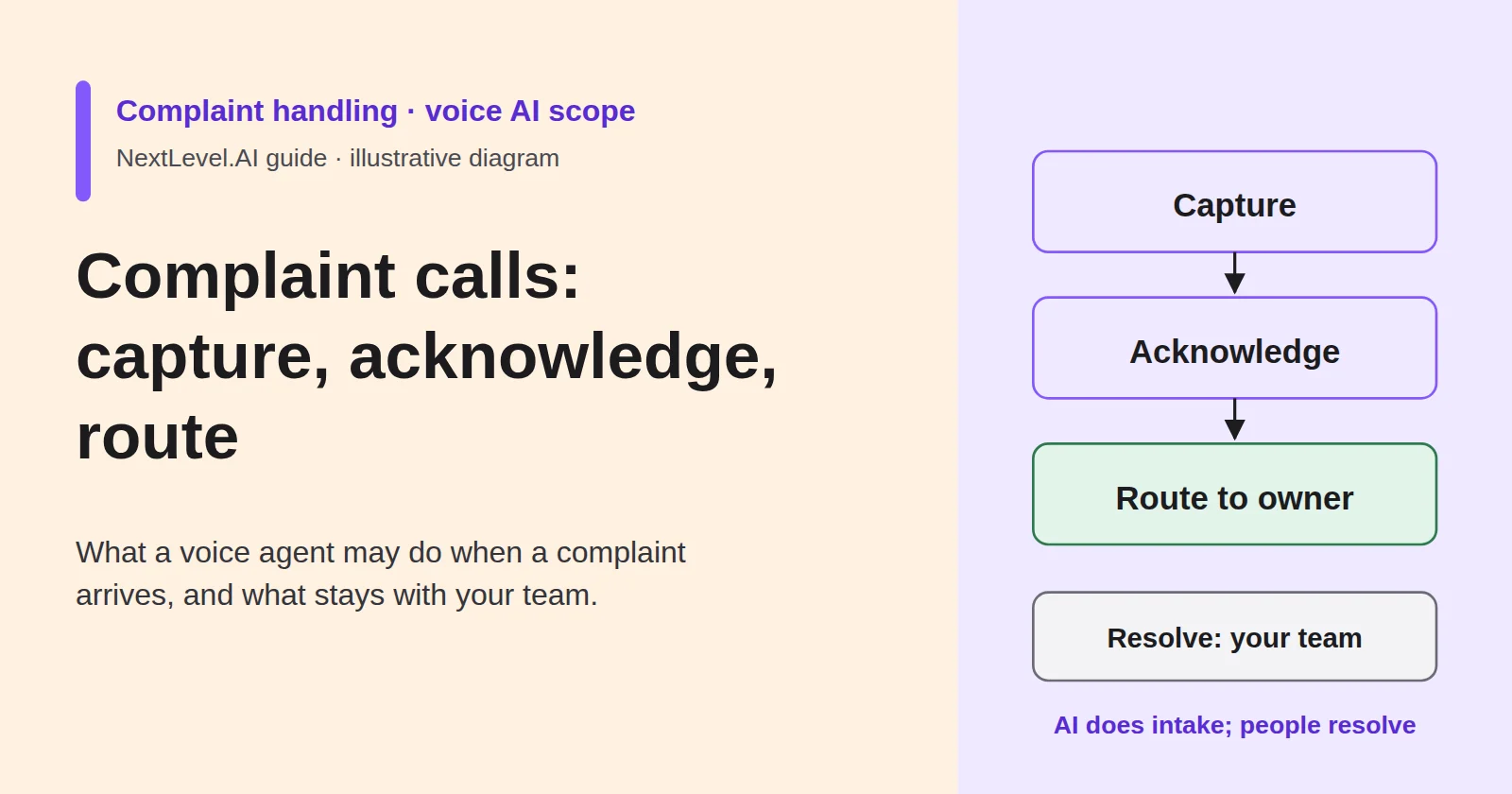
Something specific, not "transfer to a person" and hope. A voice agent can recognise a complaint, take a complete record in the caller's own words, acknowledge it without admitting fault or promising a remedy, and route it to a named owner, with the caller told exactly what happens next. Resolving the complaint stays with your team. This guide sets out that intake specification, with a fictional example record. It is not legal advice, and it excludes regulated complaint regimes such as those in financial services and healthcare. NextLevel sells voice agents for contact centers.
Why intake, not resolution
Resolving a complaint usually needs judgement, discretion and authority: to investigate, to decide who was at fault, and to offer a remedy. Those are exactly the things you should not delegate to an automated agent. Complaints are hard even for trained people. In SQM Group's 2024 first-call resolution benchmark, which covers more than 500 North American inbound customer service centers and measures resolution through post-call customer surveys, complaints had the lowest first-call resolution of the call types measured: 48%, in human-staffed centers. NextLevel's call deflection guide cites the same research and advises keeping complaints human-first and using automation for intake only.
Intake still matters. A complaint taken badly, with missing facts, no reference and no owner, turns into a second complaint about how the first was handled. A complaint taken well gives your team a complete case before anyone calls the customer back, and gives the caller a reference and a clear next step. That is the job.
Tell a complaint from a routine request
A workable test comes from ISO 10002, the international guideline on complaints handling. It defines a complaint as an "expression of dissatisfaction made to an organization, related to its product or service, or the complaints-handling process itself, where a response or resolution is explicitly or implicitly expected" (ISO 10002:2018, clause 3.2). Two things together, then: dissatisfaction, and an expectation that you will do something about it.
In practice, the agent listens for:
- Explicit words: "complaint", "complain", "unacceptable", "I want to escalate this".
- Repetition: "again", "the third time", "still not fixed", "nobody called me back".
- An expected remedy: refund, compensation, someone to call, someone held accountable.
- Dissatisfaction with how they were treated: a member of staff, a previous call or the complaints process itself.
Compare two callers. "My delivery is late, when will it arrive?" is a status request; the agent can answer it. "My delivery is late again, and I want to know what you're going to do about it" is a complaint; the caller expects a response beyond the status.
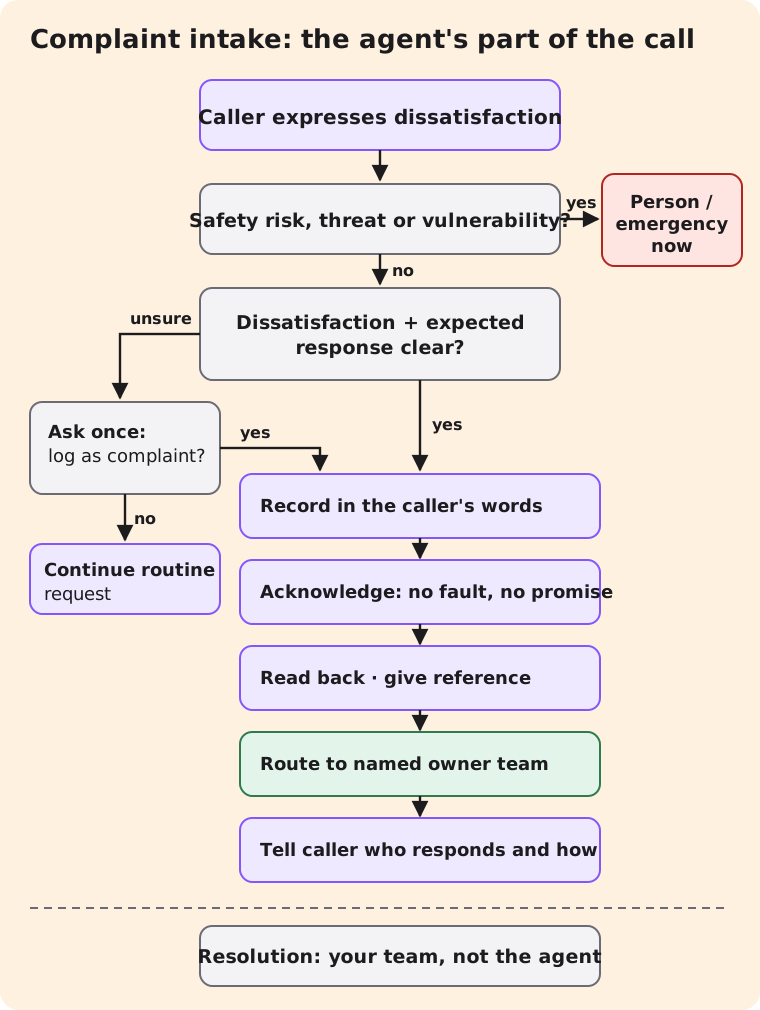
When the agent is unsure, it asks once: "Would you like me to log this as a complaint, so someone from our team follows it up?" If the caller says yes, it is a complaint. Never make a caller argue that their complaint qualifies.
Some calls skip intake altogether. If the caller mentions a risk to anyone's safety, a threat, or circumstances that suggest they are vulnerable, the agent routes them to a person or your emergency procedure immediately, and records why.
The minimum complaint record
The record should let the person who picks it up understand the complaint without calling the customer to ask the same questions again. Keep the caller's words as the primary content. The agent's summary is a convenience, not a substitute.
| Field | Why it is needed |
|---|---|
| Case reference | Given to the caller; links later contacts |
| Date, time, channel | Starts any response clock your policy sets |
| Caller identity | Verified under your normal rules; nothing extra collected |
| Callback number and preferred time | So the owner can respond |
| What happened, in the caller's words | Transcript excerpt, not a paraphrase |
| What the caller wants | Their stated expectation, recorded without comment |
| Related order or account reference | So the owner can investigate |
| Previous contacts | Links to earlier cases or calls on the same issue |
| Category and urgency | Drives routing; set by rules, reviewable |
| Safety or vulnerability flag | Triggers immediate routing |
| What the caller was told | The exact acknowledgement and next step given |
| Assigned owner team | Who has accepted the case |
Here is a fictional example record:
Case C-20418 · 9 Nov, 14:12 · phone (AI intake)
Caller says: "This is the third delivery that's come late. I took a day off for it. Nobody called me back last time."
Caller wants: a call from a manager and to be refunded the delivery charge
Related: order 55871; previous contacts 2 Nov (status), 5 Nov (status)
Category: delivery, repeat · Urgency: normal · Vulnerability: none stated
Told: complaint logged, reference C-20418, delivery team will contact by phone in line with published policy
Owner: Delivery complaints team
Notice what is not in the record: any judgement about whether the caller is right, and any promise about the refund.
Collect only what the complaint needs. If a caller volunteers sensitive details, such as health information, record what is necessary to handle the complaint and nothing more. Keep recordings and transcripts under the same retention rules as your other customer records.
What the agent may and may not say
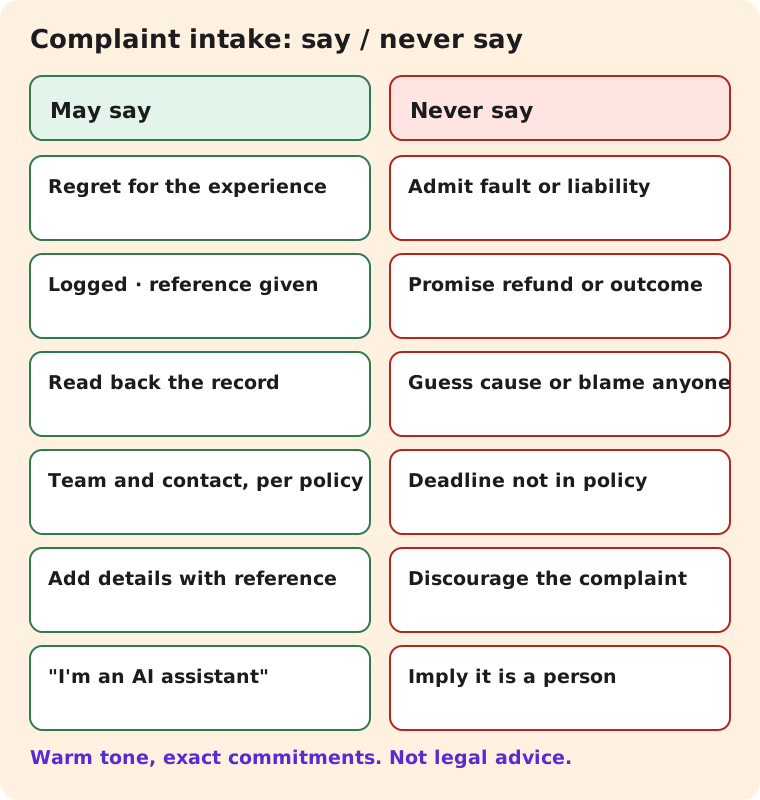
Write this list before the first test call and give it the same status as your other policies. The agent's tone can be warm. Its commitments must be exact.
| The agent may say | The agent must never say |
|---|---|
| "I'm sorry you've had this experience." | "That was our fault" or anything that admits liability |
| "I've logged this as a complaint. Your reference is C-20418." | "You'll get a refund" or any promise of compensation or outcome |
| "Let me read back what I've recorded." | Guesses about what went wrong, or blame for staff or the caller |
| "The delivery team handles complaints like this. They will contact you [as your policy states]." | A deadline that your published policy does not set |
| "If you'd like to add anything, quote this reference." | Anything that discourages the caller from complaining |
| "I'm an AI assistant, and a member of the team will follow up." | Anything implying the agent is a person |
Read back the record before closing. It catches transcription errors and shows the caller they were heard.
Three caller behaviours need scripted handling. If the caller presses for a commitment ("Just tell me I'll get my money back"), the agent repeats what it can do: log, route and give the reference. If the caller asks for a person, the agent offers the fastest route your service provides and records the complaint first if the caller agrees, so the person does not start from nothing.
If the caller is angry, the agent does not argue, defend the company or try to calm them with promises. It keeps to short acknowledgements, records what they say and offers a person. If the caller becomes abusive, the agent follows the same abusive-caller policy your human agents use, and the record notes what happened.
Routing, ownership and what the caller is told
Each complaint category needs a named owner team, a queue the case lands in, and a rule for what happens if nobody accepts it. An unowned complaint queue is worse than none, because the caller has been told someone will respond.
Route by category and urgency, using rules you can audit. Then make ownership visible. The case is not "routed" when it enters a queue. It is routed when a person or team accepts it. If acceptance does not happen within the period your policy sets, the case escalates automatically to a supervisor.
What the caller hears must match what your process will actually do. The agent gives the reference, says which team will handle it and how they will make contact, and states a timeframe only if your published complaints policy sets one. If you offer a warm transfer for complaints during staffed hours, the record goes with the call. NextLevel's AI-to-human handoff guide covers transfer modes and failed transfers. Outside staffed hours, the agent does not improvise a callback time.
When the same caller has an open case, the agent links the new contact to it rather than opening a duplicate, and tells the caller it has done so.
Testing and review
Test the intake before go-live with a fixed set of scripted calls:
- an explicit complaint;
- an implicit complaint inside a status call;
- a status request that is not a complaint;
- a caller pressing for compensation;
- a caller trying to get the agent to admit fault;
- a caller who mentions a safety risk;
- a caller who says they are struggling to cope;
- a caller who asks for a person immediately.
For each test, check that the right path was taken, every required field is filled, the never-say list held and the case reached the right owner.
After launch, review a weekly sample of calls the agent did not classify as complaints. A missed complaint is the more costly error: the caller believes they complained and nobody is responding. Then review a sample of logged complaints for record quality. Track the time from intake to owner acceptance as an operational measure of whether routing works.
Scope one complaint-intake flow
Pick one complaint category, such as delivery or billing, and define its record, its say and never-say list and its owner before anything else. If you would like to scope that flow as part of a pilot, start with NextLevel's AI call center, and bring your current complaints policy with you.
FAQ
Can a voice agent resolve simple complaints itself?
Not in this design. The agent captures, acknowledges and routes. Deciding fault and remedy stays with people who have authority to do so.
Should the agent apologise?
It can express regret for the caller's experience. It should not admit fault or liability, which is a decision for your team and, where relevant, your counsel.
What about regulated industries?
Regulated sectors such as financial services and healthcare have their own complaint definitions, deadlines and record-keeping rules. This guide excludes them. Take any intake design for those sectors to your compliance team and counsel first.
How does the agent know it is a complaint?
It listens for dissatisfaction combined with an expected response, and asks once when unsure. If the caller says it is a complaint, it is logged as one.