
Convert More Visitors with
Intelligent AI Website ChatBot
Proactively engages visitors, qualifies leads, answers questions, and books meetings through natural conversations—capturing up to 87% more leads than static contact forms with seamless CRM integration.
Our AI call center solutions
Our Voice Ai Agent solutions
AI Website ChatBot Features
Proactive Visitor Engagement
Initiates intelligent conversations with every website visitor in real-time, detects browsing behavior and intent signals to offer contextual assistance, and engages at optimal moments to maximize conversion—ensuring the AI bot for website captures opportunities that static forms miss.
Intelligent Lead Qualification & Scoring
Conducts natural discovery conversations to assess visitor needs, budget, authority, and timeline, applies customizable scoring criteria to rank lead quality automatically, and routes high-priority prospects directly to sales teams with complete context—delivering the most advanced AI chat bot for website lead generation.
24/7 Customer Support Automation
Instantly answers product questions, pricing inquiries, technical support requests, and policy questions by accessing your knowledge base, handles multiple simultaneous conversations without wait times, and escalates complex issues to human agents with full conversation history.
Smart Appointment Scheduling
Books sales meetings, consultations, demos, and support calls directly through conversational AI, syncs with team calendars in real-time to prevent double-booking, and sends automatic confirmations and reminders to reduce no-shows—making your AI chat bot website the ultimate conversion tool.
Personalized User Experience
Remembers previous visitor interactions and preferences for returning users, adapts conversation flow based on visitor behavior and page context, and customizes messaging for different traffic sources, industries, or buyer personas to maximize relevance.
Comprehensive Analytics & Insights
Tracks engagement metrics including conversation rates, lead quality scores, and conversion paths, identifies common questions and pain points to optimize messaging, provides full conversation transcripts for sales coaching and quality assurance, and reveals content gaps where visitors seek information.
Get Your Tailored AI Website ChatBot Free of Charge!
Request your AI Website ChatBot trained on your company’s website content, and we’ll deliver a personalized demo experience within 24 hours — including a web-based AI assistant that captures leads, answers questions instantly, and helps schedule appointments directly from your site.
Free trial. 5 hours of voice conversations credit included.
No credit card erquired.

3x
Increase in website lead capture vs. static contact forms

87%
Of customer questions answered instantly without human intervention

60%
Reduction in cost per lead through automation
AI Website ChatBot Key Capabilities:
Specific
Dynamic qualification frameworks
Adapts discovery questions based on industry, company size, and visitor responses to efficiently identify sales-ready prospects using BANT or custom criteria
Multi-intent handling
Simultaneously addresses multiple visitor needs within single conversations, seamlessly transitioning between product questions, pricing inquiries, and booking requests
Knowledge base integration
Instantly retrieves accurate answers from product documentation, FAQs, help centers, and internal knowledge systems to resolve inquiries without human escalation
Lead enrichment automation
Captures contact information, company details, role, specific requirements, and timeline; validates data quality before CRM sync to ensure sales teams receive actionable leads
Meeting booking automation
Checks real-time calendar availability, presents time slot options, handles time zone conversions, books appointments, and sends confirmations with meeting links
Conversation handoff protocols
Seamlessly transfers hot leads to available sales representatives with complete conversation context, or captures contact information for callback when team is offline
A/B testing capabilities
Experiments with different greeting messages, question sequences, and engagement triggers to optimize conversion rates based on data-driven insights
General
Multi-channel deployment
Works as website chat widget, mobile app integration, landing page assistant, and Facebook Messenger bot for comprehensive digital presence
Multilingual support
Conducts conversations in 30+ languages with automatic language detection, accommodating global audiences without separate bot configurations
Enterprise-grade security
Ensures GDPR, CCPA, and industry-specific compliance with encrypted data transmission, secure credential storage, and configurable data retention policies
Custom branding & personality
Matches your brand voice, tone, and visual identity with customizable avatars, colors, conversation style, and greeting messages
CRM & marketing automation
Integrates seamlessly with Salesforce, HubSpot, Marketo, Pardot, Pipedrive, and major marketing platforms for unified lead management
Advanced analytics dashboard
Provides real-time visibility into engagement metrics, conversion funnels, popular questions, lead quality distribution, and ROI measurement
Request Your Tailored AI Website ChatBot Now for Free!
Free AI Website Chat Bot prototyping includes 5 hours of voice conversations, 5M tokens for text interactions, and unlimited lead capture and appointment scheduling chats — with no usage restrictions.

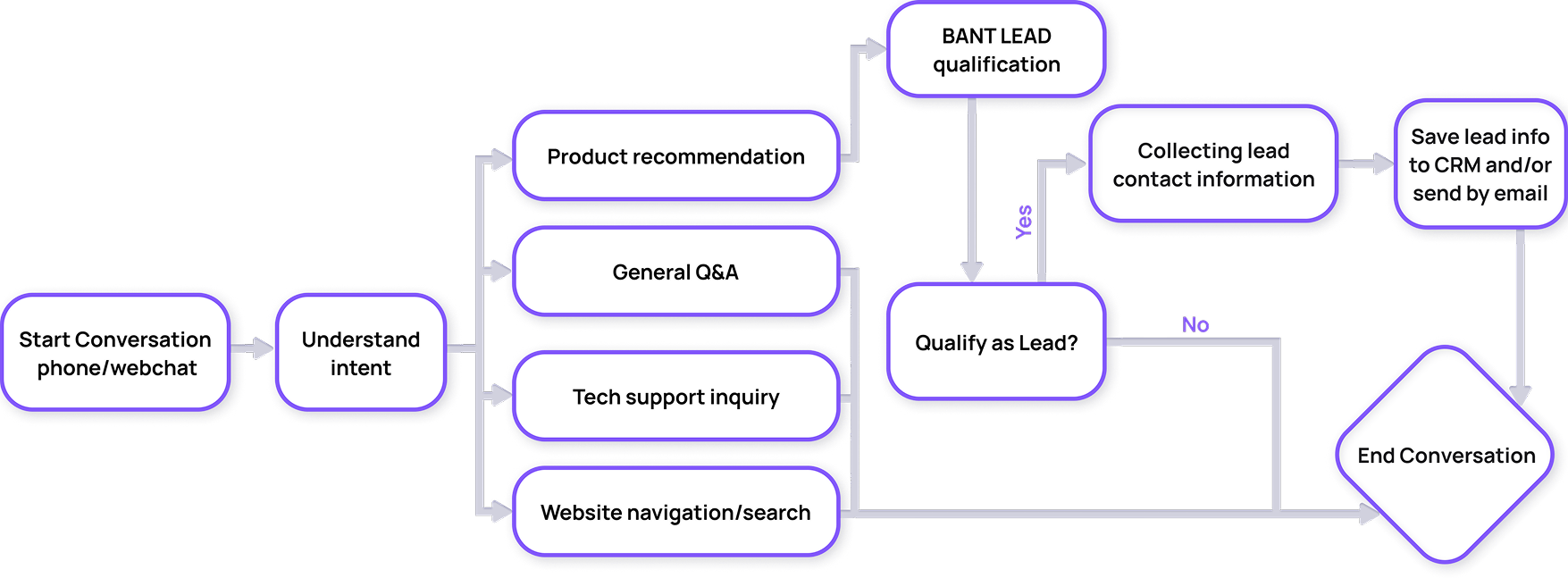
1.
Visitor Engagement
Monitors visitor behavior such as pages viewed, time spent, scroll depth, and exit intent signals in real time, then initiates contextually relevant conversations at optimal moments—ensuring the AI bot captures attention before visitors leave.

2.
Need Discovery
Greets visitors with customized messaging based on traffic source, industry, or page context, then conducts natural discovery conversations to understand needs, challenges, timeline, and decision-making authority—adapting question flow dynamically.

3.
Information Retrieval
Accesses integrated knowledge bases to instantly answer product questions, pricing inquiries, feature comparisons, and technical specifications with accuracy; handles common support requests independently and provides relevant content recommendations.

4.
Lead Qualification
Applies customizable qualification criteria to assess lead quality based on budget, authority, need, and timeline, automatically ranks prospects by sales-readiness, routes high-priority leads, and captures complete lead profiles with key requirements.

5.
Scheduling & CRM Sync
Books qualified prospects directly into sales calendars with real-time availability, handles time zones, sends confirmations automatically, and syncs complete conversation data to CRM including transcripts, qualification insights, and follow-up triggers.
Integrations
We provide over 100 out-of-the-box integrations using n8n and Zapier services.


AI Voice Agent Pricing
We provide over 100 out-of-the-box integrations using
n8n and Zapier services.
Compare plansChoose your workspace plan according to your organisational plan | SaverFrom $89/ mChoose Plan | StandardFrom $175/ mChoose Plan | BusinessFrom $385/ mChoose Plan | PremiumFrom $650/ mChoose Plan | EnterpriseLet’s talkChoose Plan |
|---|---|---|---|---|---|
| Total monthly voice conversation time included (hours) | 8.5 | 17.5 | 40 | 70 | Custom |
| Recommended website traffic | up to 1,000 | up to 10,000 | up to 25,000 | up to 100,000 | over 100,000 |
| Website pages scanned | up to 25 | up to 100 | up to 1,000 | up to 5,000 | 100,00+ |
| AI Video Avatar | V | V | 100,00+ | ||
| Internal Page Links in Answers | V | V | V | V | |
| MultiLanguage Support | 1 | 5 | 30 | 30 | 45+ |
| Agent conversation concurrency | 3 | 5 | 25 | 50 | 100-1000 |
| External AI integrations | V | V | |||
| Communication channels | Website or phone line | Both | Both | Both | Both |
Request Your Free Tailored AI Website
ChatBot Demo Agent
Request Your Tailored AI Website Bot
Fill out and submit the form and we’ll start creating your tailored AI BDR Agent right away, free of charge.
Activate Your 14-Day Free Trial
Get access to your tailored AI Website Bot and client portal, and start your 14-day free trial. We’ll email you the agent page link, portal credentials, the one-line installation script, and setup instructions. Delivery usually takes up to 2 business days.
Continue or Wrap Up After 14 Days
Become a customer of the AI Website Bot or chat soon about other products. After the 14-day free trial, we’ll send you a payment link — feel free to process it, or simply end the trial and we’ll see you later.
How AI Website ChatBot performs
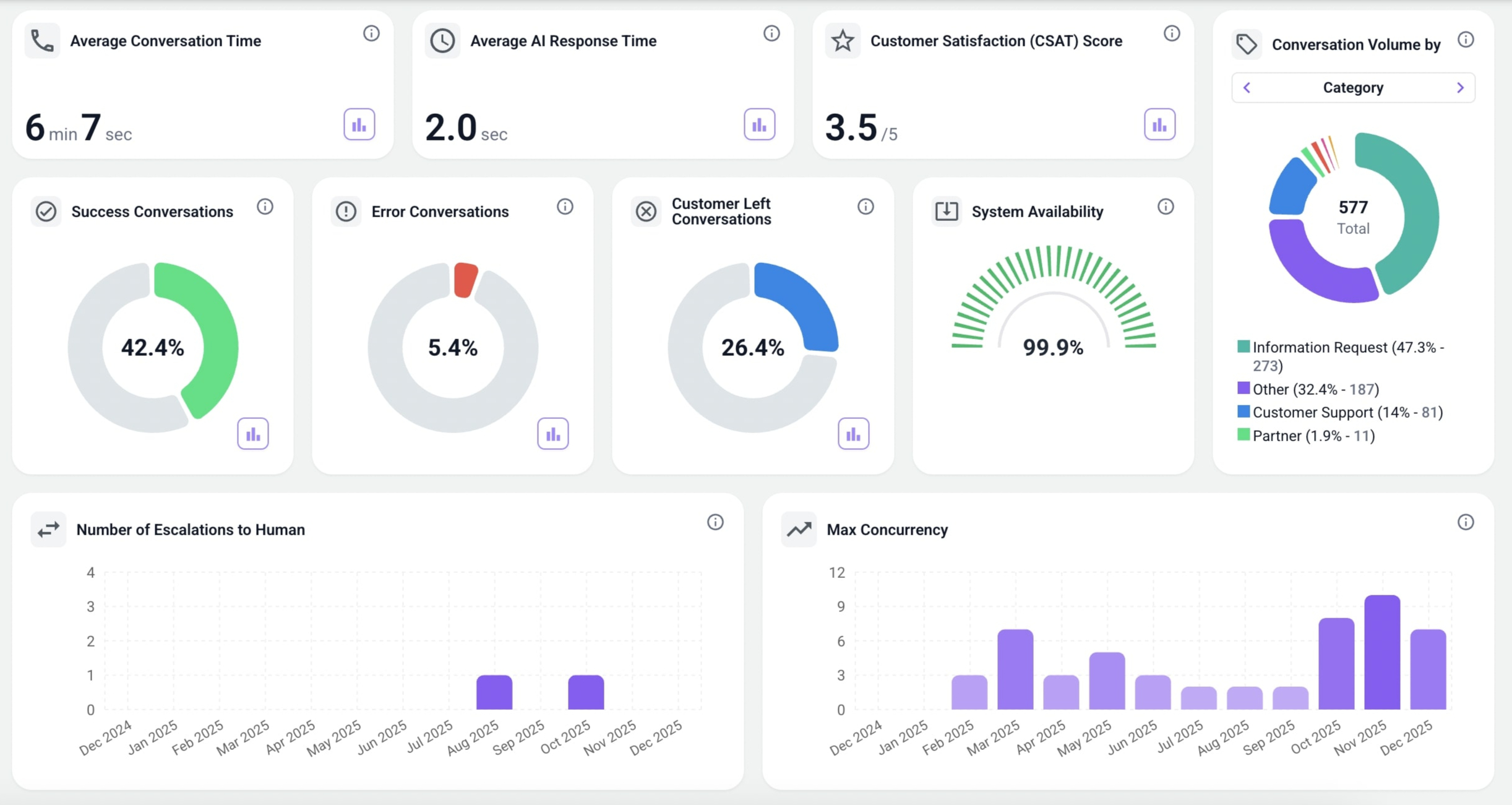
Analyze AI Agent success rate, errors, gaps, trends, inquiry topics & much more

1.
Performance Metrics
View Success, Error, and Abandoned conversation rates to identify gaps and improve agent performance.

2.
Conversation Insights
Categorize conversations by topic, inquiry type, and sentiment for deeper insights.

3.
Transcript Access
Drill down from flagged or categorized conversations to actual transcripts directly from the dashboard KPIs.

4.
Agent Optimization
Track trends and continuously refine your agents — either independently or with our expert support.

For Marketing Teams:
- Capture 3x more qualified leads than traditional forms and static CTAs.
- Gain insights into visitor questions, pain points, and objections.
- Qualify leads automatically before they reach sales.
- Track the full customer journey with detailed analytics.
- Reduce cost per lead by up to 60% while improving lead quality.

For Sales Teams:
- Receive only pre-qualified, sales-ready leads with full conversation context.
- Book more meetings with prospects showing clear purchase intent.
- Access transcripts to understand what prospects care about before the first call.
- Focus on high-value conversations instead of repetitive pricing questions.
- Reduce response time from hours to seconds, boosting conversion rates.

For Customer Support Teams:
- Automate common support questions across product, access, and policy inquiries.
- Reduce ticket volume so agents focus on complex issues.
- Provide 24/7 support availability even with limited staffing.
- Identify knowledge gaps based on recurring customer questions.
- Handle unlimited simultaneous conversations without service delays.
Compliance
Our platform adheres to the highest compliance standards, ensuring full regulatory alignment.

AICPA SOC2

Hitrust

ISO 27001

HIPAA

GDPR

ISO 42001

CCPA

CPRA

CPA
What clients say about NextLevel.AI

Made The Trade
Working with Michael and his team has been an incredible experience.
They developed a cutting-edge AI solution that has truly revolutionized our business operations. We’ve been able to promote and showcase the technology with confidence, and the team has been highly receptive to feedback, making continuous improvements.
We’re excited to implement it into our day-to-day processes and look forward to the ongoing impact it will have on our business.

SalonHQ
The NextLevel. ai team has successfully developed the first advanced prototype of our Stylist AI agent in under a week.
This innovation allows our web shoppers to receive personalized beauty product recommendations directly on our web store through an engaging voice conversation with our AI Stylist. This enhanced customer interaction has not only improved the shopping experience but also attracted significant investor interest, recognizing its potential to revolutionize beauty retail.
Collaborating with NextLevel.ai has truly been a game-changer for SalonHQ.
Thank you, Michael and the NextLevel!

Digital Innovation
Teaming up with NextLevel AI to create our Voice AI BDR agent has been a game-changer for us.
Now, our AI BDR agent takes care of the first touch—engaging website visitors, understanding their needs, and passing qualified leads to our sales team. It even books meetings and seamlessly syncs everything into our CRM, saving us a ton of time.
What really sets it apart is how it adapts in real-time, personalizes conversations, and even identifies high-value enterprise prospects for targeted engagement. NextLevel AI absolutely nailed it. Their team has been incredible—super responsive, always open to feedback, and constantly pushing the technology forward.
Ready to innovate your business?
Looking to transform your business? Let’s collaborate to
create innovative solutions that drive success.
Call Us: +13233105315
Book a meeting
* Schedule a conversation with our team and explore how we can help your business thrive.
Have questions about AI Website ChatBot?
What is an AI website bot and how do AI chat bots for websites work with automation and advanced AI?
An AI website bot is an intelligent conversational agent that uses advanced AI and automation to proactively engage website visitors through natural language chat conversations, qualifying leads and answering customer queries instantly. The AI chat bot for website leverages conversational AI models to understand visitor intent regardless of phrasing, providing accurate answers by accessing your knowledge base seamlessly. These AI chatbots for websites conduct discovery conversations to improve customer experience, qualify sales-readiness, and integrate with your CRM to sync qualified leads automatically. Unlike simple chatbots for websites following rigid decision trees, the best AI solutions use multiple AI models and train your AI agent continuously—the AI bot for website learns from real conversation data to personalize interactions, answer questions more effectively, and streamline customer support. Advanced AI chat bot websites transform passive content into active engagement engines, where the chat bot AI website handles customer queries 24/7, letting your AI chatbot capture opportunities that static forms miss while the AI-powered system seamlessly routes qualified leads to sales teams.
How do custom chatbot platforms with knowledge base integration provide accurate answers and analytics?
Custom chatbot platforms enable businesses to build AI solutions tailored to their specific needs, integrating comprehensive knowledge base systems that provide accurate answers to customer support inquiries instantly. The AI bot website accesses FAQs, product documentation, policy information, and troubleshooting guides seamlessly to answer questions without human intervention, while analytics dashboards track conversation metrics including engagement rates, resolution accuracy, and qualified leads captured. Top AI platforms offer customizable conversation flows that personalize interactions based on visitor behavior, GDPR and SOC 2 compliance for data safeguarding, and sync capabilities with CRM systems to automate customer journey tracking. The dashboard provides real-time visibility into bot performance: how many customer queries the AI customer support handles independently, which questions require optimization, and where the AI-powered system drives the most conversions. Custom AI chatbot solutions let your AI chatbot adapt to your unique business requirements—whether you add your website’s specific terminology, train your AI agent on industry-specific scenarios, or configure the custom chatgpt-style interface to match your brand voice—ensuring the chat interface delivers accurate responses aligned with company standards while the all-in-one platform seamlessly integrates across your technology stack.
What makes the best AI chat bots different with real-time message optimization and conversational AI?
The best AI chat bots use conversational AI models to deliver real-time, natural interactions that feel human-like rather than robotic script-following, analyzing each message context to generate appropriate responses dynamically. Unlike basic bot systems with pre-programmed responses, advanced chat solutions leverage AI to understand intent, handle unexpected questions gracefully, and optimize conversation flow based on visitor behavior patterns. Top-tier AI chat platforms integrate across multiple channels including your website, Facebook Messenger, WhatsApp, and mobile apps—ensuring the chat bot provides consistent experiences wherever customers engage. The bot technology uses real-time processing to instantly retrieve relevant information from knowledge bases, product catalogs, and customer databases, then crafts personalized message responses that directly address specific visitor needs. What distinguishes leading chat bots is continuous improvement: the platform analyzes thousands of conversations to optimize greeting timing, identify which messages drive highest engagement, refine qualification questions that better predict conversion, and generate insights on common pain points. The conversational AI learns which conversation paths lead to successful outcomes—whether booking meetings, completing purchases, or resolving support issues—then automatically adjusts strategies to maximize those results, while real-time dashboards let teams monitor bot performance and intervene when complex scenarios require human handover.
How do AI bot websites integrate with platforms like Shopify to streamline workflow and automate customer support?
AI bot websites integrate seamlessly with e-commerce platforms like Shopify, CRM systems, marketing automation tools, and customer support platforms to streamline workflow and automate customer interactions across your entire technology stack. The integration enables the AI chatbot to access real-time product inventory, pricing, order status, and customer purchase history—providing accurate answers to customer support queries about shipping, returns, product availability, and account details without manual lookup. For Shopify merchants, the AI bot website can answer questions about product specifications, recommend items based on browsing behavior, process simple transactions, and automate customer follow-up for abandoned carts or order confirmations. The platform integration with CRMs like Salesforce and HubSpot allows the AI bot to sync qualified leads automatically, update contact records with conversation data, and trigger workflow automations based on visitor actions—eliminating manual data entry while ensuring sales teams receive complete context. Integration with calendar systems enables the AI chatbot to automate appointment booking, checking real-time availability and scheduling meetings directly during conversations. The workflow automation extends to customer support: tickets created from complex queries automatically route to appropriate teams, escalation protocols trigger when the AI identifies high-priority issues, and follow-up sequences ensure resolution. Built-in connectors for major platforms mean businesses can deploy the AI bot website in days rather than months, while open APIs support custom integrations with proprietary systems—creating seamless data flow across your entire customer engagement ecosystem where every interaction informs the next touchpoint.
Can businesses build AI chatbots with no-code AI chatbot builder tools and customize the chat interface?
Yes, businesses can build AI chatbots using no-code AI chatbot builder platforms that require no coding expertise, enabling marketing and customer service teams to create, customize, and deploy sophisticated conversational agents independently. Modern no-code chatbot builders provide visual interfaces where you drag-and-drop conversation elements, define logic flows, and configure responses—the no-code approach lets teams train your AI agent on company-specific information, customize the chat interface appearance, and optimize conversation paths without developer involvement. The customizable platforms allow businesses to tailor every aspect: custom chatbot branding including colors, fonts, avatars, and positioning that match website aesthetics; personalized greeting messages adapted to different page contexts or visitor segments; and configurable conversation flows that reflect unique qualification criteria or customer support procedures. Users can build AI solutions for specific use cases—whether lead generation, customer support automation, appointment booking, or product recommendations—by selecting pre-built templates then customizing them to business requirements. The no-code AI chatbot builder includes testing environments where teams preview conversations before deployment, A/B testing capabilities to optimize performance, and analytics showing which customizations drive best results. While no-code platforms democratize AI chatbot creation, they also offer flexibility: businesses start with simple implementations then progressively add sophistication as needs evolve, and many platforms provide custom API access when advanced integrations require technical development—balancing ease-of-use with enterprise-grade capabilities that let your AI chatbot grow alongside your business.
How do AI chatbots improve customer experience with user-friendly interfaces and seamless handover to boost sales?
AI chatbots improve customer experience by providing instant, personalized assistance through user-friendly chat interfaces that eliminate friction in the customer journey, dramatically reducing response times from hours to seconds while ensuring consistent, high-quality interactions. The user-friendly design makes engagement effortless: visitors simply type questions naturally without navigating complex menus or filling lengthy forms, the AI understands intent immediately and provides relevant answers, and conversations flow naturally with context maintained throughout multiple exchanges. Customer experience improvements come from 24/7 availability ensuring support whenever customers need it, elimination of wait times even during peak demand, and personalized recommendations based on browsing behavior and previous interactions. The AI chatbot remembers returning visitor preferences, addresses them by name, and picks up previous conversations seamlessly—creating continuity that builds relationships. To boost sales, the AI identifies purchase intent signals, proactively offers product recommendations, answers objections in real-time, and guides prospects through decision-making processes. When conversations require human expertise, seamless handover protocols transfer visitors to live agents with complete conversation history—ensuring customers don’t repeat information and agents can immediately address needs. The handover happens transparently: the AI explains a specialist is joining, provides the agent with full context including qualification data and detected pain points, then monitors resolution to ensure satisfaction. This hybrid approach maximizes customer experience by combining AI’s instant availability and unlimited scalability with human agents’ judgment and empathy—letting businesses boost sales conversion while maintaining the personalized touch that builds customer loyalty.
How do top-tier all-in-one AI platforms work with WordPress and other website builders for deepseek customer insights?
Top-tier all-in-one AI platforms integrate seamlessly with WordPress, Shopify, Wix, Squarespace, and custom-built websites through simple installation methods—typically adding a single code snippet or installing a plugin to deploy the full conversational AI solution. For WordPress sites specifically, businesses install dedicated plugins that add the AI chatbot interface without technical complexity, configure settings through intuitive dashboards, and customize appearance to match WordPress themes—the all-in-one platform handles hosting, AI model management, and infrastructure automatically. These comprehensive platforms combine multiple capabilities in unified solutions: conversational AI for customer engagement, knowledge base integration for accurate answers, CRM synchronization for lead management, analytics dashboards for performance tracking, and appointment scheduling—eliminating the need to cobble together separate tools. The all-in-one approach simplifies management where everything operates through a single interface, pricing consolidates under one subscription, and data flows seamlessly between components without complex integrations. Advanced platforms perform deepseek analysis of customer interactions, mining conversations for insights about pain points, feature requests, objection patterns, and buying signals that inform product development and marketing strategy. The deepseek capabilities identify hidden trends: which questions appear frequently but lack adequate documentation, where customers express frustration indicating UX improvements needed, what features customers actually care about versus what marketing emphasizes, and which conversation paths lead to highest conversion rates. Whether you add your website bot to WordPress, Confluence documentation, or custom applications, top-tier platforms provide enterprise capabilities with consumer-grade simplicity—businesses launch sophisticated AI customer engagement without specialized technical resources.
How does AI customer support automation work with Zapier and Confluence to streamline operations and automate customer workflows?
AI customer support automation transforms service operations by handling 70-85% of routine inquiries independently while integrating with tools like Zapier and Confluence to automate workflows across your entire support ecosystem. The automation begins when the AI chatbot answers common customer queries about account access, password resets, order status, product usage, billing questions, and troubleshooting—resolving issues instantly without creating support tickets or requiring agent intervention. Integration with Zapier enables powerful workflow automation: when the AI identifies issues requiring escalation, Zapier automatically creates tickets in your help desk, notifies appropriate team members via Slack, updates customer records in your CRM, and triggers follow-up email sequences—all without manual intervention. For knowledge management, Confluence integration allows the AI to access comprehensive documentation, technical specifications, and internal wikis to provide accurate answers, while also identifying gaps where documentation needs improvement based on recurring questions. The AI customer support system uses automation to streamline repetitive tasks: automatically categorizing inquiry types, routing complex issues to specialists based on expertise, prioritizing urgent requests requiring immediate attention, and following up with customers to ensure resolution satisfaction. Zapier connections extend automation to thousands of business applications: when customers complete purchases, the AI can automatically send thank-you messages, request reviews, or offer complementary products; when support cases close, the system can trigger satisfaction surveys, update analytics dashboards, and archive conversation data for compliance. The Confluence integration ensures support teams maintain a single source of truth: the AI references the same documentation human agents use, reducing inconsistencies, and conversation insights inform documentation updates—creating a continuous improvement cycle where customer interactions directly improve knowledge quality.
Can businesses upload content and train AI agents to handle complex queries for chatbot app deployment?
Yes, businesses can upload comprehensive content including PDFs, product documentation, policy manuals, training materials, and FAQs to train AI agents on company-specific information, enabling the chatbot app to handle complex queries with expert-level accuracy. The upload process accepts various formats—PDF documents, Word files, spreadsheets, web pages, and structured data—which the AI platform processes to create searchable knowledge bases that power accurate response generation. When visitors submit queries, the trained AI agent searches uploaded content to retrieve relevant information, synthesizes answers that directly address specific questions, and cites sources when providing detailed explanations. This capability transforms generic chatbots into domain experts: healthcare providers upload medical protocols and treatment guidelines, insurance companies upload policy documents and coverage details, SaaS companies upload technical documentation and API references—ensuring the chatbot app delivers accurate, compliant responses aligned with company standards. The training process goes beyond simple document upload: businesses can refine AI understanding by providing example conversations, correcting inaccurate responses, and defining terminology specific to their industry or products. Advanced platforms support continuous learning where the AI agent improves over time by analyzing which responses successfully resolve queries versus which require human escalation, automatically identifying content gaps where documentation needs expansion. For chatbot app deployment across channels, the trained AI maintains consistent knowledge whether visitors engage via website chat, mobile app, or messaging platforms—eliminating inconsistencies where different channels provide conflicting information. The query handling sophistication extends to multi-step processes: when customers ask complex questions requiring multiple information sources, the AI combines insights from various uploaded documents to provide comprehensive answers, and for content creation needs, some platforms can generate customer-facing materials based on internal documentation, ensuring external communications align with source-of-truth content.
What AI models power chatbots including GPT, Claude, Gemini, Mistral, and other LLM platforms?
Modern AI chatbots leverage advanced language models including GPT (Generative Pre-trained Transformer) from OpenAI, Claude from Anthropic, Gemini from Google, Mistral AI, and other specialized LLM (Large Language Model) platforms to deliver human-like conversational experiences. The AI model selection significantly impacts chatbot capabilities: GPT models excel at creative content generation and broad knowledge coverage, Claude provides strong reasoning and safety-focused responses, Gemini offers multimodal capabilities processing text and images, while Mistral delivers efficient performance for European markets with data sovereignty requirements. Leading chatbot platforms support multiple AI models, allowing businesses to choose or combine models based on specific needs: ChatGPT-powered bots might handle creative marketing conversations, Claude-based agents could manage complex policy explanations requiring nuanced understanding, and Gemini integration enables visual product searches where customers upload images. The LLM technology enables chatbots to understand context across long conversations, remember previous exchanges, generate relevant responses rather than retrieving pre-written scripts, and adapt to unique business terminology after training. Advanced implementations use multiple AI models simultaneously—routing different query types to specialized models optimized for those tasks: technical questions to models trained on documentation, sales conversations to models optimized for persuasive dialogue, and support inquiries to models focused on problem-solving clarity. Businesses can also train your AI agent on company-specific data while leveraging the base capabilities of models like GPT or Claude, combining broad language understanding with domain expertise. The choice between ChatGPT, Claude, Gemini, Mistral, or other platforms depends on factors including conversation complexity, language support requirements, response speed priorities, data privacy considerations, and budget constraints—most enterprise chatbot platforms abstract these technical decisions, allowing businesses to focus on conversation design while the platform optimizes AI model selection for performance and cost efficiency.
How do AI chatbots remain compliant with privacy policies and safeguard customer data with GDPR protections?
AI chatbots remain compliant with privacy policies and data protection regulations by implementing robust safeguards including GDPR compliance for European markets, CCPA adherence for California consumers, and industry-specific standards like HIPAA for healthcare applications. The compliant architecture includes end-to-end encryption for all conversation data in transit, encrypted storage for customer information at rest, and secure authentication protecting administrative access—ensuring customer data remains safeguarded throughout its lifecycle. For GDPR compliance, chatbot platforms provide transparent privacy policy disclosures informing visitors about data collection purposes and processing activities, explicit consent mechanisms where visitors actively agree to data usage before conversations begin, right-to-access features allowing individuals to request their stored data, and right-to-deletion capabilities enabling data removal upon request. The privacy policy framework clearly communicates what information the AI collects during conversations, how long data is retained before automatic deletion, who has access to conversation logs, and whether data is shared with third parties—ensuring complete transparency that builds visitor trust. Additional safeguards include data minimization principles where chatbots collect only information necessary for specific purposes, anonymization of conversation analytics separating personally identifiable information from performance metrics, and role-based access controls limiting which team members can view sensitive customer data. For businesses operating globally, compliant chatbot platforms support data residency requirements ensuring customer information stays within specific geographic regions, maintain detailed audit logs tracking all data access for regulatory reviews, and provide Data Processing Agreements (DPAs) documenting how customer information is handled. The AI chatbot systems also safeguard against security threats through regular vulnerability assessments, penetration testing, SOC 2 certification validation, and incident response protocols—protecting customer data from unauthorized access, breaches, or misuse while ensuring businesses meet their regulatory obligations and maintain customer confidence in data privacy practices.
What AI-powered features like artificial intelligence enable chatbots to streamline operations and provide accurate responses?
AI-powered chatbots leverage artificial intelligence capabilities including natural language understanding, machine learning, and contextual reasoning to streamline operations through intelligent automation that learns and improves continuously. The features like intent detection allow chatbots to understand what visitors actually mean regardless of how questions are phrased—whether asking “What’s your pricing?” or “How much does this cost?”—the artificial intelligence recognizes these as identical queries and provides consistent answers. Advanced AI-powered systems use sentiment analysis to detect visitor emotions (frustration, excitement, urgency) and adapt conversation tone accordingly, ensuring appropriate empathy and responsiveness. The artificial intelligence enables entity recognition that extracts key information from unstructured conversations: company names, job titles, budget ranges, timeline requirements—automatically populating CRM fields without forcing visitors through rigid forms. To streamline operations, AI-powered features like automatic categorization sort inquiries by type (sales, support, billing) and route to appropriate teams, while smart escalation protocols identify conversations requiring human intervention based on complexity or emotional signals. The provide accurate responses capability comes from semantic search technology that understands meaning rather than just matching keywords—when someone asks “Can your software integrate with our existing tools?”, the artificial intelligence retrieves integration documentation even if it doesn’t contain those exact words. Context maintenance features like conversation memory ensure the chatbot remembers details from previous messages, avoiding repetitive questions that frustrate visitors. AI-powered personalization uses visitor data including browsing history, past interactions, and firmographic information to tailor responses—enterprise prospects receive different messaging than small business visitors. Additional features like predictive text suggest common follow-up questions, while A/B testing continuously experiments with different conversation flows to optimize conversion rates—the artificial intelligence analyzing thousands of interactions to identify which approaches work best, then automatically applying those insights to streamline operations and improve every subsequent visitor experience.
Can businesses create chatbots without coding using builder tools and integrate PDF documentation?
Yes, businesses can create chatbots without any coding expertise using visual builder tools and drag-and-drop interfaces that democratize AI technology, making sophisticated conversational agents accessible to marketing and customer service teams without developer involvement. The builder platforms provide intuitive design environments where users create conversation flows by connecting dialog blocks, define response logic through simple conditional rules, and configure integration settings through point-and-click menus—eliminating the need for programming languages or technical skills. Without coding requirements, teams rapidly prototype and deploy chatbots: select pre-built templates for common use cases (lead generation, customer support, appointment booking), customize conversation scripts to match brand voice and business requirements, and test interactions through built-in simulators before going live. The builder tools support comprehensive customization including greeting messages adapted to different page contexts, qualification questions tailored to ideal customer profiles, response variations for different visitor segments, and escalation rules determining when human handover occurs. For knowledge integration, businesses can easily upload PDF files containing product documentation, policy manuals, technical specifications, and training materials—the platform automatically processes PDF content to create searchable knowledge bases that power accurate chatbot responses. When visitors ask questions, the chatbot searches PDF documentation to retrieve relevant information, generates natural language answers that synthesize multiple sources, and provides citations showing which PDF documents informed responses. The builder platforms handle technical complexity like natural language processing model training, integration with CRM and calendar systems, and performance optimization—allowing businesses to focus on conversation design and content quality. No coding also means faster iteration: marketing teams A/B test different greeting messages, support teams update FAQ responses when policies change, and sales teams refine qualification criteria—all through simple builder interfaces that update chatbot behavior instantly without deployment cycles or developer bottlenecks.
How do AI chat platforms generate responses, optimize conversations, and improve over time?
AI chat platforms generate responses using sophisticated language models that understand context, retrieve relevant information from knowledge bases, and synthesize natural answers tailored to specific visitor questions—moving beyond simple template-based replies to dynamic, contextually appropriate conversations. The generate capability works through multi-step processing: first analyzing visitor intent to understand what they’re actually asking, then searching connected knowledge sources (uploaded documents, product catalogs, CRM data) for relevant information, and finally composing responses that directly address the question using natural language that matches your brand voice. To optimize conversations, AI chat platforms continuously analyze performance data identifying which response styles drive highest engagement, which greeting messages convert best for different visitor segments, and which conversation paths lead to successful outcomes like meeting bookings or purchase completions. The optimize process uses A/B testing where the platform experiments with variations—testing different opening questions, comparing response lengths (concise versus detailed), and evaluating timing strategies (immediate engagement versus delayed triggers)—then automatically adopts approaches that demonstrate superior conversion rates. Advanced platforms employ machine learning to improve over time: the AI chat system learns from thousands of interactions which answers successfully resolve inquiries versus which trigger follow-up questions or human escalation, identifies knowledge gaps where documentation needs expansion based on questions it couldn’t answer confidently, and recognizes patterns in successful sales conversations that can be replicated. The continuous improvement includes sentiment analysis tracking visitor satisfaction signals, allowing the platform to optimize tone and empathy levels; intent clustering that groups similar questions revealing opportunities to create new FAQ categories; and outcome correlation showing which conversation elements most strongly predict conversion—enabling the AI chat platform to automatically refine its approach without manual tuning. Businesses benefit from this self-optimization as the AI chat generates increasingly accurate responses, reduces escalation rates through better first-contact resolution, and delivers higher conversion rates as it learns which messaging resonates with different visitor segments—the platform essentially becoming more valuable over time as conversation volume grows and the system accumulates more optimization data.
How do businesses deploy custom AI chatbots using OpenAI and no-code platforms?
Businesses deploy custom AI chatbots by leveraging advanced language models like OpenAI’s GPT combined with no-code platforms that simplify configuration, training, and deployment without requiring specialized technical expertise or development teams. The custom AI approach begins with selecting appropriate base models—OpenAI provides powerful conversational capabilities through GPT-4 and ChatGPT technologies that understand context, generate natural responses, and handle complex queries—then customizing these foundations with company-specific knowledge, brand voice, and unique business logic. No-code platforms democratize this process: users connect their OpenAI API credentials through simple configuration screens, upload training materials including product documentation and FAQ databases, define conversation flows using visual builders, and customize response styles to match brand personality—all without writing code. The custom AI chatbot inherits OpenAI’s sophisticated language understanding while being tailored to specific business needs: responding with accurate product details, following company policies for refunds and returns, using industry-specific terminology, and executing custom workflows like creating CRM records or triggering internal notifications. Deployment flexibility means businesses can launch their custom AI chatbot across multiple channels simultaneously—embedding website chat widgets, integrating with Facebook Messenger and WhatsApp, and deploying within mobile apps—all managed through unified no-code dashboards. Advanced customization includes defining escalation rules determining when human handover occurs, configuring lead qualification criteria that match ideal customer profiles, and setting up integration workflows that connect the chatbot with existing business systems like Salesforce, HubSpot, or Zendesk. The OpenAI-powered custom AI continuously improves through fine-tuning: businesses provide feedback on response quality, correct inaccurate answers, and add new training examples—the no-code platform handles the technical complexity of model retraining while users focus on improving conversation quality. This combination of OpenAI’s cutting-edge language models with accessible no-code tools enables businesses of any size to deploy sophisticated custom AI chatbots that deliver enterprise-grade conversational experiences, scale automatically with demand, and provide the personalized engagement that drives measurable business results including higher conversion rates, reduced support costs, and improved customer satisfaction.
