AI Agent Continuous Learning: Boosting Sales and Marketing in 2025


AI agents are changing how companies handle sales and marketing, letting systems learn and adapt on their own in ways that seemed impossible a decade ago. Yet here is something wild. AI is expected to take over 60 percent of all sales tasks by 2028, up from just 45 percent in 2023.
That kind of shift makes tech seem unstoppable, but the biggest surprise is that the real advantage is not just raw automation. What matters most is how these smart agents work side by side with people, making teams faster, smarter, and more innovative than ever before.
Table of Contents
- Understanding AI Agent Continuous Learning
- Business Impact For Sales And Marketing Teams
- Best Practices For Implementation In 2025
- Overcoming Challenges And Ensuring Success
Quick Summary
| Takeaway | Explanation |
|---|---|
| AI Agent Continuous Learning Enhances Adaptability | AI agents dynamically update and improve their knowledge and performance without human intervention, allowing organizations to remain responsive in rapidly changing environments. |
| Integration and Change Management are Crucial | Successful implementation of AI requires careful system integration with existing platforms and effective change management strategies to foster a culture of technological adaptation. |
| Data Quality is Essential for Performance | Maintaining high data quality through comprehensive auditing and bias detection is critical, as poor data can undermine AI performance and insights. |
| Focus on Employee Engagement | Cultivating a culture that embraces AI as a collaborative tool rather than a replacement is key to reducing resistance and enhancing productivity among sales and marketing teams. |
| Ongoing Assessment Maximizes Impact | Establishing evaluation frameworks to continuously monitor AI agent performance will ensure alignment with evolving business objectives and optimization of operational strategies. |
Understanding AI Agent Continuous Learning
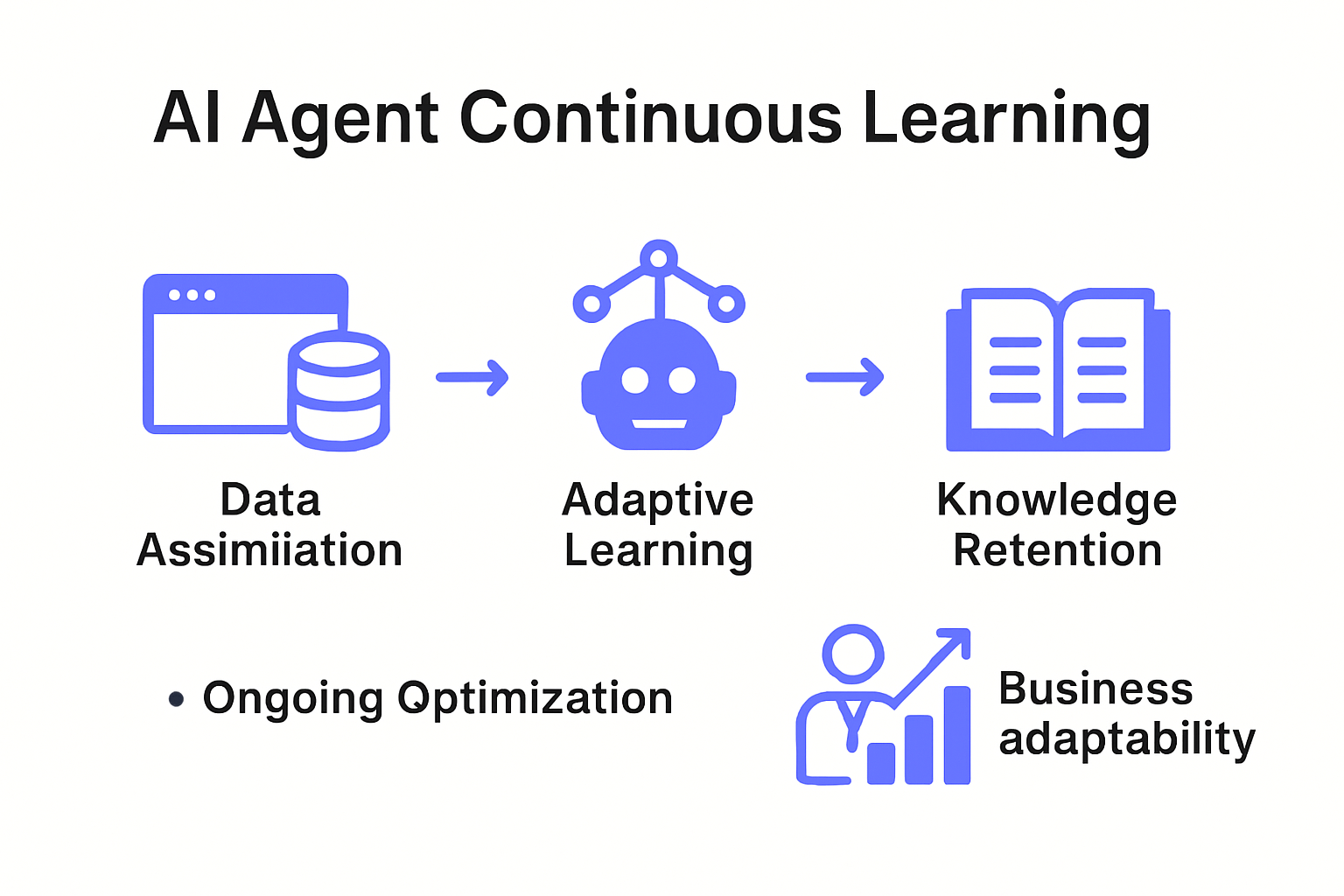
AI agent continuous learning represents a transformative approach in technology where artificial intelligence systems dynamically update and enhance their knowledge and performance capabilities without human intervention. These advanced systems learn progressively, adapting to new data and environments with remarkable precision.
AI agent continuous learning
The Core Mechanics of Continuous Learning
Continuous learning for AI agents goes beyond traditional machine learning models. Unlike static algorithms that require complete retraining, these intelligent systems can incrementally acquire knowledge while maintaining previously learned information. Explore our advanced training methodologies to understand how these agents evolve.
The mechanism involves several sophisticated processes:
- Data Assimilation: AI agents continuously process new information, extracting meaningful patterns and insights
- Adaptive Algorithms: Intelligent systems dynamically adjust their internal models based on recent experiences
- Performance Optimization: Agents automatically refine their decision-making capabilities through ongoing learning
According to research published in the Journal of Business Research, AI technologies are fundamentally reshaping how businesses approach knowledge acquisition and performance enhancement. The study highlights that companies leveraging continuous learning AI can experience significant improvements in operational efficiency.
Real World Applications
In sales and marketing contexts, an AI agent’s continuous learning becomes particularly powerful. As noted by a comprehensive University of Alabama at Birmingham study, AI technologies are predicted to fulfill 60% of sales tasks by 2028, representing a substantial increase from 45% in 2023.
The implications are profound. Continuous learning enables AI agents to:
- Understand complex customer interaction patterns
- Predict emerging market trends with increasing accuracy
- Personalize communication strategies in real time
Moreover, research from arXiv emphasizes that continual learning systems are essential for AI to incrementally acquire and update knowledge throughout their operational lifetime. This approach ensures maximum adaptability in rapidly changing business environments.
By embracing AI agent continuous learning, organizations can transform their sales and marketing strategies from reactive to predictive, creating more intelligent and responsive business ecosystems.
Here is a brief table summarizing the statistics on AI’s projected impact on sales tasks, as described above:
AI Adoption in Sales Tasks Over Time
| Year | Percentage of Sales Tasks Fulfilled by AI |
|---|---|
| 2023 | 45% |
| 2028 | 60% |
Business Impact for Sales and Marketing Teams
AI agents that continuous learning transform sales and marketing teams from traditional reactive approaches to intelligent, proactive strategies. By integrating advanced machine learning capabilities, organizations can reimagine their operational effectiveness and competitive positioning.
Revolutionizing Performance Metrics
Sales and marketing professionals now leverage AI agents to dramatically enhance performance metrics. Discover how our lead qualification strategies can accelerate your team’s productivity. According to research from MIT Sloan Management Review, organizations integrating AI into their sales processes achieve significant financial benefits by fostering mutual learning between human teams and intelligent systems.
Key performance improvements include:
- Precision Targeting: AI agents analyze complex customer data patterns
- Predictive Analytics: Real-time market trend forecasting
- Resource Optimization: Intelligent allocation of sales and marketing resources
Advanced Learning and Skill Development
Continuous learning AI transforms professional development within sales teams. Adobe’s eLearning research reveals that AI-powered adaptive learning tools can precisely assess knowledge gaps and provide personalized skill enhancement recommendations.
These intelligent systems offer unprecedented advantages:
- Automated skills gap identification
- Personalized training content
- Dynamic performance tracking
Moreover, LinkedIn’s Account Prioritizer research demonstrates that machine learning models can increase renewal bookings by 8.08% through intelligent account prioritization and integrated explanation algorithms.
By embracing AI agent continuous learning, sales and marketing teams transition from traditional approaches to data-driven, highly responsive operational models. This technological evolution enables organizations to stay ahead in an increasingly competitive business environment, transforming raw data into strategic insights and actionable intelligence.
Below is a summary table outlining key advantages continuous learning AI provides for sales and marketing teams, based on the features highlighted above:
Advantages of Continuous Learning AI in Sales & Marketing
| Feature / Benefit | Description |
|---|---|
| Precision Targeting | Analyzes complex customer data patterns |
| Predictive Analytics | Provides real-time forecasting on market trends |
| Resource Optimization | Allocates sales and marketing resources intelligently |
| Automated Skills Gap ID | Automatically detects knowledge gaps for employee development |
| Personalized Training | Offers tailored learning content for each team member |
| Dynamic Performance Tracking | Continuously monitors and tracks performance improvements |
| Increased Renewal Bookings | Drives up customer renewal rates through smart account prioritization (e.g., +8.08%) |
Best Practices For Implementation In 2025
The successful implementation of AI agent continuous learning requires strategic planning, technical expertise, and a holistic organizational approach. As businesses prepare for 2025, understanding the critical best practices becomes paramount for achieving transformative results.
Strategic Integration and System Alignment
Implementing AI agents demands meticulous system integration and alignment. Explore our comprehensive integration strategies to ensure seamless technological convergence. According to research from Medium, optimal performance requires seamless integration with existing platforms like Customer Relationship Management (CRM) and Enterprise Resource Planning (ERP) systems.
Key integration considerations include:
- API Compatibility: Ensure robust API connections
- Data Interoperability: Enable smooth information exchange
- Security Protocols: Implement comprehensive data protection mechanisms
Comprehensive Change Management
Transitioning to AI agent continuous learning is not merely a technological shift but a fundamental organizational transformation. A comprehensive study from Instancy emphasizes the critical role of change management in successful AI implementation.
Effective change management strategies involve:
- Transparent communication about AI agent roles
- Comprehensive team training programs
- Creating a culture of technological adaptation
Continuous Evaluation and Optimization
Research from Talk to Agent highlights the importance of ongoing assessment and refinement. Organizations must establish robust evaluation frameworks that continuously monitor AI agent performance, ensuring alignment with evolving business objectives.
Critical evaluation metrics include:
- Performance accuracy
- Adaptation speed
- Business impact measurement
By embracing these best practices, organizations can effectively harness AI agent continuous learning, transforming potential technological challenges into strategic opportunities for growth and innovation in 2025 and beyond.
Overcoming Challenges and Ensuring Success
Implementing AI agent continuous learning is not without significant challenges. Organizations must proactively address complex technological, cultural, and ethical considerations to successfully integrate these advanced systems into their sales and marketing ecosystems.
Data Quality and Integrity Management
Research from Revoyant reveals that incomplete or biased data can critically undermine AI agent performance. Explore our data optimization strategies to ensure robust system reliability. Maintaining high data quality requires a multifaceted approach:
- Comprehensive Data Auditing: Regular comprehensive assessments of data sources
- Bias Detection: Advanced algorithms to identify and mitigate potential data biases
- Continuous Data Refinement: Ongoing validation and improvement of training datasets
Cultural Transformation and Employee Engagement
Successful AI implementation extends beyond technological deployment. According to Medium research, reducing employee resistance requires transparent communication and strategic involvement. Organizations must cultivate a culture that views AI as a collaborative tool rather than a replacement.
Key strategies for cultural adaptation include:
- Creating cross functional AI integration teams
- Providing comprehensive AI literacy training
- Demonstrating tangible benefits of AI collaboration
Advanced Learning and Ethical Considerations
Cutting-edge research from arXiv highlights the potential of reinforcement learning integrated with large language models to enhance AI agent adaptability. This approach enables more nuanced and personalized interactions while maintaining ethical boundaries.
Critical ethical considerations involve:
- Ensuring transparent decision-making processes
- Protecting individual privacy rights
- Maintaining human oversight and intervention capabilities
By addressing these challenges systematically, organizations can transform potential obstacles into opportunities for innovation. The key lies in viewing AI agent continuous learning not as a technological replacement, but as an intelligent collaborative framework that amplifies human capabilities and drives strategic business performance.
Turn Continuous Learning Into Real Sales Growth With Voice AI Agents
Ready to give your business the advantage of human-like, fully adaptable AI voice agents? Discover how NextLevel’s voice AI agents deliver continuous learning for sales and marketing success. These AI agents let you personalize outreach, qualify leads, and engage customers across every channel without missing a beat. Future-proof your team today. Visit NextLevel AI to see how you can outpace the competition. Start now and make your sales and marketing strategies smarter, faster, and more resilient for 2025.
Recommended
- AI BDR Agent: Lead Qualification & Engagement – NextLevel.AI
- AI Corporate Training Agent – Rocket in Training Efficiency
- NextLevel – Voice AI Agents Tailored for Your Business
- AI Insights & Resources | NextLevel.AI Blog
- Artificial Intelligence Call Center Agents | NextLevel
- AI Agent for Table of Benefits Insurance & Provider Support
Frequently Asked Questions
What is AI agent continuous learning?
AI agent continuous learning is a transformative approach in which artificial intelligence systems dynamically update and enhance their knowledge and performance without human intervention, allowing them to adapt to new data and environments with precision.
How does continuous learning benefit sales and marketing teams?
Continuous learning allows sales and marketing teams to transition from reactive strategies to proactive approaches, enhancing performance metrics, improving precision targeting, and optimizing resource allocation through advanced machine learning capabilities.
What are some challenges of implementing AI agent continuous learning?
Key challenges include ensuring data quality and integrity, managing cultural transformations within the organization, and addressing ethical considerations related to AI decision-making processes.
What best practices should organizations follow for successful AI implementation?
Organizations should focus on strategic integration of AI with existing systems, comprehensive change management, and continuous evaluation of AI performance to ensure alignment with business objectives.