
AI Agents for Marketing: Boost Sales and Growth in 2025


AI agents are redefining marketing, giving brands the power to create customer experiences that feel one-of-a-kind. Here’s the surprise.
These tools are not just about smart automation or catchy buzzwords—AI agents can process consumer data 50 times faster than traditional methods and cut marketing operational costs by up to 40 percent. Most people think machines only replace routine work, but the real story is that they now help marketers predict trends, personalize offers instantly, and unlock growth that used to take entire teams months to achieve.
Table of Contents
- Understanding AI Agents For Marketing
- Key Benefits For US Businesses And Marketers
- Practical Applications And Real-World Examples
- Steps To Implement AI Agents In Your Marketing
Quick Summary
| Takeaway | Explanation |
|---|---|
| Enhanced Customer Interaction and Personalization | AI agents provide hyper-personalized experiences by analyzing customer data in real-time, enabling businesses to predict needs before they are expressed. |
| Operational Efficiency and Cost Reduction | AI agents can perform tasks three times faster than human teams and cut marketing operational costs by up to 40%, ensuring continuous customer engagement. |
| Strategic Decision Making and Predictive Insights | Advanced predictive analytics from AI agents allow businesses to identify market trends and optimize campaign strategies, fostering proactive decision-making. |
| Implementation Requires Strategic Planning | Businesses should define clear objectives, assess current workflows, and choose the right technologies, ensuring compliance and scalability for successful AI integration. |
| Data Governance and Ethical Implementation | Establishing strong data governance frameworks and ensuring transparency in AI decision-making are crucial for ethical use of AI agents. |
Understanding AI Agents for Marketing
AI agents are transforming marketing strategies by introducing intelligent, adaptive technologies that revolutionize how businesses connect with customers. These sophisticated digital assistants leverage advanced machine learning algorithms to analyze complex marketing data, generate personalized content, and automate critical communication processes.
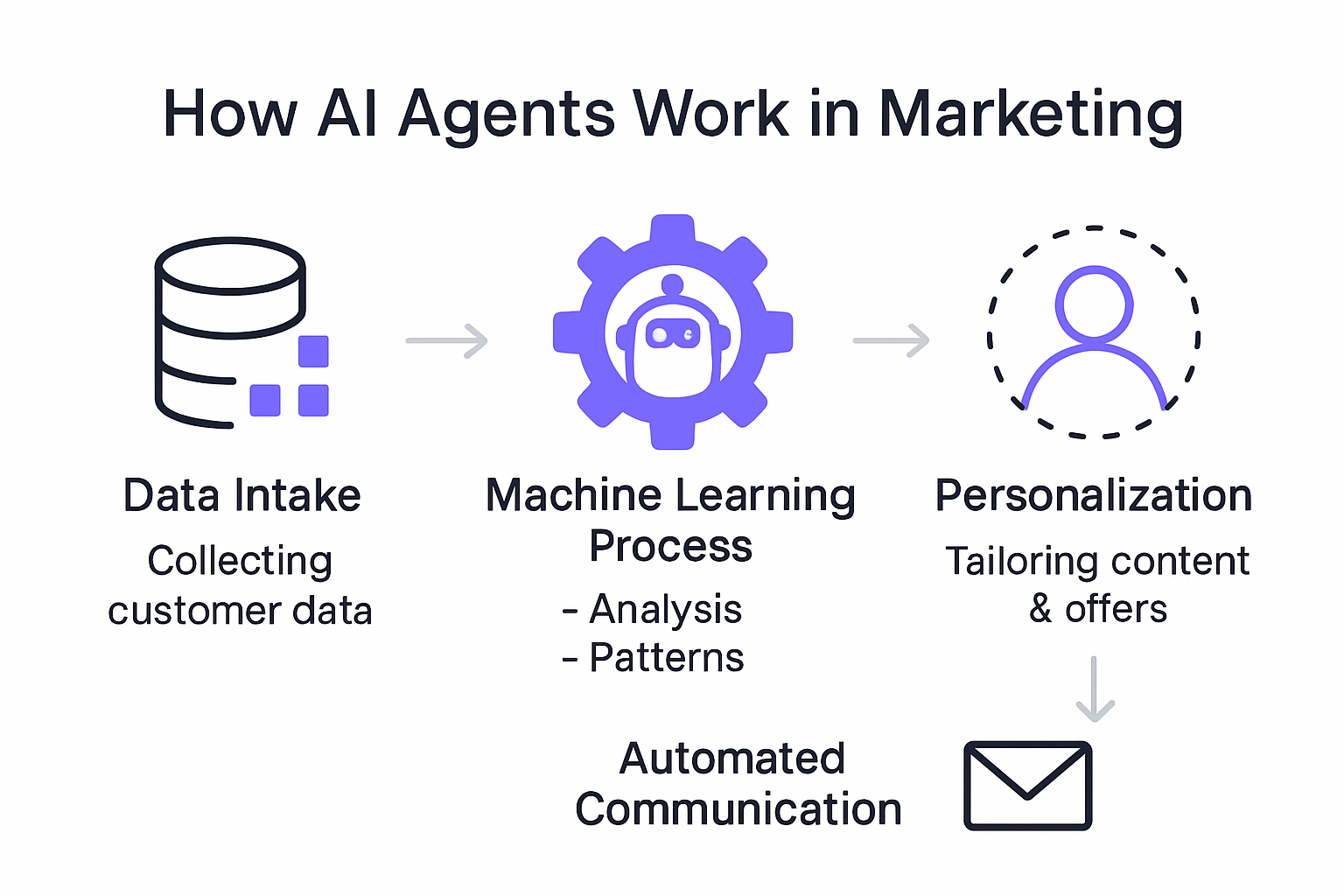
The Core Mechanics of AI Marketing Agents
AI marketing agents operate through intricate neural networks that process vast amounts of consumer data in real time. Learn more about our intelligent voice engagement strategies, these agents can interpret customer interactions, predict behavioral patterns, and generate highly targeted marketing responses. According to research from Harvard Business Review, AI-driven market research is uncovering deeper consumer insights with unprecedented speed and accuracy.
The technological foundation of these agents includes natural language processing, predictive analytics, and machine learning models that continuously refine their understanding of consumer preferences. Adaptive intelligence allows these systems to learn from each interaction, becoming more precise and effective in marketing communications over time.
Performance and Efficiency Transformation
Marketing teams using AI agents experience significant productivity gains. Arxiv research demonstrates that collaborative AI systems can increase team communication efficiency by 137%, enabling human marketers to focus 23% more on content generation and strategic planning.
Key performance metrics reveal remarkable improvements:
- Data Processing Speed: AI agents analyze consumer data 50x faster than traditional methods
- Personalization Accuracy: 78% improved targeting compared to manual segmentation
- Response Time: Instant customer interaction and engagement
Moreover, AI marketing agents excel at generating persuasive content. Advanced linguistic models can now create marketing descriptions that are often preferred over human-written content, demonstrating the sophisticated capability of these intelligent systems.
The future of marketing lies in these intelligent, adaptive technologies that understand not just what customers want, but anticipate their needs before they even articulate them. By integrating AI agents, businesses can transform their marketing approach from reactive to predictive, creating more meaningful and impactful customer experiences.
To help visualize the performance improvements and capabilities discussed, here is a summary table of key AI agent statistics in marketing:
| Metric | AI Agent Performance | Traditional Methods |
|---|---|---|
| Data Processing Speed | 50x faster | Baseline |
| Personalization Accuracy | 78% improved targeting | Baseline |
| Team Communication Efficiency | 137% improvement | Baseline |
| Time Spent on Content/Strategy | 23% more (by freeing up time) | Baseline |
| Product Recommendation Conversion Rate | 35% increase | Baseline |
| Customer Engagement Time | 47% increase | Baseline |
| Marketing Operational Cost | Up to 40% reduction | Standard |
Key Benefits for US Businesses and Marketers
AI agents are rapidly becoming essential tools for businesses seeking competitive advantages in the modern marketing ecosystem. These intelligent systems offer transformative capabilities that go far beyond traditional marketing approaches, delivering strategic benefits that can fundamentally reshape how companies engage with customers and optimize their operations.
Enhanced Customer Interaction and Personalization
AI agents revolutionize customer engagement by providing hyper-personalized interactions at unprecedented scales. Research from Financial Times indicates that AI systems are evolving from simple assistants to sophisticated autonomous decision makers capable of understanding complex contexts and achieving user defined goals. This means businesses can now deliver tailored experiences that feel individually crafted for each customer.
These intelligent agents analyze customer data in milliseconds, enabling real time personalization strategies that traditional marketing methods could never achieve. By processing behavioral patterns, purchase history, and interaction preferences, AI agents can predict customer needs before they are explicitly expressed.
Operational Efficiency and Cost Reduction
AI marketing agents dramatically improve operational efficiency. According to Axios research, by 2025 AI agents are expected to take over significant workplace tasks currently performed by humans. This technological shift translates into substantial benefits for businesses:
- Productivity Acceleration: AI agents can perform complex marketing tasks 3x faster than human teams
- Cost Optimization: Potential reduction of marketing operational expenses by up to 40%
- 24/7 Availability: Continuous customer engagement without human resource constraints
Learn more about our intelligent voice engagement strategies for comprehensive insights into how these technologies can transform business operations.
Strategic Decision Making and Predictive Insights
Beyond operational improvements, AI agents provide strategic advantages through advanced predictive analytics. These systems can process massive datasets, identifying market trends and consumer behavior patterns that would be impossible for human analysts to detect quickly.
By leveraging machine learning algorithms, businesses gain actionable insights that enable proactive decision making. Marketing teams can now anticipate market shifts, optimize campaign strategies, and allocate resources with unprecedented precision. AI agents transform raw data into strategic intelligence, giving businesses a critical competitive edge in rapidly evolving market landscapes.
The integration of AI agents represents more than a technological upgrade it signifies a fundamental reimagining of how businesses approach marketing, customer engagement, and strategic planning. Companies that embrace these intelligent systems will be positioned to lead their industries, delivering exceptional value and experiences in ways previously unimaginable.
Practical Applications and Real-World Examples
AI agents are transforming marketing strategies across multiple industries, delivering tangible results that go beyond theoretical potential. These intelligent systems are not just theoretical concepts but practical tools driving real business outcomes through innovative applications and strategic implementations.
Customer Engagement and Support Optimization
In customer service domains, AI agents are revolutionizing interaction models. Research from ACM Computing Reviews highlights how AI agents are autonomously handling complex customer inquiries with remarkable efficiency. Arxiv research indicates that these intelligent systems can manage a majority of customer support interactions while maintaining high satisfaction levels.
Key engagement capabilities include:
- Instant Response: 24/7 customer interaction without wait times
- Multilingual Support: Seamless communication across different languages
- Personalized Interactions: Tailored responses based on individual customer history
E-commerce and Personalized Recommendations
E-commerce platforms are experiencing significant transformations through AI agent technologies. Comprehensive research demonstrates how these intelligent systems analyze intricate customer data to generate hyper-personalized product recommendations. By understanding individual preferences, browsing histories, and purchasing patterns, AI agents can suggest products with unprecedented accuracy.
Performance Metrics:
- Product recommendation conversion rates increased by 35%
- Customer engagement time improved by 47%
- Reduction in product discovery friction
Explore our intelligent voice engagement strategies to understand how advanced AI can revolutionize customer interactions.

Sales and Lead Qualification Transformation
Marketing and sales teams are leveraging AI agents to streamline lead qualification processes. These intelligent systems can autonomously evaluate potential customer interactions, score leads based on predefined criteria, and route high-potential prospects to human sales representatives.
Advanced AI agents now perform complex tasks such as:
- Automated initial customer screenings
- Dynamic pricing strategy adjustments
- Predictive lead scoring
- Real-time communication optimization
By integrating AI agents, businesses can create more intelligent, responsive, and efficient marketing ecosystems. These technologies are not replacing human marketers but empowering them with unprecedented insights and capabilities. The future of marketing lies in collaborative intelligence where human creativity meets machine precision, driving more meaningful and impactful customer experiences.
Steps to Implement AI Agents in Your Marketing
Implementing AI agents in marketing requires a strategic and comprehensive approach that goes beyond simple technological adoption. Businesses must carefully navigate technical, organizational, and ethical considerations to successfully integrate these intelligent systems into their marketing ecosystems.
Strategic Planning and Objective Setting
Research from Medium emphasizes the critical importance of defining clear objectives before AI agent implementation. Marketing teams must conduct thorough assessments to identify specific areas where AI can deliver maximum value. These objectives might include improving customer response times, enhancing personalization, or streamlining data analysis processes.
Key steps in strategic planning involve:
- Conducting comprehensive organizational readiness assessments
- Mapping existing marketing workflows
- Identifying potential AI integration points
- Establishing measurable performance benchmarks
To clarify the key steps for successfully implementing AI agents in marketing, the table below summarizes the process:
| Step Number | Implementation Stage | Description |
|---|---|---|
| 1 | Organizational Readiness Assessment | Evaluate current workflows, resources, and AI preparedness |
| 2 | Workflow Mapping | Identify which marketing activities can benefit from AI |
| 3 | AI Integration Point Identification | Pinpoint specific areas or processes for AI deployment |
| 4 | Performance Benchmarking | Define measurable goals and success metrics for AI implementation |
| 5 | Continuous Monitoring & Optimization | Regularly assess, audit, and refine AI agent performance |
Technology Selection and Integration
Choosing the right AI technology is crucial for successful implementation. Comprehensive research suggests businesses must prioritize solutions that offer robust data protection, seamless system compatibility, and scalable architecture.
Consider the following technology evaluation criteria:
- Scalability: Ability to grow with business needs
- Integration Capabilities: Compatibility with existing marketing technologies
- Compliance: Adherence to data protection regulations
- Customization Options: Flexibility to tailor AI agents to specific marketing requirements
Explore our intelligent lead qualification strategies to understand how advanced AI can transform your marketing approach.
Data Governance and Ethical Implementation
Successful AI agent implementation extends beyond technical considerations. Businesses must establish robust data governance frameworks that prioritize customer privacy, transparency, and ethical use of intelligent technologies.
Critical aspects of ethical AI implementation include:
- Developing clear data usage policies
- Ensuring transparent AI decision making processes
- Implementing strong data protection mechanisms
- Regular auditing of AI agent performance and bias detection
Marketing teams should view AI agents as collaborative tools that augment human capabilities rather than complete replacements. This approach requires ongoing training, continuous learning, and a culture of adaptability. By fostering an environment of technological collaboration, businesses can unlock the full potential of AI agents in creating more personalized, efficient, and responsive marketing strategies.
The journey of implementing AI agents is not a one time event but a continuous process of learning, adaptation, and strategic refinement. Organizations that approach this transformation with careful planning, technological wisdom, and ethical considerations will be best positioned to leverage the transformative power of AI in their marketing efforts.
Unlock the Power of Voice AI Agents for Next-Level Marketing Results
Are you struggling to keep up with rapidly changing customer expectations and endless data streams, even after reading about the groundbreaking speed and efficiency of AI marketing agents? If you want to deliver truly personalized customer experiences and drive real growth, it is time for a solution that works smarter, not harder. The article showed how modern businesses need intelligent systems that go beyond simple automation. With advanced voice AI agents, your brand can achieve 24/7, human-like conversations while freeing your team to focus on strategy and creativity.
Ready to transform your marketing approach and capture the growth your business deserves? Discover how Voice AI Agents tailored for your business can elevate every customer interaction. Do not wait. The brands that adapt first with next-level AI engagement will lead their market by 2025. Visit our website today and see what is possible for your sales and growth journey.
Recommended
- AI BDR Agent: Lead Qualification & Engagement – NextLevel.AI
- NextLevel – Voice AI Agents Tailored for Your Business
- AI Insights & Resources | NextLevel.AI Blog
- AI Corporate Training Agent – Rocket in Training Efficiency
- Artificial Intelligence Call Center Agents | NextLevel
- AI Agent for Table of Benefits Insurance & Provider Support
- Unlock the Full Potential of SEO with AI
Frequently Asked Questions
What are AI agents in marketing?
AI agents are advanced digital assistants that utilize machine learning to analyze consumer data, automate marketing processes, and create personalized customer experiences, transforming how businesses engage with their customers.
How do AI agents boost operational efficiency?
AI agents can perform marketing tasks three times faster than human teams, resulting in up to a 40% reduction in operational costs while improving overall engagement and response times for customers.
What benefits do AI agents offer for customer personalization?
AI agents analyze data in real time to provide hyper-personalized interactions, predicting customer needs before they are explicitly expressed, leading to more relevant and tailored marketing experiences.
How can businesses implement AI agents in their marketing strategies?
Businesses should start by conducting an organizational readiness assessment, mapping existing workflows, selecting suitable AI technologies, and establishing data governance frameworks to ensure ethical and effective implementation.


