What Is AI-Driven Support? A 2025 Guide for US Businesses


AI-driven support is moving beyond chatbots and canned answers. Here is something most business owners overlook.
AI systems trained on over 2.5 million support tickets have cut analyst workload by 80.8 percent. This is not about replacing people. It is about reshaping how companies solve problems and deliver value on a scale that just was not possible before. This transformation exemplifies what is AI-driven support.
Table of Contents
- Defining AI-Driven Support For Modern Businesses
- Key Benefits For US Owners, Marketers, And Sales
- How AI-Driven Support Works In Practice
- Choosing The Right AI Support Tools For 2025
Quick Summary
| Takeaway | Explanation |
|---|---|
| AI-driven support transforms customer interactions | Leveraging advanced machine learning and natural language processing, AI-driven support systems create intelligent, adaptive experiences that significantly enhance communication and operational efficiency. |
| Operational efficiency gains for business owners | AI tools can automate routine tasks like scheduling and email management, freeing up business owners to focus on strategic development and reducing labor costs. |
| Enhanced marketing through personalization | AI-powered marketing automation enables precise audience segmentation and actionable insights, allowing marketers to create targeted campaigns that resonate with customers and improve engagement. |
| Sales performance improvement | AI-driven tools enhance lead qualification and customer interaction, enabling sales teams to craft personalized strategies and optimize performance through continuous learning. |
| Strategic evaluation for AI tool selection | Businesses should use a structured framework to assess AI support tools, focusing on scalability, integration capabilities, customization options, and data security to ensure effective long-term solutions. |
Defining AI-Driven Support for Modern Businesses
AI-driven support represents a transformative approach to customer service and business operations that leverages artificial intelligence to enhance communication, problem-solving, and customer experiences. At its core, this technology goes beyond traditional support models by introducing intelligent systems capable of understanding, responding, and adapting to complex business interactions.
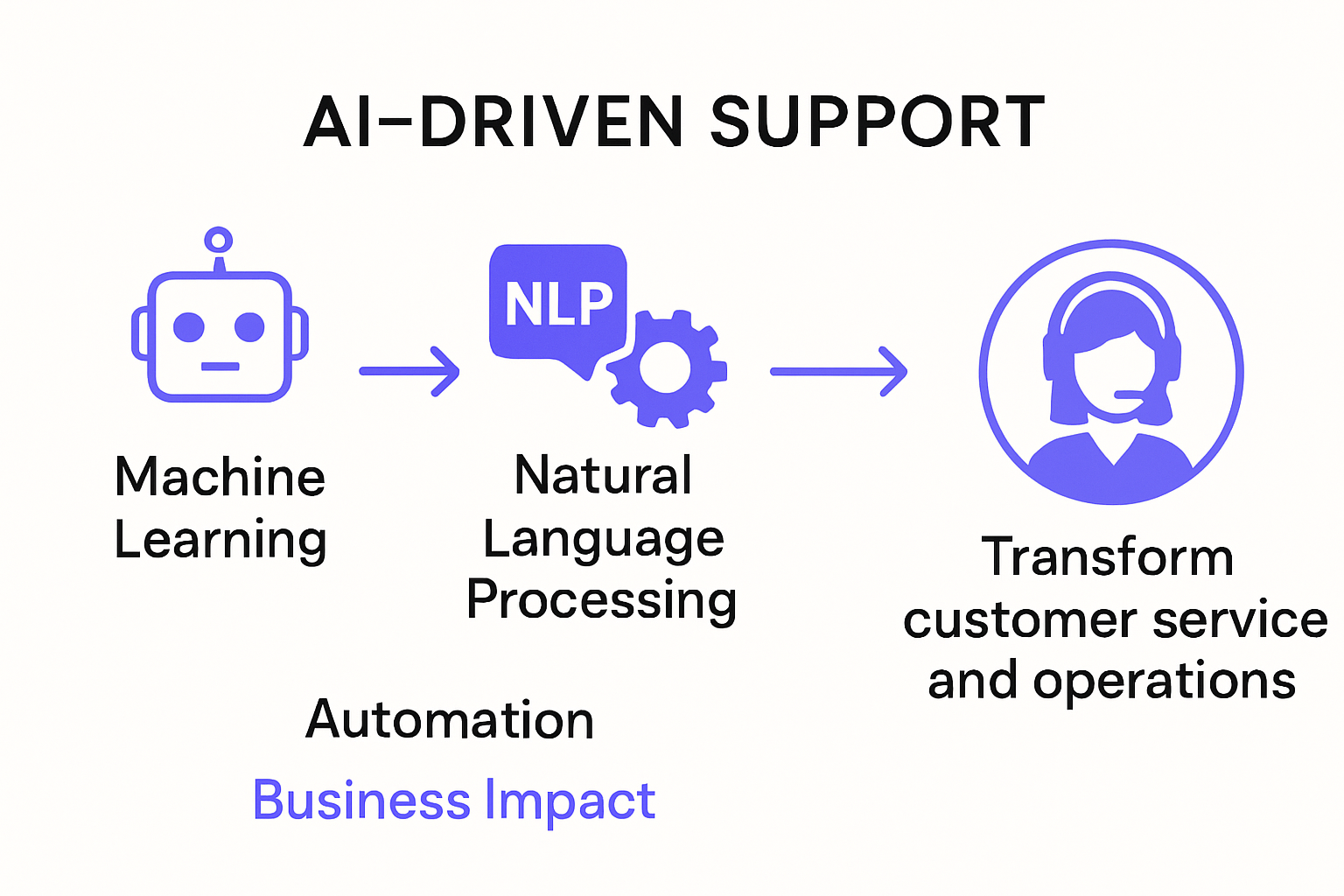
The Fundamental Architecture of AI-Driven Support
Modern AI-driven support systems are built on sophisticated machine learning algorithms and natural language processing technologies that enable intelligent automation. Unlike traditional support models, these systems can analyze context, interpret customer intent, and provide personalized responses in real-time. Explore our AI insights to understand how these technologies are reshaping business communication.
The architecture typically involves multiple interconnected components. First, machine learning models are trained on extensive datasets, allowing them to recognize patterns and understand nuanced communication. Second, natural language processing enables these systems to comprehend human language across multiple contexts. Third, adaptive learning mechanisms continuously improve system performance by incorporating feedback and new interaction data.
Business Impact and Operational Transformation
According to research from the Small Business Administration, AI-driven support systems can dramatically transform business operations. These intelligent platforms enable organizations to provide 24/7 customer service, handle routine inquiries efficiently, and free human agents to focus on more complex, high-value interactions.
The operational benefits extend beyond customer service. As research from EdX indicates, AI integration can automate repetitive tasks, improve decision-making through advanced data analysis, and create more personalized customer experiences. This translates into increased operational efficiency, reduced response times, and enhanced overall business competitiveness.
Moreover, academic research from ArXiv highlights that AI-augmented Business Process Management Systems make business processes more adaptable, proactive, and context-sensitive. These systems can dynamically adjust to changing business environments, providing unprecedented flexibility and responsiveness.
Businesses adopting AI-driven support are not just implementing a technology solution they are fundamentally reimagining their approach to customer interaction, operational efficiency, and strategic growth. The future of business support is intelligent, adaptive, and powered by advanced artificial intelligence technologies.
Key Benefits for US Owners, Marketers, and Sales
AI-driven support offers transformative advantages for business professionals across multiple domains, providing strategic solutions that enhance operational efficiency, customer engagement, and revenue generation. By leveraging advanced artificial intelligence technologies, US business owners, marketers, and sales teams can unlock unprecedented opportunities for growth and innovation.
Strategic Efficiency for Business Owners
Business owners stand to gain significant operational advantages through AI-driven support systems. Research from the Small Business Administration reveals that AI tools can automate routine tasks such as scheduling, email management, and inventory tracking. This automation allows owners to redirect their focus from administrative responsibilities to strategic business development.
The financial implications are substantial. By reducing manual workload, businesses can minimize labor costs and optimize resource allocation. Learn more about AI lead qualification strategies to understand how intelligent systems can streamline business processes and improve overall productivity.
Enhanced Marketing and Customer Engagement
Marketers benefit dramatically from AI-powered technologies. According to research from the Bipartisan Policy Center, AI marketing automation enables precise audience segmentation, predictive behavior analysis, and highly targeted campaign development. These capabilities allow marketers to create more personalized, effective communication strategies that resonate with specific customer demographics.
Key marketing advantages include:
- Advanced Customer Insights: AI algorithms analyze complex data patterns to reveal nuanced customer preferences
- Predictive Campaign Performance: Intelligent systems forecast potential campaign outcomes before full deployment
- Real-time Personalization: Dynamic content adaptation based on individual user interactions
To help clarify the diverse benefits delivered by AI-driven support to different business functions, the table below summarizes the key advantages for business owners, marketers, and sales professionals as described above.
| Business Function | Key AI-Driven Benefit | Example/Description |
|---|---|---|
| Business Owners | Operational Efficiency | Automates tasks (scheduling, emails, inventory), reduces manual workload & labor costs |
| Marketers | Enhanced Personalization | Audience segmentation, predictive analysis, real-time campaign personalization |
| Marketers | Advanced Customer Insights | AI analyzes complex data to discover customer preferences |
| Sales | Improved Lead Qualification & Engagement | Automated lead scoring, personalized communication, continuous learning improvements |
| Sales | Revenue Growth | Boosts conversion rates and optimizes sales strategies |
Sales Performance and Revenue Generation

Sales professionals experience remarkable transformations through AI-driven support. Research from the University of Rhode Island demonstrates that AI technologies can significantly improve lead qualification, customer interaction, and conversion rates.
Intelligent systems provide sales teams with actionable insights by:
- Automated Lead Scoring: Rapidly identifying high-potential prospects
- Personalized Engagement: Crafting tailored communication strategies
- Performance Optimization: Continuous learning and adaptation of sales approaches
The cumulative impact of AI-driven support extends beyond individual departmental improvements. By creating a more integrated, intelligent business ecosystem, organizations can achieve holistic growth, improved customer satisfaction, and competitive advantage in an increasingly digital marketplace.
How AI-Driven Support Works in Practice
AI-driven support represents a sophisticated technological approach that transforms traditional customer interaction models through intelligent, adaptive systems. By combining advanced machine learning algorithms, natural language processing, and real-time data analysis, these systems create responsive and intuitive support experiences that go far beyond standard automated responses.
Intelligent Interaction and Context Understanding
At the core of AI-driven support is the ability to comprehend and interpret complex human communication. Research from ArXiv demonstrates how advanced systems like AliMe Assist can handle millions of customer questions daily, successfully addressing 85% through sophisticated voice and text input mechanisms.
The interaction process involves multiple sophisticated stages. First, natural language processing algorithms parse incoming customer queries, breaking down linguistic nuances and intent. Second, machine learning models compare the query against extensive training datasets to generate contextually appropriate responses. Third, adaptive learning mechanisms continuously refine response accuracy by incorporating feedback and interaction data.
Technical Architecture and Data Processing
The technical backbone of AI-driven support systems is remarkably complex. Explore our corporate training solutions to understand how these intelligent systems are built and deployed. These platforms typically integrate several key technological components:
- Machine Learning Models: Neural networks trained on extensive datasets
- Natural Language Processing: Advanced algorithms for semantic understanding
- Data Integration: Real-time access to knowledge bases and historical interaction records
According to IBM research, sophisticated AI support systems can dramatically reduce workload. In one study, a machine learning model trained on 2.5 million support tickets achieved an impressive 79.9% recall rate and reduced analyst workload by 80.8% in identifying potential escalation risks.
To provide a clearer view of the technical performance and impact of AI-driven support systems, the following table organizes the key statistics from referenced research:
| Aspect | Statistic/Result | Source |
|---|---|---|
| Support Tickets Analyzed | 2,500,000+ | IBM research (2020) |
| Analyst Workload Reduction | 80.8% | IBM research (2020) |
| Recall Rate for Escalations | 79.9% | IBM research (2020) |
| Customer Questions Addressed | 85% (by AliMe Assist) | ArXiv (2018), Alibaba study |
Practical Implementation and Continuous Learning
Practical implementation of AI-driven support involves continuous refinement and adaptation. Unlike static support systems, these intelligent platforms learn and evolve with each interaction. They can dynamically adjust communication strategies, predict potential customer needs, and provide increasingly personalized support experiences.
The implementation process typically follows a structured approach:
- Initial system training using comprehensive historical data
- Continuous performance monitoring
- Regular algorithm updates based on interaction insights
- Progressive expansion of response capabilities
Businesses adopting AI-driven support are not merely implementing a technology solution they are fundamentally reimagining customer interaction paradigms. By leveraging intelligent systems that can understand context, learn from interactions, and provide personalized support, organizations can create more responsive, efficient, and engaging customer experiences.
Choosing the Right AI Support Tools for 2025
Selecting the appropriate AI support tools represents a critical strategic decision for businesses seeking to leverage technological innovations in 2025. The rapidly evolving landscape of artificial intelligence demands a nuanced, comprehensive approach to tool selection that goes beyond surface-level features and considers long-term organizational goals and technological compatibility.
Strategic Evaluation Criteria
Businesses must develop a structured framework for evaluating AI support tools. Research from ArXiv recommends a phased adoption strategy, particularly for small and medium enterprises, emphasizing the importance of starting with low-cost, general-purpose AI tools to build technical competence and foster a positive organizational attitude toward AI technologies.
Key evaluation criteria include:
- Scalability: Ability to grow with your business needs
- Integration Capabilities: Seamless connection with existing systems
- Customization Potential: Flexibility to adapt to specific business requirements
- Data Security: Robust protection of sensitive information
Explore our AI insights and resources to understand the nuanced approach to selecting the most appropriate AI support tools for your specific business context.
Technical Compatibility and Performance Metrics
Technical assessment goes beyond surface-level features. According to recent academic research, businesses should prioritize AI tools that offer:
- Advanced natural language processing capabilities
- Machine learning models with proven accuracy
- Real-time adaptation and continuous learning mechanisms
- Transparent performance tracking and reporting
Businesses must also consider the total cost of ownership, which includes not just the initial investment but also implementation costs, training requirements, and potential productivity gains. This holistic approach ensures a more comprehensive evaluation of potential AI support solutions.
Future-Proofing Your AI Support Strategy
Preparing for the AI-driven future requires more than just selecting a current technology solution. Businesses need to develop a forward-looking strategy that anticipates technological evolution and maintains flexibility.
Consider the following forward-thinking approach:
- Modular Tool Selection: Choose tools with open architectures
- Continuous Learning Investment: Allocate resources for ongoing AI skill development
- Ethical AI Considerations: Prioritize tools with transparent and responsible AI frameworks
- Vendor Ecosystem Assessment: Evaluate the long-term innovation potential of technology providers
The most successful organizations will view AI support tools not as static technologies but as dynamic partners in their business transformation. By adopting a strategic, nuanced approach to tool selection, businesses can create a robust AI support infrastructure that drives innovation, efficiency, and competitive advantage in the rapidly evolving digital landscape of 2025.
Take Your Business Support from Reactive to Proactive with Voice AI Agents
Struggling with never-ending support tickets and routine inquiries that keep your team away from high-value work? Want to experience the same operational transformation discussed in the article, where AI-driven support cuts workload by over 80 percent and unlocks real omnichannel engagement? With NextLevel’s Voice AI Agents, you can empower your business with human-like conversation and adaptive responses across all your customer touchpoints.
Now is the time to see how AI can deliver both practical efficiency and powerful customer experiences. Visit https://nextlevel.ai to discover how you can personalize your support, free up your team, and future-proof your business. Do not let outdated support hold you back. Contact us today and start building a smarter, customer-focused future.
Recommended
- AI Insights & Resources | NextLevel.AI Blog
- AI Corporate Training Agent – Rocket in Training Efficiency
- AI BDR Agent: Lead Qualification & Engagement – NextLevel.AI
- AI Chatbot for Website That Talks to Visitors – NextLevel
- Voice AI for Mental Health Support – NextLevel.AI Agents
- Artificial Intelligence Call Center Agents | NextLevel
- Optimizing Efficiency: AI Applications in Business
Frequently Asked Questions
What is AI-Driven Support?
AI-driven support is a technology that utilizes artificial intelligence to enhance customer service, automate tasks, and improve communication between businesses and customers.
How does AI-Driven Support benefit business owners?
AI-driven support helps business owners by automating routine tasks, reducing labor costs, and allowing them to focus on strategic development to boost overall operational efficiency.
What advantages does AI provide for marketing?
AI-driven support enhances marketing efforts by enabling precise audience segmentation, predictive analytics for campaigns, and real-time personalization, leading to more effective communication with customers.
How do I choose the right AI support tools for my business in 2025?
When selecting AI support tools, consider factors like scalability, integration capabilities, customization options, and data security to ensure the tools align with your long-term business goals.