AI Agent Voice Selection: Guide for US Businesses and Marketers 2025


AI voice agents are everywhere now, reshaping how US businesses talk with their customers. Most people focus on flashy speech recognition or fancy accents. But get this.
A single AI voice tweak can boost product recommendations up to 30 percent more persuasively, just by switching tone or gender. Choosing the right voice is not just a tech upgrade. It is the new secret weapon for brand trust, sales, and making sure customers stick around.
Table of Contents
- Understanding AI Agent Voice Selection
- Impact Of Voice Choice On Branding And Sales
- Key Criteria For Selecting An AI Agent Voice
- Best Practices For Testing And Implementing Voice
Quick Summary
| Takeaway | Explanation |
|---|---|
| Select based on voice effectiveness | Evaluate voice agents on speech recognition, emotional tone, and context handling to enhance user interactions. |
| Align voice with brand identity | Choose a voice that matches your brand’s personality to build trust and consistency across platforms. |
| Prioritize emotional intelligence | Opt for voices that can adapt to user emotions and conversation context to improve engagement and satisfaction. |
| Implement rigorous testing frameworks | Establish comprehensive testing to evaluate performance metrics and user interactions for better efficiency. |
| Ensure compliance and security | Adhere to ethical standards and implement robust security measures to protect user data and build trust. |
Understanding AI Agent Voice Selection
Voice AI agents represent a transformative technology for businesses seeking advanced communication solutions. The process of AI agent voice selection involves strategic decision making that goes far beyond simple technological implementation.
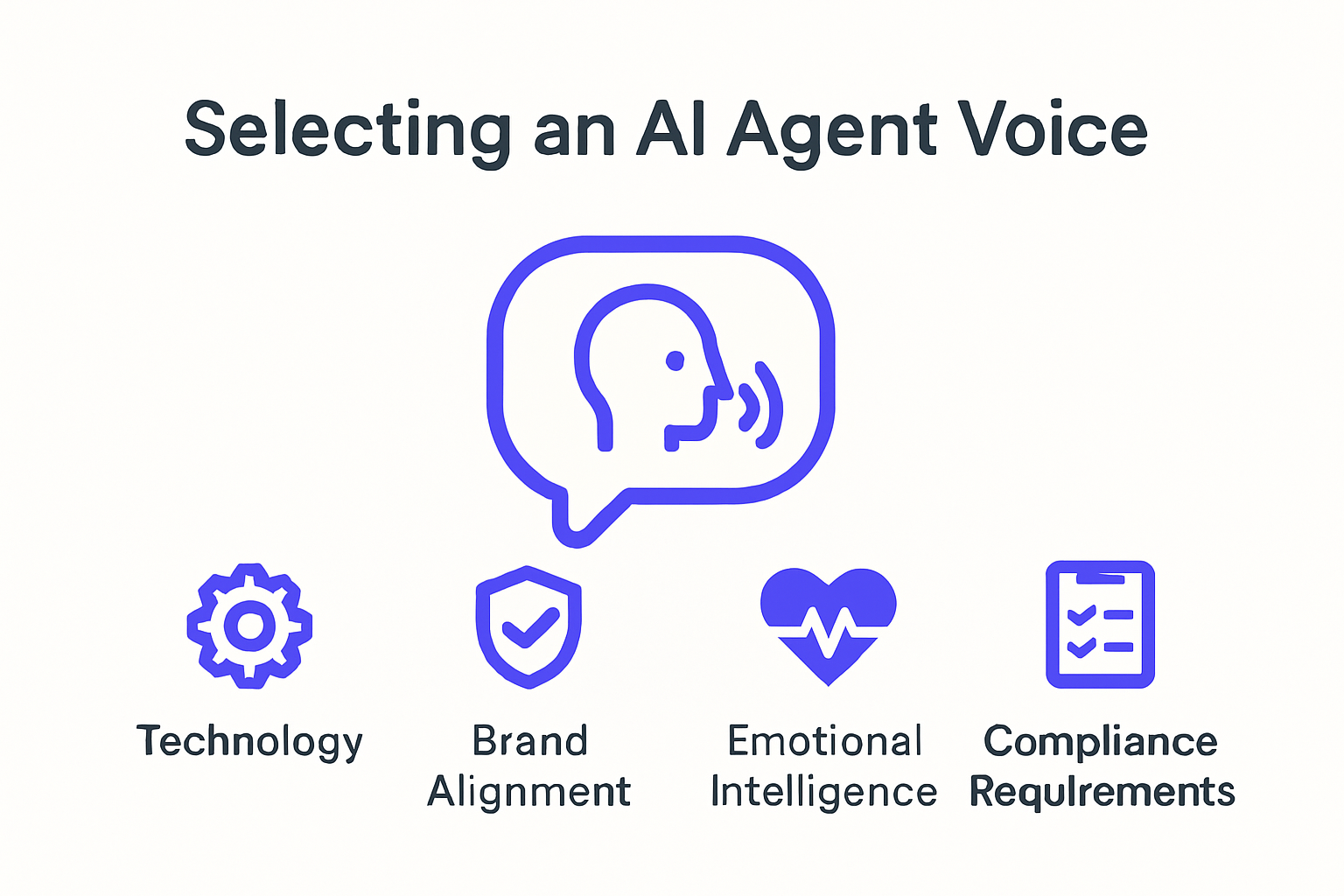
Key Components of Voice Agent Selection
Selecting the right AI voice agent requires a comprehensive understanding of multiple critical factors. Learn more about voice AI strategies, businesses must evaluate several fundamental aspects that determine the effectiveness of their conversational interfaces.
According to Google Cloud’s Dialogflow guidelines, successful voice agent design hinges on three primary elements: speech recognition accuracy, conversation structure, and adaptive repair strategies. These components ensure that AI interactions remain smooth, natural, and responsive to user needs.
Businesses must consider technical capabilities such as:
- Natural Language Processing (NLP) accuracy
- Multilingual support capabilities
- Context understanding and retention
- Emotional intelligence and tone adaptation
Technical and Conversational Intelligence
The sophistication of AI voice agents extends beyond mere voice recognition. Research from AssemblyAI suggests that effective voice agents must master complex conversational dynamics, including nuanced turn-taking, context preservation, and dynamic interaction styles.
Advanced voice agents integrate multiple intelligence layers. They analyze linguistic patterns, interpret emotional subtexts, and generate responses that feel increasingly human-like. This requires sophisticated machine learning models trained on extensive conversational datasets.
Key technological considerations include:
- Speech-to-text conversion quality
- Real-time language processing
- Contextual understanding mechanisms
Selecting the Right Voice Agent Framework
Choosing an appropriate voice agent framework demands a strategic approach. Businesses must align technological capabilities with specific operational requirements. Factors such as industry vertical, customer interaction complexity, and scalability play crucial roles in selection.
The ideal voice agent should seamlessly integrate with existing communication infrastructures, provide robust data security, and offer customization options that reflect the unique brand personality. Performance metrics like response time, error rate, and user satisfaction become critical evaluation parameters.
By understanding these intricate selection dynamics, businesses can transform their customer interaction strategies, creating more engaging, efficient, and intelligent communication channels.
Impact of Voice Choice on Branding and Sales

Voice selection plays a critical role in shaping brand perception and driving sales performance for businesses leveraging AI agents. The voice behind an interaction can significantly influence customer trust, engagement, and purchasing decisions.
Psychological Impact of Voice Characteristics
Research reveals profound psychological dynamics in voice agent interactions. Learn more about voice AI strategies, businesses must recognize that voice characteristics fundamentally shape user perceptions and emotional responses.
According to a groundbreaking study on voice assistant persuasiveness, research indicates that specific voice attributes dramatically impact consumer behavior. Voices with positive or neutral tones, particularly those of middle-aged males or younger females, demonstrated higher persuasive potential in product recommendation scenarios.
Key psychological factors include:
- Emotional Resonance: Voice tone triggers immediate emotional responses
- Perceived Credibility: Voice characteristics influence perceived expertise
- Trust Signals: Vocal qualities communicate reliability and competence
Brand Identity and Voice Consistency
Maintaining a consistent voice identity becomes paramount in building brand recognition. Research on migratable AI suggests that consistent voice characteristics across different interaction platforms enhance user trust and competence perception.
Businesses must strategically align voice selection with brand personality. A financial services firm might opt for a professional, authoritative voice, while a youth-oriented technology brand could choose a more energetic and casual tone. This alignment creates a cohesive brand experience that resonates with target audience expectations.
Consider the following brand voice alignment strategies:
- Match voice characteristics to target demographic
- Ensure vocal consistency across communication channels
- Reflect brand values through voice selection
Sales Performance and Voice Agent Effectiveness
The connection between voice selection and sales performance extends beyond mere aesthetic preferences. Research on human-agent interactions demonstrates that voice characteristics significantly influence user perception of anthropomorphism and interaction quality.
Companies implementing well-designed voice agents can experience substantial improvements in customer engagement. The right voice can transform mundane interactions into memorable experiences, increasing conversion rates and customer loyalty.
Measurable sales impact includes:
- Improved customer interaction duration
- Higher conversion rates
- Enhanced customer satisfaction metrics
Ultimately, voice selection represents a strategic decision with far-reaching implications. By understanding the psychological nuances of voice interactions, businesses can craft AI agents that not only communicate effectively but also strengthen brand identity and drive sales performance.
Key Criteria for Selecting an AI Agent Voice
Selecting the right AI agent voice requires a strategic approach that goes beyond simple audio preferences. Businesses must carefully evaluate multiple dimensions to ensure their voice interface delivers optimal performance and user engagement.
Technical Voice Quality Parameters
Explore advanced voice AI solutions, businesses need to understand the critical technical parameters that define voice agent effectiveness. According to research on synthetic voice qualities, voice quality significantly impacts user acceptance across different demographic segments.
Key technical criteria include:
- Clarity and Pronunciation accuracy
- Natural speech rhythm and intonation
- Minimal audio artifacts or distortions
- Adaptive speech rate
- Multilingual pronunciation capabilities
Technical assessment involves rigorous testing of voice synthesis algorithms, evaluating parameters such as signal-to-noise ratio, harmonic consistency, and linguistic precision. Advanced machine learning models now enable more nuanced voice generation that closely mimics human communication patterns.
Emotional Intelligence and Contextual Adaptation
Research on emotional storytelling reveals that human-like voices are strongly preferred over purely synthesized alternatives. This underscores the importance of emotional intelligence in voice agent design.
Businesses must consider voices that can:
- Detect and respond to user emotional states
- Modulate tone based on conversation context
- Express empathy and understanding
- Maintain professional boundaries
Contextual adaptation means the voice agent can recognize subtle communication nuances. For instance, a customer service voice might shift from formal to supportive depending on the interaction’s emotional temperature.
Compliance and Ethical Voice Selection
Voice selection extends beyond technical capabilities into ethical considerations. Organizations must ensure their AI voice agents adhere to inclusivity standards, avoiding potential biases or discriminatory communication patterns.
Critical compliance factors include:
- Gender-neutral voice options
- Accent and dialect diversity
- Cultural sensitivity
- Accessibility for users with hearing impairments
- Transparent AI communication
Companies should implement comprehensive voice evaluation frameworks that assess not just technical performance but also ethical implications. This approach ensures voice agents represent organizational values while delivering exceptional user experiences.
Ultimately, selecting an AI agent voice is a multifaceted decision requiring holistic assessment. By integrating technical excellence, emotional intelligence, and ethical considerations, businesses can create voice interfaces that truly connect with their audience.
To help compare the main criteria for AI voice agent selection, the table below summarizes the technical, emotional, and ethical aspects that businesses should evaluate:
| Selection Criterion | Description | Key Considerations |
|---|---|---|
| Technical Quality | Voice clarity, accuracy, naturalness | Clarity, pronunciation, speech rhythm, minimal distortion, multilingual support |
| Emotional Intelligence | Ability to express and respond to emotions | Contextual adaptation, empathy, tone modulation |
| Compliance & Ethics | Fairness, inclusion, and transparency | Gender-neutrality, accent diversity, accessibility, bias mitigation |
Best Practices for Testing and Implementing Voice
Implementing an AI voice agent requires a strategic and methodical approach that goes beyond technological capabilities. Businesses must develop comprehensive testing and implementation frameworks to ensure optimal performance and user experience.
Structured Testing Methodology
Discover advanced voice AI implementation strategies, organizations need a rigorous testing framework that evaluates multiple performance dimensions. According to the US Government Accountability Office, systematic evaluation is crucial for effective AI voice solution deployment.
A comprehensive testing approach should include:
- Functional Performance Testing: Assess accuracy of speech recognition
- User interaction scenario simulations
- Stress testing under varied communication conditions
- Cross-platform compatibility verification
- Performance metrics benchmarking
Developing a multi-phase testing protocol allows businesses to identify potential limitations and refine voice agent capabilities before full-scale implementation. This approach minimizes risks and ensures a smoother user experience.
The following table provides a summary of key steps in a best practices framework for testing and implementing AI voice agents:
| Step | Purpose | Example Activities |
|---|---|---|
| Functional Testing | Ensure base accuracy and proper recognition | Speech recognition, command interpretation |
| Scenario Simulation | Test interaction quality in realistic contexts | Customer queries, support dialogues |
| Stress & Load Testing | Evaluate stability under heavy usage | High message volume, multiple concurrent users |
| Cross-Platform Verification | Confirm seamless operation across devices | Testing on web, mobile, voice assistants |
| Performance Benchmarking | Measure metrics and compare to standards | Response time, error rate assessment |
| Iterative Refinement | Sharpen agent based on user and system feedback | Adjust tone, troubleshoot errors, optimize flow |
Performance Optimization Strategies
Optimizing voice agent performance requires continuous monitoring and iterative improvements. Key strategies involve collecting and analyzing user interaction data, identifying communication patterns, and implementing machine learning-driven refinements.
Critical optimization considerations include:
- Real-time error rate tracking
- User satisfaction sentiment analysis
- Conversation flow efficiency metrics
- Language model continuous learning
- Adaptive response generation
Businesses should establish feedback loops that enable rapid iteration. This means creating mechanisms for ongoing performance assessment and immediate algorithmic adjustments based on user interactions.
Security and Compliance Framework
Implementing voice AI agents demands robust security and compliance protocols. Organizations must protect user data, ensure transparent communication, and adhere to evolving regulatory standards.
Essential security and compliance elements include:
- End-to-end conversation encryption
- User consent and data privacy controls
- Transparent AI interaction disclosure
- Bias detection and mitigation protocols
- Accessibility compliance standards
Companies should develop comprehensive governance frameworks that address potential ethical and legal challenges associated with AI voice technologies. This proactive approach builds user trust and demonstrates organizational commitment to responsible AI deployment.
Successful voice AI agent implementation is not a one-time event but a continuous journey of technological refinement, user-centric design, and strategic optimization. By embracing comprehensive testing, performance monitoring, and robust security practices, businesses can create voice interfaces that deliver exceptional user experiences while maintaining the highest standards of technological excellence.
Elevate Your Brand With the Power of AI Voice Personalization
If you recognize the challenge of matching your AI voice agents to your brand’s personality and sales goals, you are not alone. In the article, we discussed how the wrong voice choice can block trust, reduce engagement, and damage conversions. Businesses like yours need voice agents with natural language processing, emotional intelligence, and adaptive tones that reinforce your brand identity at every touchpoint.
Experience the difference that true voice adaptation can make for your business. With Next Level Voice AI, you get human-like voices that are fully customizable for omnichannel engagement and compliance. Do not let outdated or generic voices hold your brand back. Visit https://nextlevel.ai to see how fast advanced voice technology can boost your service quality and sales performance. Take the next step now to secure customer loyalty with an AI voice that truly fits your mission.
Recommended
- NextLevel – Voice AI Agents Tailored for Your Business
- AI BDR Agent: Lead Qualification & Engagement – NextLevel.AI
- Reselling AI Agents – High Margin Potential – NextLevel.AI
- AI Insights & Resources | NextLevel.AI Blog
- AI in Real Estate: Tools and Trends for Agents in 2025
- Voice Technology is Breaking Barriers in K-Pop | Music Gateway
Frequently Asked Questions
What factors should businesses consider when selecting an AI voice agent?
What factors should businesses consider when selecting an AI voice agent?
Businesses should evaluate speech recognition accuracy, emotional tone, context handling, and voice characteristics that align with their brand identity.
How does AI voice selection impact customer engagement and sales?
The choice of voice can significantly influence customer trust, emotional responses, and purchasing decisions, leading to improved engagement and higher conversion rates.
What are the best practices for testing AI voice agents?
Best practices include functional performance testing, scenario simulations, stress testing under varied conditions, and continuous optimization based on user feedback.
Why is emotional intelligence important in AI voice selection?
Emotional intelligence allows voice agents to detect and respond to user emotions, enhancing user experience through empathy and context-appropriate interactions.