
The Future of Customer Service AI: Trends and Impact for 2025


AI is shaking up the customer service world and some companies are already seeing a 17% jump in customer satisfaction after adopting AI tools.
Most people assume robots will replace real agents and erase the personal touch. Strange as it sounds, the real story is about humans and machines working together and making support smarter, faster, and actually more human than ever before. This collaborative approach is defining the future of customer service AI.
Table of Contents
- How Ai Is Changing Customer Service
- Key Ai Trends Shaping 2025 And Beyond
- Balancing Automation With Human Touch
- Preparing Your Business For Ai-Driven Service
Quick Summary
| Takeaway | Explanation |
|---|---|
| Intelligent Automation Increases Efficiency | AI is dramatically improving operational efficiency in customer service by processing inquiries faster and more accurately, resulting in a 17% increase in customer satisfaction for companies that implement AI solutions. |
| Personalization Enhances Customer Experience | AI enables hyper-personalized interactions by leveraging data to predict customer needs and tailor support experiences, which leads to more meaningful engagements. |
| Hybrid Model Balances AI and Human Interaction | The future of customer service relies on a collaborative approach where AI handles routine tasks, allowing human agents to focus on complex interactions that require empathy and critical thinking. |
| Strategic Planning is Essential for AI Integration | Businesses must assess their current capabilities and develop a robust technology infrastructure to successfully incorporate AI into their customer service, ensuring operational improvements. |
| Continuous Training and Ethical Implementation Are Key | Organizations need to invest in employee training to adapt to AI technologies while maintaining ethical standards for responsible AI deployment and continuous optimization of service. |
How AI Is Changing Customer Service
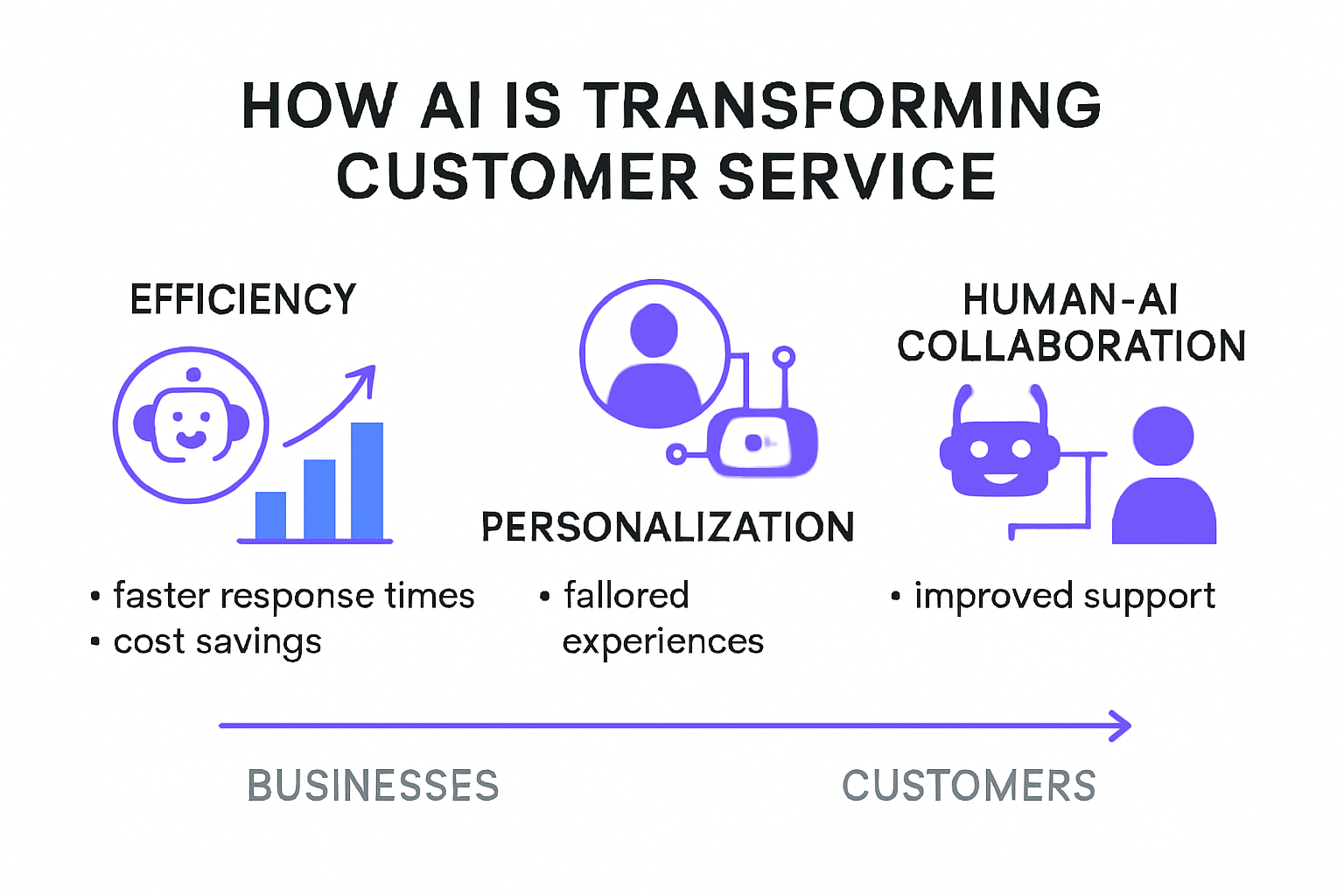
Artificial intelligence is fundamentally transforming customer service by introducing unprecedented levels of efficiency, personalization, and responsiveness. Organizations are rapidly adopting AI technologies to reimagine how they interact with customers, creating more intelligent and adaptive support ecosystems.
Intelligent Automation and Enhanced Efficiency
AI is revolutionizing customer service workflows through intelligent automation. Research from MIT Technology Review reveals that 73% of companies plan to deploy AI in customer service domains to dramatically improve operational efficiency. These advanced systems can process customer inquiries faster and more accurately than traditional human-only support teams.
By leveraging machine learning algorithms, AI can analyze complex customer interactions in real time, providing instant responses and routing issues to the most appropriate support channels. This approach significantly reduces wait times and increases overall customer satisfaction. According to an IBM report, organizations implementing AI-driven customer service solutions have seen a remarkable 17% increase in customer satisfaction rates.
Personalized Customer Experience
AI enables hyper-personalized customer interactions by analyzing extensive data points and understanding individual customer preferences. Machine learning models can now predict customer needs before they even articulate them, creating proactive support experiences. The technology goes beyond simple scripted responses, utilizing natural language processing to understand context, sentiment, and nuanced communication.
For instance, AI systems can now track a customer’s previous interactions, purchase history, and engagement patterns to craft tailored solutions. This level of personalization was previously impossible with traditional customer service models. A groundbreaking study by Brynjolfsson et al. demonstrated that AI assistants increased worker productivity by 15%, with significant improvements observed among less experienced support agents.
The Human-AI Collaboration
Contrary to popular belief, AI is not replacing human workers but augmenting their capabilities. The future of customer service lies in seamless collaboration between human expertise and artificial intelligence. AI handles routine inquiries, data processing, and initial problem screening, allowing human agents to focus on complex, emotionally nuanced interactions that require deep empathy and critical thinking.
This hybrid model ensures that customers receive quick, accurate initial responses while maintaining the option for human intervention when needed. Explore our guide on intelligent customer support strategies to understand how businesses are navigating this transformative landscape.
As AI continues to evolve, customer service will become more responsive, intelligent, and customer-centric than ever before. The technology promises not just efficiency, but a fundamental reimagining of how businesses connect and communicate with their customers.
Key AI Trends Shaping 2025 and Beyond

The AI landscape is undergoing rapid transformation, with emerging technologies poised to redefine how businesses interact with customers and manage complex operational challenges. As we approach 2025, several groundbreaking trends are set to revolutionize artificial intelligence applications across multiple domains.
Multimodal AI and Enhanced Contextual Understanding
Research from Google Cloud highlights the emergence of multimodal AI as a critical trend for 2025. These advanced systems can process and integrate information from multiple sources including text, images, audio, and video, creating a more comprehensive understanding of complex scenarios. This breakthrough allows AI to interpret context with unprecedented depth, enabling more nuanced and intelligent interactions.
Multimodal AI goes beyond traditional single-channel processing. By combining different data types, these systems can analyze subtle contextual cues that were previously impossible to detect. For customer service, this means AI agents can now understand emotional undertones, visual context, and complex communication patterns far more accurately than ever before.
Autonomous AI Agents and Decision Making
The evolution of AI is moving toward more independent and sophisticated autonomous systems. According to the Financial Times, AI agents are transitioning from simple assistants to complex decision-making entities capable of analyzing data, understanding intricate contexts, and making strategic choices independently.
In customer service, this translates to AI systems that can not only respond to queries but also proactively identify potential issues, recommend solutions, and even predict customer needs before they arise. These autonomous agents will fundamentally change how businesses approach customer support, creating more predictive and adaptive service models.
Advanced Conversational AI and Personalization
Webex’s research reveals a significant trend in conversational AI technologies. Virtual agents powered by advanced natural language processing will become increasingly sophisticated, handling complex inquiries with human-like understanding and empathy. These systems will leverage deep learning to create highly personalized interaction experiences.
The key differentiator will be the ability to understand not just the words customers use, but the intent, emotion, and broader context behind their communication. Discover our approach to intelligent customer interactions and how we’re pioneering these transformative technologies.
As we move into 2025, these AI trends will not just incrementally improve customer service but fundamentally reimagine how businesses communicate, support, and engage with their customers. The future of AI is about creating more intelligent, empathetic, and proactive systems that understand human needs at a deeper level than ever before.
To illustrate the key differences among the top AI trends impacting customer service, the table below summarizes their main features and benefits as discussed in this section.
| Trend | Main Features | Primary Benefits |
|---|---|---|
| Multimodal AI & Enhanced Contextual Understanding | Processes text, images, audio, video; integrates multi-source data; deep context/sentiment understanding. | More nuanced, intelligent, and emotionally aware responses. |
| Autonomous AI Agents & Decision Making | Independent decision-making; predicts needs; recommends solutions; handles complex queries. | Proactive, adaptive, and predictive customer support. |
| Advanced Conversational AI & Personalization | Deep learning, NLP, and emotion detection; understands intent and context; human-like interactions. | Highly personalized, empathetic, and efficient experiences. |
Balancing Automation With Human Touch
As artificial intelligence continues to transform customer service, organizations face the critical challenge of maintaining a delicate balance between technological efficiency and human empathy. The future of customer interactions lies not in complete automation, but in creating a harmonious collaboration between AI capabilities and human emotional intelligence.
The Strategic Hybrid Model
Research from the International Institute for Management Development emphasizes the importance of strategically dividing tasks between AI and human agents. This approach involves leveraging AI for repetitive, low-risk interactions while preserving human roles that require nuanced understanding and emotional connection. By implementing this hybrid model, businesses can optimize operational efficiency without sacrificing the quality of customer experiences.
AI technologies excel at handling routine inquiries, processing data rapidly, and providing instant responses. However, they cannot replace the deep empathy and complex problem-solving skills that human agents bring to challenging customer interactions. The goal is not to replace human workers but to augment their capabilities, allowing them to focus on more meaningful and emotionally sophisticated customer engagements.
Emotional Intelligence and Complex Problem Solving
According to Harrisburg University, maintaining human empathy remains crucial in customer service. While AI can process information quickly and provide standardized responses, it struggles to understand the subtle emotional nuances of human communication. Complex scenarios requiring emotional intelligence, such as handling customer frustrations or navigating sensitive issues, still demand human intervention.
The most effective customer service strategies will integrate AI as a supportive tool rather than a complete replacement. AI can pre-screen issues, gather initial information, and provide context to human agents, enabling them to respond more effectively and efficiently. This approach transforms customer service from a transactional experience to a more personalized, empathetic interaction.
Training and Adaptation Strategies
CMSWire highlights the importance of continuous training and adaptation in this evolving landscape. Organizations must invest in upskilling their human workforce to work seamlessly alongside AI technologies. This involves developing new skills in interpreting AI-generated insights, managing complex customer interactions, and understanding the strategic deployment of artificial intelligence.
Learn more about our approach to intelligent customer support and how we balance technological innovation with human expertise. By creating a collaborative ecosystem where AI and human agents complement each other, businesses can deliver unprecedented levels of customer satisfaction and operational efficiency.
The future of customer service is not about choosing between AI and human interaction, but about creating a symbiotic relationship that leverages the strengths of both technological innovation and human emotional intelligence. As we move forward, the most successful organizations will be those that master this delicate balance, transforming customer service into a more responsive, empathetic, and intelligent experience.
Below is a table contrasting the typical roles of AI and human agents in the strategic hybrid customer service model, helping clarify how responsibilities are divided (as described above).
| Task Type | AI Role | Human Agent Role |
|---|---|---|
| Routine inquiries | Handles initial responses quickly and accurately | Escalates only if complexity or nuance is detected |
| Data collection | Gathers and processes information rapidly | Reviews and interprets data as needed |
| Emotional scenarios | Detects sentiment but refers to human if nuanced | Provides empathy, navigates sensitive or complex emotions |
| Complex problem solving | Offers standard solutions where possible | Applies critical thinking, customizes response to unique cases |
| Proactive engagement | Identifies patterns and flags potential issues | Reaches out personally when deeper engagement is required |
Preparing Your Business for AI-Driven Service
Transitioning to an AI-driven customer service model requires strategic planning, technological investment, and a comprehensive understanding of how artificial intelligence can transform customer interactions. Businesses must take a proactive approach to integrate AI technologies effectively and create seamless, intelligent support ecosystems.
Technology Infrastructure and Strategic Assessment
According to IBM’s 2025 report, mature AI adopters experienced a significant 17% higher customer satisfaction percentage. This underscores the importance of developing a robust technological infrastructure that supports AI integration. Companies must conduct a thorough assessment of their current customer service capabilities, identifying specific areas where AI can deliver the most substantial improvements.
The initial step involves mapping existing customer interaction workflows and pinpointing repetitive tasks that AI can efficiently handle. This strategic evaluation helps businesses understand where automation can streamline operations without compromising the quality of customer experiences. Technologies like natural language processing, machine learning, and predictive analytics become critical tools in transforming traditional customer service models.
Training and Change Management
Microsoft’s 2025 insights emphasize the critical role of employee training and change management in successful AI adoption. Organizations must invest in comprehensive training programs that help existing staff understand, collaborate with, and leverage AI technologies effectively.
This involves developing new skill sets that enable employees to work alongside AI systems. Staff members need to learn how to interpret AI-generated insights, manage complex customer interactions, and understand the strategic deployment of artificial intelligence. The goal is to create a culture of technological adaptability where employees view AI as an empowering tool rather than a potential replacement.
Ethical Implementation and Continuous Optimization
Research from the American Military University highlights the importance of ethical AI implementation in customer service. Businesses must establish clear guidelines and governance frameworks that ensure AI technologies are deployed responsibly, maintaining transparency, protecting customer data, and preserving human dignity in automated interactions.
Continuous optimization is key to successful AI integration. This means regularly assessing AI performance, gathering customer feedback, and making iterative improvements to AI algorithms and interaction models. Explore our comprehensive guide to AI-powered customer support strategies to understand how businesses can develop adaptive, intelligent service ecosystems.
Preparing for an AI-driven service future is not about wholesale replacement of human workers, but about creating intelligent, collaborative systems that enhance customer experiences. By approaching AI integration strategically, investing in employee skills, and maintaining a commitment to ethical technology deployment, businesses can unlock unprecedented levels of efficiency, personalization, and customer satisfaction.
Ready to Transform Your Customer Experience with AI Voice Agents?
The article reveals how customer service AI is evolving toward smarter, faster, and more human experiences, but many businesses still struggle to balance automation with a true personal touch. Common pain points include long customer wait times, generic conversations, and missed opportunities for genuine engagement. When routine tasks slow your team down or your customers crave more personalized service, you risk falling behind industry leaders who already use intelligent, adaptable technology every day.
Imagine solving these challenges with AI that not only handles repetitive requests but also understands voice, intent, and emotion for real omnichannel support. Elevate your support with voice AI agents designed for real business impact. Your future success starts with the right technology partner.
Discover the difference a tailored approach can make and see how our Voice AI Agents deliver seamless, human-like interactions across all channels. Visit our resource center to find proven strategies for launching smarter support today. Take the next step and explore NextLevel AI before your competitors do. The future of customer service is now. Click to empower your team and build customer loyalty that lasts.
Recommended
- AI Insights & Resources | NextLevel.AI Blog
- Artificial Intelligence Call Center Agents | NextLevel
- NextLevel – Voice AI Agents Tailored for Your Business
- AI BDR Agent: Lead Qualification & Engagement – NextLevel.AI
- How to Improve Customer Service: Proven Strategies for 2025 – Peuneo
- Optimizing Efficiency: AI Applications in Business
Frequently Asked Questions
What are the key trends shaping AI in customer service for 2025?
Key trends include multimodal AI for enhanced contextual understanding, autonomous AI agents capable of independent decision-making, and advanced conversational AI that offers personalized interactions.
How is AI improving customer service efficiency?
AI improves efficiency by automating routine inquiries, processing customer questions faster, and analyzing data to provide accurate responses, leading to increased customer satisfaction rates.
Will AI replace human agents in customer service?
No, AI is not set to replace human agents; instead, it complements their roles by handling repetitive tasks, allowing humans to focus on complex interactions that require empathy and emotional intelligence.
How can businesses prepare for AI-driven customer service?
Businesses can prepare by assessing their technology infrastructure, investing in employee training, and implementing ethical AI practices to ensure responsible deployment and continuous optimization.
What are the best AI tools for sales team productivity in enterprises?
Enterprise sales teams achieve maximum productivity by combining conversation intelligence, workflow automation, and predictive analytics. Leading tools include NextLevel.AI for automated outbound outreach and lead qualification, Gong.io for conversation intelligence and deal insights, Salesforce Einstein for predictive lead scoring and opportunity management, Outreach.io for sales engagement sequencing, and Clari for revenue forecasting and pipeline management.
The most effective approach layers these capabilities strategically. NextLevel.AI handles high-volume prospecting and qualification calls, freeing sales reps to focus on high-value relationships and closing deals. Meanwhile, conversation intelligence platforms analyze successful sales calls to replicate winning behaviors. The right combination typically reduces manual administrative tasks by 60-80%, increases contact rates by 40%, and shortens sales cycles by 25-30%. When evaluating tools, prioritize seamless CRM integration, mobile accessibility for field teams, customizable workflows that match your sales process, and comprehensive analytics that provide actionable insights rather than just data dumps.


