
Improving Sales with AI: Smart Strategies for 2025


AI is shaking up sales faster than anyone imagined. Companies using AI in their revenue teams have seen up to 29 percent higher sales growth compared to their competitors.
Surprised? Most people think AI is just about speeding up repetitive tasks. The real shock is how AI is quietly replacing guesswork with data-driven moves that win deals before your competition even knows a lead is hot.
Table of Contents
- How AI Transforms The Sales Process
- AI Tools Every Business Needs In 2025
- Proven Ways To Boost Revenue With AI
- Overcoming Common AI Challenges In Sales
Quick Summary
| Takeaway | Explanation |
|---|---|
| AI Transforms Sales Processes | AI introduces precision and data-driven insights into traditional sales, enhancing lead scoring, predictive forecasting, and customer interactions for improved efficiency and effectiveness. |
| Adopt Key AI Tools | Businesses should implement advanced predictive analytics, intelligent automation, and personalized customer engagement platforms to create competitive advantages and drive measurable results. |
| Boost Revenue with Intelligent Strategies | Utilizing AI for lead conversion, revenue optimization, and personalized engagement techniques can significantly enhance sales growth and customer loyalty. |
| Address Workforce and Infrastructure Challenges | Successful AI integration requires addressing skill development, technical infrastructure, and data quality challenges to maximize the effectiveness of AI solutions in sales. |
| Ensure Ethical AI Implementation | Businesses must prioritize ethical considerations including fairness, accountability, and data privacy to navigate challenges in AI adoption responsibly. |
How AI Transforms the Sales Process
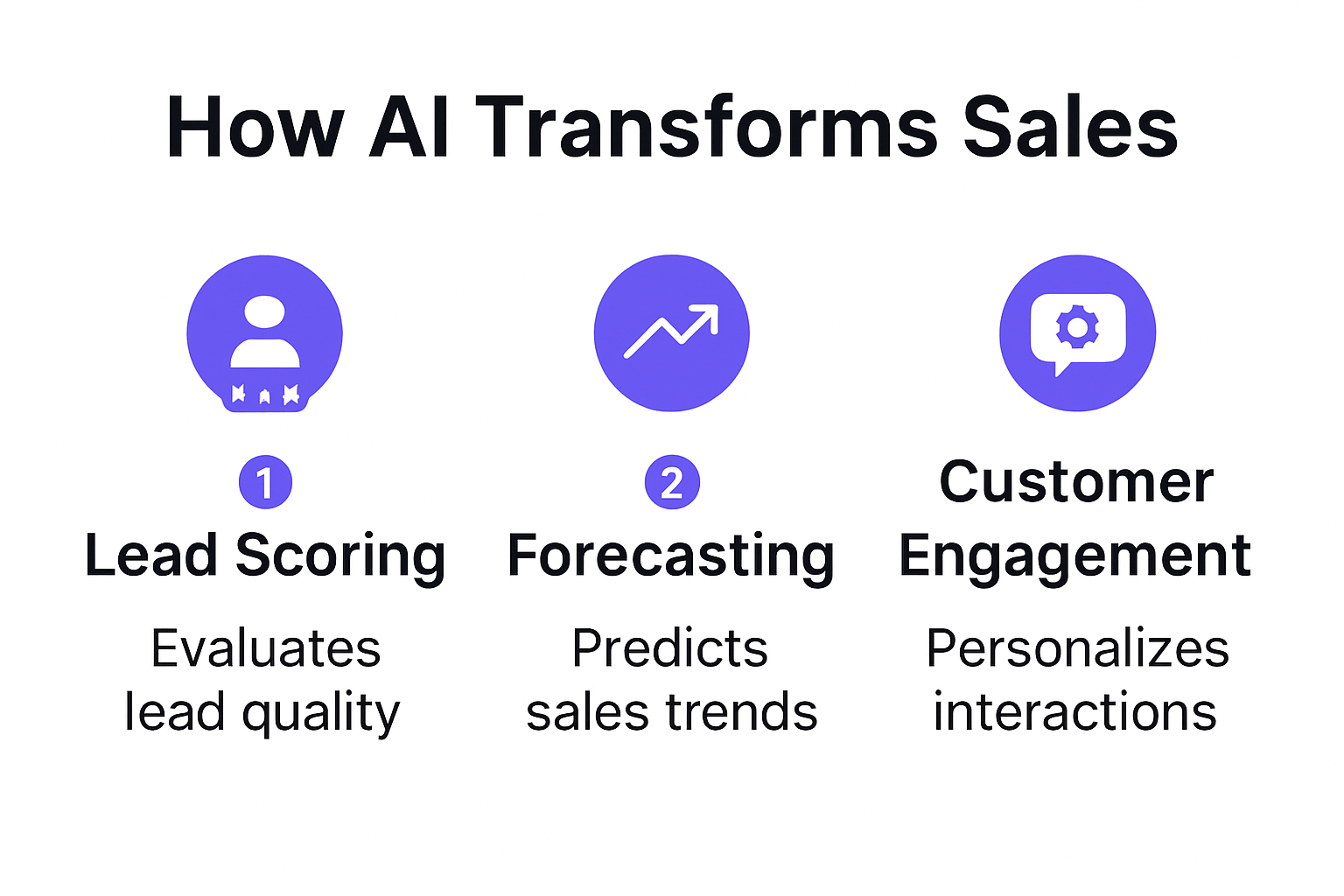
Artificial Intelligence is fundamentally reshaping sales strategies by introducing unprecedented levels of precision and intelligence into traditional sales processes. The transformation goes far beyond simple automation creating a comprehensive ecosystem of intelligent interactions and data-driven decision making.
Intelligent Lead Scoring and Prioritization
AI revolutionizes lead management through advanced predictive analytics. Cutting-edge lead qualification strategies enable sales teams to identify and prioritize high-potential prospects with remarkable accuracy. According to research from ResearchGate, AI-powered lead scoring algorithms can analyze complex datasets including behavioral patterns, demographic information, and interaction histories to rank prospects.
Traditional lead evaluation methods often relied on subjective assessments and manual tracking. AI transforms this approach by providing objective, data-driven insights. The algorithms continuously learn and adapt, improving their predictive capabilities with each interaction. Sales teams can now focus their energy on leads most likely to convert, dramatically improving efficiency and resource allocation.
Predictive Sales Forecasting and Resource Optimization
Predictive analytics powered by AI enable unprecedented accuracy in sales forecasting. By analyzing historical performance data, market trends, and external variables, AI systems generate nuanced projections that go beyond traditional statistical models. Advanced AI systems can detect subtle patterns and potential market shifts that human analysts might overlook.
Companies implementing AI-driven forecasting experience significant improvements in resource planning. These intelligent systems can predict potential revenue streams, identify potential bottlenecks, and recommend strategic interventions. Sales managers gain a comprehensive view of potential outcomes, allowing for more informed strategic decision making.
Enhanced Customer Interaction and Personalization
AI transforms customer interactions by enabling hyper-personalized communication strategies. Intelligent voice agents and chatbots can now understand context, sentiment, and individual customer preferences. These systems provide instant, tailored responses that feel genuinely human while maintaining consistent performance.
The integration of natural language processing allows AI systems to analyze communication patterns, recommend optimal engagement strategies, and even predict customer needs before they are explicitly articulated. This level of personalization creates deeper customer relationships and increases the likelihood of successful conversions.
As we approach 2025, AI is not just a technological tool but a strategic partner in sales processes. Organizations embracing these intelligent systems will gain significant competitive advantages through enhanced efficiency, precision, and customer understanding. The future of sales is intelligent, adaptive, and data-driven.
AI Tools Every Business Needs in 2025
The rapidly evolving business landscape demands sophisticated AI tools that can drive efficiency, improve decision making, and create competitive advantages. As we enter 2025, businesses must strategically select AI technologies that transform core operational processes and deliver measurable results.
Advanced Predictive Analytics and Sales Intelligence
Predictive analytics have become essential for businesses seeking data driven insights. According to research from ArXiv, advanced AI systems like SalesRLAgent are revolutionizing sales intelligence with unprecedented accuracy. These tools utilize reinforcement learning frameworks to predict conversion probabilities during sales conversations, achieving remarkable 96.7% accuracy rates.

Sophisticated AI resource platforms enable businesses to integrate predictive models that go beyond traditional forecasting. Companies can now leverage machine learning algorithms that analyze complex datasets, identifying potential market trends and customer behavior patterns with extraordinary precision. The ability to anticipate customer needs before they emerge provides a significant strategic advantage.
Intelligent Automation and Workflow Optimization
Automation tools powered by artificial intelligence are transforming how businesses manage workflows and allocate resources. According to LinkedIn’s research, machine learning models can now automate account prioritization processes, resulting in substantial improvements in renewal bookings and operational efficiency.
These intelligent systems can handle complex tasks including:
- Automated lead qualification identifying high potential prospects
- Real time performance tracking providing instant insights into sales metrics
- Resource allocation optimization ensuring team efforts are strategically directed
Personalized Customer Engagement Platforms
AI driven customer engagement platforms represent the next frontier of business interaction. By integrating natural language processing and machine learning, these tools create hyper personalized communication experiences that adapt in real time.
According to advanced AI research, causal predictive optimization frameworks are enabling businesses to generate more meaningful customer interactions. These platforms can:
- Understand complex customer sentiment
- Recommend optimal engagement strategies
- Predict potential customer needs before explicit expression
Businesses adopting these AI tools will not just survive but thrive in the competitive 2025 marketplace. The key lies in selecting technologies that provide genuine strategic value and seamlessly integrate with existing operational frameworks. As AI continues to evolve, the most successful organizations will be those capable of leveraging these intelligent systems to drive innovation and create exceptional customer experiences.
Here’s a summary table comparing the main types of AI tools every business needs in 2025, along with their core capabilities and primary benefits:
| AI Tool Type | Core Capabilities | Primary Benefits |
|---|---|---|
| Predictive Analytics & Sales Intelligence | Data modeling, trend detection, conversion prediction | Accurate forecasting, proactive insights |
| Intelligent Automation & Workflow Optimization | Automated lead qualification, performance tracking, resource allocation | Increased efficiency, operational streamlining |
| Personalized Customer Engagement Platforms | Sentiment analysis, tailored communication, need prediction | Enhanced customer interaction, higher loyalty |
Proven Ways to Boost Revenue with AI
Artificial Intelligence has emerged as a powerful catalyst for revenue generation, offering businesses unprecedented opportunities to optimize sales strategies and drive financial growth. As organizations seek competitive advantages, AI technologies provide strategic pathways to enhance revenue performance.
Intelligent Lead Conversion Strategies
AI transforms lead conversion by enabling precision targeting and personalized engagement. According to Salesforce research, sales teams utilizing AI are 1.3 times more likely to experience revenue increases compared to traditional approaches. Advanced lead qualification systems can analyze complex behavioral patterns, identifying high potential prospects with remarkable accuracy.
These intelligent systems go beyond basic demographic filtering. By integrating machine learning algorithms, businesses can develop nuanced lead scoring models that predict conversion probabilities with unprecedented precision. This approach allows sales teams to focus energy on prospects most likely to generate substantial revenue, dramatically improving resource allocation and conversion rates.
Predictive Revenue Optimization
Predictive analytics powered by AI provide businesses with sophisticated revenue forecasting capabilities. Research from Gong indicates that revenue organizations implementing AI experienced 29% higher sales growth compared to non adopting peers.
These advanced systems analyze multiple data points including:
- Historical sales performance
- Market trend indicators
- Customer interaction patterns
- Economic environment signals
By synthesizing these complex datasets, AI generates sophisticated revenue projections that enable more strategic decision making. Businesses can anticipate potential market shifts, identify emerging opportunities, and proactively adjust sales strategies to maximize revenue potential.
Personalized Customer Engagement Techniques
AI enables hyper personalized customer engagement strategies that directly impact revenue generation. By leveraging natural language processing and machine learning, businesses can create tailored communication experiences that significantly improve conversion rates.
Intelligent systems can now:
- Analyze individual customer preferences
- Recommend personalized product offerings
- Predict optimal communication timing
- Generate contextually relevant interactions
These personalized approaches transform customer interactions from transactional exchanges to meaningful relationships. By understanding and anticipating customer needs, businesses can increase customer loyalty, reduce churn, and create sustainable revenue streams.
As we approach 2025, AI is no longer an optional technology but a critical component of successful revenue strategies. Organizations that embrace these intelligent systems will gain substantial competitive advantages, driving growth through data driven insights and precision targeting. The future of revenue generation is intelligent, adaptive, and fundamentally powered by artificial intelligence.
Below is a table summarizing key AI strategies for boosting revenue, along with their methods and measurable impact based on statistics from the article:
| Strategy Category | Method/Technique | Impact/Statistic |
|---|---|---|
| Lead Conversion | Predictive lead scoring and targeted engagement | 1.3x more likely to increase revenue (Salesforce) |
| Revenue Optimization | AI-powered revenue forecasting and trend analysis | 29% higher sales growth (Gong) |
| Customer Engagement | Hyper-personalized communication and offer recommendations | Increased loyalty, reduced churn |
Overcoming Common AI Challenges in Sales
As artificial intelligence continues to revolutionize sales processes, organizations encounter complex challenges that demand strategic approaches and comprehensive solutions. Successful AI integration requires more than technological implementation it demands a holistic transformation of organizational culture and capabilities.
Workforce Adaptation and Skills Development
Advanced AI implementation strategies highlight the critical importance of workforce preparation. According to research from Gartner, by 2027, 95% of seller research workflows will begin with AI, signaling a massive shift in professional skill requirements.
Organizations must invest in comprehensive upskilling programs that enable sales professionals to collaborate effectively with AI technologies. This involves:
- Developing AI literacy across all organizational levels
- Creating training modules that demonstrate AI tool integration
- Fostering a culture of continuous learning and technological adaptation
Successful adaptation requires transforming employee perspectives from viewing AI as a threat to seeing it as a collaborative partner that enhances their professional capabilities. By positioning AI as an augmentation tool rather than a replacement, businesses can reduce resistance and accelerate technological adoption.
Technical Infrastructure and Data Quality Challenges
Implementing AI requires robust technical infrastructure and high quality data ecosystems. Digital transformation research emphasizes the need for comprehensive infrastructure assessments before AI deployment.
Key technical considerations include:
- Ensuring sufficient computational resources
- Developing secure and scalable cloud based solutions
- Implementing rigorous data governance frameworks
- Creating standardized data collection and management protocols
Data quality remains a fundamental challenge. AI systems are only as effective as the underlying data they analyze. Organizations must invest in data cleansing, normalization, and continuous validation processes to maintain AI system accuracy and reliability.
Ethical AI and Transparency Concerns
As AI becomes more prevalent in sales processes, ethical considerations and transparency become paramount. Infrastructure optimization research highlights the growing importance of responsible AI implementation.
Businesses must address critical ethical dimensions including:
- Ensuring algorithmic fairness and reducing potential bias
- Maintaining clear accountability mechanisms
- Protecting customer data privacy
- Providing transparent explanations of AI decision making processes
Effective AI integration requires establishing clear ethical guidelines that align technological capabilities with human values. Organizations must create governance frameworks that prioritize responsible innovation while maintaining technological competitiveness.
Navigating AI challenges demands a strategic approach that balances technological innovation with human expertise. Successful organizations will view these challenges not as obstacles but as opportunities for transformative growth. By developing comprehensive strategies that address workforce, technical, and ethical considerations, businesses can unlock the full potential of AI in sales environments.
Bring AI-Powered Sales Growth to Your Business
Ready to move from slow, manual sales to fast, data-driven results? The article “Improving Sales with AI: Smart Strategies for 2025” highlights the struggle many companies face: teams waste hours on unqualified leads and miss out on personal connections that win deals. If you have seen those pain points in your own business or want to leap ahead of competitors, the answer is investing in AI that truly adapts to your customers and sales goals.
Unlock immediate advantages with Voice AI Agents tailored to your sales needs. Deliver human-like conversations and qualify leads in real time across every channel. See how our technology brings together all the core benefits from the article: precise lead scoring, predictive insights, and the power to engage customers in ways that increase revenue. Do not wait while your competitors invest in smarter tools. Visit https://nextlevel.ai now and schedule a demo to see how we can transform your sales process for 2025.
Recommended
- AI Insights & Resources | NextLevel.AI Blog
- AI BDR Agent: Lead Qualification & Engagement – NextLevel.AI
- AI Corporate Training Agent – Rocket in Training Efficiency
- NextLevel – Voice AI Agents Tailored for Your Business
- Artificial Intelligence Call Center Agents | NextLevel
- AI AI Health Coach / Health Advocate Solution – NextLevel
- Revolutionizing Analytics: How AI Powers Data Interpretation
- Top B2B Sales Techniques for Success in 2025
Frequently Asked Questions
What are the benefits of using AI in sales?
AI enhances sales processes by providing data-driven insights, improving lead scoring accuracy, enabling predictive sales forecasting, and facilitating personalized customer interactions, leading to increased efficiency and revenue growth. Improving sales with AI has become essential for businesses seeking competitive advantages in today’s market.
How can businesses implement AI tools for sales?
Businesses can implement AI tools by selecting technologies such as advanced predictive analytics, intelligent automation, and personalized customer engagement platforms, ensuring they integrate seamlessly with existing systems for maximum impact.
What challenges might organizations face when adopting AI for sales?
Common challenges include workforce adaptation, ensuring data quality, developing robust technical infrastructure, and addressing ethical concerns related to AI deployment and customer data privacy.
How does AI improve customer engagement strategies?
AI improves customer engagement by enabling hyper-personalized communication, understanding customer preferences, predicting needs, and facilitating timely interactions, which ultimately strengthens customer relationships and drives loyalty.


