Multilingual AI Voice Agents for Sales and Marketing in 2025


AI voice agents are reshaping how businesses connect with people from every background and language. Here’s a wild shift: 63 percent of leading AI platforms now operate in five or more languages, and user engagement has jumped by 41 percent for global companies.
Yet, the real magic is not just in translating words at lightning speed. Instead, it is in crafting emotionally intelligent conversations that feel perfectly tailored to each customer, no matter where they are from. The way businesses communicate is about to get a lot smarter—and a whole lot more personal.
Table of Contents
- Benefits Of Multilingual AI Voice Agents For US Businesses
- How AI Voice Agents Drive Sales And Marketing
- Implementing Multilingual Voice Agents In Your Company
- Top Trends In Multilingual AI Voice Agents For 2025
Quick Summary
| Takeaway | Explanation |
|---|---|
| Enhanced Customer Communication | Multilingual AI voice agents facilitate seamless communication across languages, improving customer satisfaction and access to support. |
| Operational Efficiency | Automating routine tasks allows companies to reduce costs and free up human resources for more complex tasks, enhancing overall operational efficiency. |
| Strategic Market Expansion | These agents enable businesses to enter new markets with reduced risk and increased credibility through accurate, real-time communication in local languages. |
| Intelligent Lead Engagement | AI voice agents streamline the lead qualification process and personalize engagement strategies based on user profiles, increasing conversion rates. |
| Trends in Global Reach | Advancements in AI voice technology, including emotional intelligence and real-time translation, create opportunities for more authentic and nuanced customer interactions globally. |
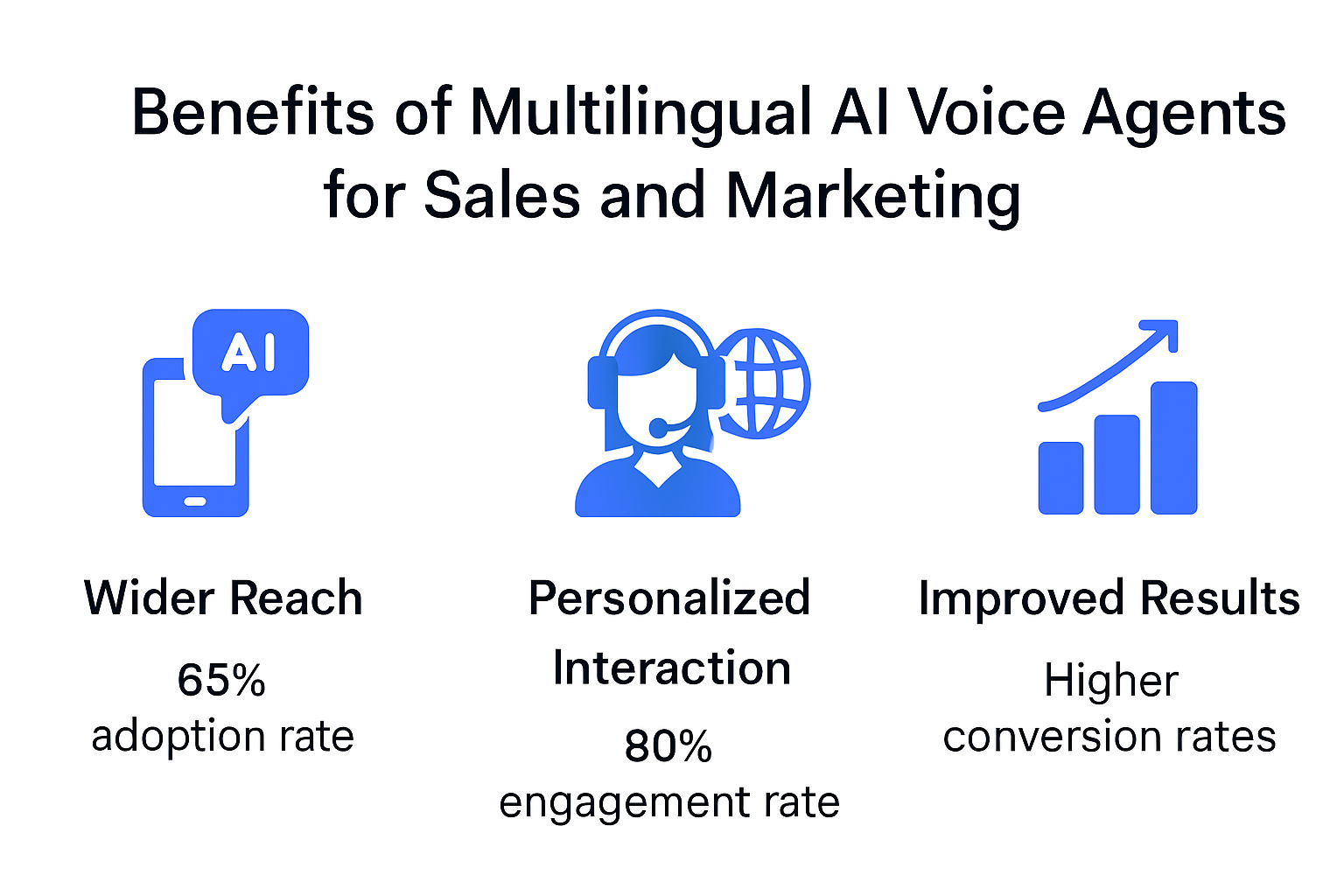
Benefits of Multilingual AI Voice Agents for US Businesses
Multilingual AI voice agents are transforming how US businesses communicate with diverse customer bases, offering unprecedented opportunities for growth and customer engagement. These advanced technological solutions provide companies with a powerful toolkit to expand their reach, improve customer interactions, and drive significant business performance.
Enhanced Customer Communication and Accessibility
Businesses gain a substantial competitive advantage by implementing multilingual AI voice agents that can seamlessly communicate across multiple languages. According to research from Educba, these intelligent systems enable companies to provide 24/7 customer support across various languages, dramatically reducing wait times and enhancing overall customer satisfaction. This capability is particularly crucial in the United States, where multilingual populations continue to grow.
The ability to communicate in multiple languages instantly breaks down communication barriers. For sales and marketing teams, this means reaching broader audiences without requiring extensive human resources. A single AI voice agent can now handle customer inquiries in Spanish, Mandarin, Arabic, and English simultaneously, ensuring no potential customer feels excluded or misunderstood.

Operational Efficiency and Cost Reduction
Multilingual AI voice agents deliver remarkable operational benefits for businesses. Teneo AI research demonstrates that these systems can automate routine tasks and manage multiple interactions concurrently, significantly reducing operational costs. By handling standard inquiries and preliminary customer interactions, these AI agents free up human staff to focus on more complex, high-value tasks.
The cost savings are substantial. Companies can reduce customer service staffing expenses while maintaining high-quality, round-the-clock support. Small to medium enterprises particularly benefit, as they can now offer enterprise-level communication capabilities without massive infrastructure investments. Learn more about our tailored voice AI solutions.
Moreover, multilingual AI voice agents provide consistent performance. Unlike human agents who might experience fatigue or inconsistent communication, these AI systems maintain uniform quality across all interactions. They follow predefined scripts, ensure regulatory compliance, and deliver standardized customer experiences regardless of language or time of day.
Strategic Market Expansion
For US businesses looking to expand into international markets, multilingual AI voice agents are game changers. These technologies enable companies to test and enter new markets with minimal risk. By providing immediate, accurate communication in local languages, businesses can build trust and credibility faster than traditional expansion methods.
The scalability of these AI solutions means businesses can quickly adapt their communication strategies. Whether targeting Hispanic markets in the southwestern United States or preparing for global expansion, multilingual AI voice agents provide the technological flexibility needed in today’s dynamic business environment.
US businesses that embrace these technologies position themselves at the forefront of customer communication innovation. The ability to speak directly to customers in their preferred language isn’t just a technical advantage—it’s a powerful statement of inclusivity and customer commitment.
How AI Voice Agents Drive Sales and Marketing
AI voice agents are revolutionizing sales and marketing strategies by introducing unprecedented levels of personalization, efficiency, and engagement. These intelligent systems are not merely technological tools but strategic partners that transform how businesses interact with potential customers and optimize their sales processes.
Intelligent Lead Qualification and Engagement
Modern sales teams are leveraging AI voice agents to streamline lead qualification processes with remarkable precision. Research from Yale University demonstrates that AI models can analyze sales interactions with unprecedented accuracy, predicting persuasive potential with 40% greater effectiveness than random selection. By incorporating human insights, these prediction models can improve accuracy to 67%, offering businesses a powerful tool for understanding and enhancing sales interactions.
The sophistication of these AI voice agents allows for nuanced engagement strategies. Explore our AI BDR agent capabilities that can dynamically adapt communication styles based on individual prospect profiles. This means each interaction is tailored, increasing the likelihood of successful lead conversion.
Here is a table summarizing the key roles of AI voice agents in sales and marketing as discussed in this section:
| Role | Description | Impact |
|---|---|---|
| Lead Qualification | Analyzes sales interactions to prioritize persuasive leads and improve model accuracy | Higher conversion rates |
| Personalized Engagement | Adapts communication style based on user profiles for tailored conversations | Greater customer satisfaction and engagement |
| Multichannel Consistency | Maintains cohesive, context-aware interactions across calls, email, and chat | Seamless customer journey |
| Data Collection & Analysis | Tracks interaction patterns, sentiment, and conversions | Data-driven marketing optimization |
| Scenario-Based Adaptability | Modifies approach based on personality insights and voice characteristics | Enhanced persuasion and retention |
Personality-Driven Sales Strategies
Cutting-edge research reveals the profound impact of personality-aware interactions in sales dialogues. A groundbreaking study from April 2025 highlighted how AI voice agents can adapt strategies by understanding user personas, such as those defined by the Myers-Briggs Type Indicator (MBTI). This approach allows for highly personalized communication that resonates more deeply with potential customers.
Furthermore, voice characteristics play a crucial role in persuasion. Research published in May 2024 found that voice assistants with positive or neutral tones, particularly those with middle-aged male or younger female voices, demonstrated higher persuasive capabilities during online interactions. This insight enables businesses to fine-tune their AI voice agents for maximum engagement.
Multichannel Marketing and Customer Journey Optimization
AI voice agents are transforming multichannel marketing by providing consistent, intelligent interactions across various touchpoints. These advanced systems can seamlessly transition between communication channels, maintaining context and personalization throughout the customer journey. Whether initiating contact through an initial phone call, following up via email, or providing support through a chat interface, AI voice agents ensure a cohesive and responsive experience.
The data collection and analysis capabilities of these agents provide marketing teams with unprecedented insights. By tracking interaction patterns, sentiment, and conversion metrics, businesses can continuously refine their strategies. This data-driven approach allows for real-time optimization of marketing campaigns and sales scripts, ensuring that communication remains relevant and effective.
Businesses that embrace AI voice agents are not just adopting a technology—they are fundamentally reimagining customer engagement. These intelligent systems represent a strategic investment in more personalized, efficient, and responsive sales and marketing approaches that can significantly enhance competitive advantage in an increasingly digital marketplace.
Implementing Multilingual Voice Agents in Your Company
Implementing multilingual voice agents requires a strategic approach that goes beyond mere technological adoption. Successful integration demands careful planning, comprehensive training, and a holistic understanding of how these advanced AI systems can transform business communication and customer engagement.
Strategic Planning and Infrastructure Preparation
Before deploying multilingual voice agents, companies must conduct a thorough assessment of their current communication infrastructure. The XPersona project research demonstrates that successful multilingual AI implementation relies on context-aware interactions across different language environments. This involves evaluating existing customer interaction channels, identifying language requirements, and developing a robust technological framework that facilitates seamless multilingual communication.
Key preparatory steps include:
- Technical Assessment: Analyze current communication systems and their compatibility with AI voice agent technologies
- Language Mapping: Identify primary and secondary languages critical to your business operations
- Integration Strategy: Develop a phased approach for introducing multilingual voice agents
Explore our custom AI voice chatbot solutions to understand how tailored implementations can address your specific business needs.
Training and Continuous Learning
Successful implementation goes far beyond initial setup. According to research from Springer, voice-based AI interfaces can significantly enhance user experiences, leading to improved service outcomes such as higher contract renewal rates and increased conversion rates. To achieve these benefits, companies must invest in comprehensive training programs.
This training encompasses multiple dimensions:
- Language Model Training: Developing a nuanced understanding of linguistic nuances, idioms, and cultural contexts
- Scenario-Based Learning: Creating extensive interaction scenarios that cover diverse customer communication needs
- Continuous Performance Monitoring: Implementing real-time feedback mechanisms to refine AI agent responses
For easier review of recommended implementation steps, here’s a table summarizing the process for introducing multilingual AI voice agents:
| Step | Activity Description |
|---|---|
| 1. Assessment | Evaluate current systems and communication channels |
| 2. Language Mapping | Identify vital primary and secondary languages |
| 3. Integration Planning | Regularly review data privacy, transparency, and ethical practices |
| 4. Training & Scenario Design | Build models, create real-world and cultural learning scenarios |
| 5. Continuous Monitoring | Set up ongoing feedback and performance improvement |
| 6. Ethical & Compliance Review | Regularly review data privacy, transparency, ethical practices |
Ethical Considerations and Performance Optimization
Implementing multilingual voice agents requires a careful balance between technological capability and ethical considerations. Companies must establish clear guidelines for AI interactions, ensuring transparency, data privacy, and respectful communication across all language interfaces.
Performance optimization involves:
- Regular audits of AI communication patterns
- Implementing robust error correction mechanisms
- Ensuring consistent performance across different language environments
Businesses that approach multilingual voice agent implementation as a strategic transformation rather than a simple technological upgrade will see the most significant benefits. This means viewing these AI systems not just as tools, but as intelligent partners in customer communication and engagement.
The future of business communication is multilingual, adaptive, and increasingly powered by sophisticated AI technologies. Companies that invest thoughtfully in these systems will gain a substantial competitive advantage, creating more personalized, efficient, and responsive customer interactions.
Top Trends in Multilingual AI Voice Agents for 2025
The landscape of multilingual AI voice agents is rapidly evolving, presenting groundbreaking opportunities for businesses to revolutionize customer communication and engagement. As we move through 2025, several key trends are reshaping the capabilities and potential of these intelligent communication platforms.
Expanding Language Capabilities and Global Reach
Research from Control Hippo reveals a significant milestone in multilingual AI technology: 63% of AI platforms now offer services in five or more languages, resulting in a remarkable 41% boost in user engagement for global organizations. This expansion goes beyond simple translation, focusing on nuanced, context-aware communication that respects cultural and linguistic subtleties.
Advanced AI voice agents are now developing accent-neutral models that can seamlessly adapt to different linguistic contexts. Explore our cutting-edge voice AI resources to understand how these technologies are transforming global communication strategies. The ability to communicate authentically across language barriers is no longer a luxury but a critical competitive advantage for businesses operating in diverse markets.
Brand-Aligned Emotional Intelligence
A transformative trend emerging in 2025 is the development of AI voice agents that can authentically reflect brand values and emotional nuances. According to Martech’s 2025 predictions, AI systems are evolving to create emotionally resonant customer experiences that go beyond transactional interactions.
This means AI voice agents are being designed to:
- Understand Emotional Context: Detect and respond to subtle emotional cues
- Maintain Brand Personality: Consistently represent the company’s core values
- Adaptive Communication: Adjust tone and approach based on individual customer interactions
Real-Time Translation and Advanced Linguistic Technologies
Breakthroughs in real-time language translation are setting new standards for multilingual communication. Bigly Sales research highlights emerging technologies that enable instantaneous, context-aware translation, breaking down communication barriers in unprecedented ways.
Key technological advancements include:
- Neural Machine Translation: More accurate and contextually intelligent translation
- Contextual Understanding: AI systems that comprehend cultural nuances and idiomatic expressions
- Continuous Learning: Adaptive models that improve linguistic capabilities through ongoing interactions
Businesses investing in these advanced multilingual AI voice agents are positioning themselves at the forefront of global communication. The future of customer engagement is not just about speaking multiple languages, but about creating genuine, intelligent, and emotionally connected interactions that transcend linguistic boundaries.
As AI technology continues to advance, multilingual voice agents will become increasingly sophisticated, offering businesses unprecedented opportunities to connect with customers on a truly global scale. The companies that embrace these technologies will gain a significant competitive advantage in an increasingly interconnected world.
Ready for True Multilingual Engagement in 2025?
Businesses today face a major challenge: reaching global customers who expect seamless, emotionally intelligent communication in their own language. If you have struggled with language barriers, inconsistent service, or missed growth opportunities, you are not alone. As highlighted in this article, multilingual AI voice agents are essential for expanding market reach, saving valuable time, and creating real, personal connections with every customer, no matter where they are.
Experience firsthand how NextLevel’s Voice AI Agents deliver consistent, human-like support across every channel and every language, all powered by advanced personalization and continuous learning. Looking for a solution that adapts to your unique market needs? Explore our tailored voice AI solutions and see how you can turn communication challenges into growth. Do not wait for your competitors to set the standard—start building multicultural loyalty and operational efficiency today. Visit NextLevel.ai and move your business ahead of the curve.
Recommended
- NextLevel – Voice AI Agents Tailored for Your Business
- AI BDR Agent: Lead Qualification & Engagement – NextLevel.AI
- AI Insights & Resources | NextLevel.AI Blog
- Artificial Intelligence Call Center Agents | NextLevel
- AI Chatbot for Website That Talks to Visitors – NextLevel
- Custom AI Voice Chatbot – Make Your Mobile App Smarter
Frequently Asked Questions
What are multilingual AI voice agents?
Multilingual AI voice agents are advanced technologies that enable businesses to communicate with customers in multiple languages, providing personalized, real-time support and enhancing customer engagement.
How can multilingual AI voice agents improve customer experience?
These agents enhance customer experience by breaking down language barriers, offering 24/7 support, and providing tailored interactions that meet the needs of diverse customer bases.
What are the benefits of using AI voice agents for sales and marketing?
AI voice agents streamline lead qualification, improve operational efficiency, and enable strategic market expansion by delivering personalized communication and insights into customer behavior.
How do businesses implement multilingual AI voice agents?
Businesses can implement these agents by assessing their current communication systems, training the AI on language nuances, and establishing a robust infrastructure that supports multilingual interactions.