Voice AI for Small Business: Boost Growth in 2025


Voice AI is shaking up the way small businesses communicate with their customers. Most people expect automation to create distance or feel robotic, but the reality is turning out to be far different. A staggering 97 percent of small businesses using AI-powered voice agents are seeing real revenue growth.
These tools are doing more than cutting costs or answering phones after hours. They are actually making customer interactions more personal, more responsive and, for many owners, a lot more profitable. What’s behind this shift and how are small businesses turning voice AI into a competitive edge?
Table of Contents
- Understanding Voice AI Solutions For Small Business
- Key Benefits Of Voice AI for Sales And Marketing
- How To Implement Voice AI in Your Small Business
- Real-World Success Stories From U.S. Businesses
Quick Summary
| Takeaway | Explanation |
|---|---|
| Voice AI Enhances Communication | Voice AI automates routine inquiries and facilitates 24/7 customer support, freeing up human resources for more complex tasks while enhancing service availability. |
| Significant Cost Savings | Implementing voice AI can lead to up to 30% reduction in customer service costs and a reported revenue boost for 97% of businesses using the technology. |
| Improved Operational Efficiency | Ongoing training and performance analysis are crucial to maintain compelling voice AI systems, ensuring high-quality customer interactions and adapting to evolving business needs. |
| Continuous Optimization Is Essential | Ongoing training and performance analysis are essential for maintaining compelling voice AI systems, ensuring high-quality customer interactions, and adapting to evolving business needs. |
| Real-World Success Stories Highlight Impact | Successful implementations in sectors like retail, healthcare, and consulting demonstrate how voice AI can increase efficiency, enhance customer experiences, and drive business growth. |
Understanding Voice AI Solutions for Small Business
Voice AI represents a transformative technology enabling small businesses to revolutionize customer interactions and operational efficiency. These intelligent voice-based systems leverage advanced artificial intelligence to create human-like conversational experiences across multiple communication channels.
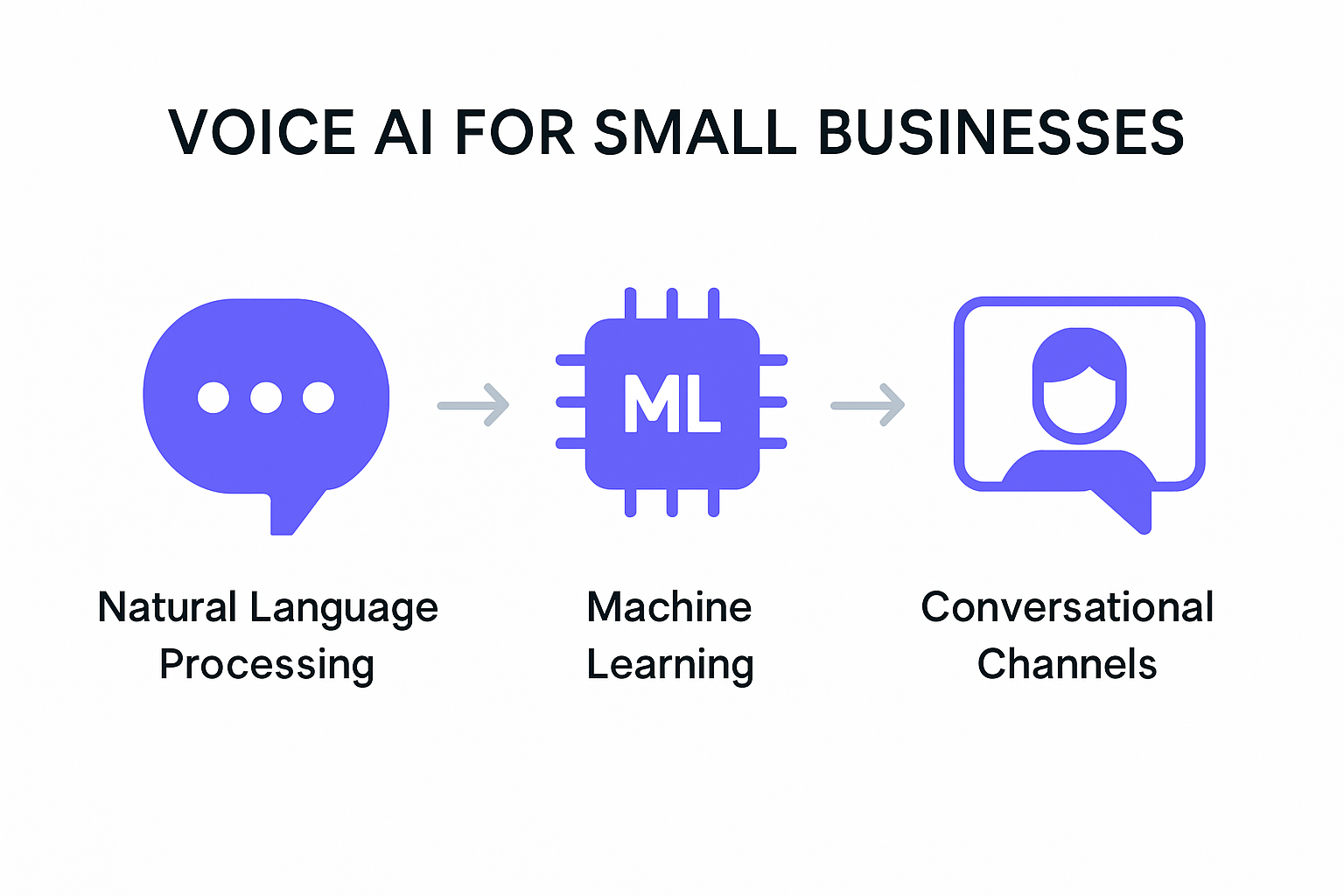
The Core Components of Voice AI Technology
At its core, voice AI integrates several key technological components to deliver intelligent communication solutions. Natural language processing algorithms enable these systems to understand spoken language with remarkable precision. Machine learning models continually enhance the system’s ability to interpret context, recognize speech patterns, and generate relevant responses.
The technology goes beyond simple voice recognition. Modern voice AI solutions can understand nuanced language, detect emotional tones, and adapt communication styles to match specific business needs. Learn more about our adaptive voice AI solutions that can transform how small businesses engage with customers.
Business Impact and Performance Metrics
Small businesses are experiencing significant benefits from voice AI implementation. According to research from Gartner, companies adopting conversational AI can reduce customer service costs by up to 30%. Moreover, a recent study revealed that 97% of small and medium-sized businesses using AI-powered voice agents report a notable revenue boost.
The performance metrics are compelling. Voice AI solutions offer:
- Operational Efficiency: Automated interactions that handle routine customer inquiries
- Cost Reduction: Minimized human resource allocation for repetitive tasks
- 24/7 Availability: Constant customer support without additional staffing
Strategic Deployment Considerations
Successful voice AI integration requires strategic planning. Small businesses must evaluate their specific communication needs, customer interaction patterns, and technological infrastructure. The goal is not just implementing technology but creating a seamless, intelligent communication ecosystem.
Key considerations include understanding your target audience’s communication preferences, ensuring data privacy and security, and selecting voice AI solutions that can scale with your business growth. The right implementation can transform customer experiences, making interactions more personalized, efficient, and responsive.
With approximately 38% of small businesses already utilizing AI technologies, voice AI is rapidly transitioning from a competitive advantage to an operational necessity. Small businesses that embrace these intelligent communication tools position themselves at the forefront of technological innovation and customer engagement.
Key Benefits of Voice AI for Sales and Marketing
Voice AI is rapidly transforming sales and marketing strategies for small businesses, offering unprecedented opportunities to enhance customer engagement, streamline communication, and drive revenue growth. By leveraging advanced artificial intelligence technologies, businesses can create more personalized, efficient, and intelligent customer interactions.
Intelligent Customer Insights and Personalization
Modern voice AI solutions provide small businesses with powerful tools for gathering and analyzing customer data. Explore our advanced lead qualification solutions that can transform your sales approach. According to research from Master of Code, voice assistants can quickly collect strategic consumer insights, enabling businesses to develop highly targeted marketing strategies.
The technology goes beyond simple data collection. Machine learning algorithms analyze conversation patterns, emotional tones, and customer preferences to generate nuanced insights. This enables businesses to craft highly personalized marketing experiences that cater to the unique needs of individual customers. Small businesses can now compete with larger organizations by delivering tailored interactions that feel intimate and responsive.
Operational Efficiency and Cost Reduction

Voice AI dramatically improves operational efficiency for sales and marketing teams. Research from Bruce and Eddy highlights that AI-powered tools enable small businesses to deliver dynamic content in real time, significantly improving conversion rates while optimizing limited marketing budgets.
The performance benefits are substantial:
- Automated Lead Qualification: Instant screening and prioritization of potential customers
- 24/7 Customer Engagement: Continuous interaction without additional staffing costs
- Scalable Communication: Handling multiple customer interactions simultaneously
Enhanced Customer Experience and Conversion
Customer experience remains the critical differentiator in competitive markets. Voice AI enables small businesses to provide sophisticated, responsive communication channels that feel personal and immediate. According to Gartner, businesses implementing conversational AI can reduce customer service costs by up to 30% while simultaneously improving interaction quality.
The technology supports multiple stages of the customer journey. From initial lead generation to post-purchase support, voice AI can seamlessly guide customers, answer questions, provide recommendations, and address concerns. This comprehensive approach transforms traditional sales and marketing models, creating more dynamic and responsive business interactions.
Small businesses embracing voice AI position themselves at the forefront of technological innovation. By integrating these intelligent communication tools, they can create more meaningful connections, optimize resource allocation, and drive sustainable growth in an increasingly digital marketplace.
How to Implement Voice AI in Your Small Business
Implementing voice AI requires a strategic approach that balances technological capabilities with your specific business needs. Small businesses must navigate the implementation process carefully to maximize the potential of these advanced communication tools and ensure a smooth integration into existing operations.
Assessing Your Business Communication Needs
Before implementing voice AI, conduct a comprehensive assessment of your current communication infrastructure. Explore our adaptive voice AI solutions designed to meet diverse business requirements. Research from ColorWhistle reveals that 38% of small businesses are actively utilizing AI technologies, indicating a growing trend toward technological integration.
Key evaluation criteria should include:
- Customer Interaction Patterns: Analyze the frequency and type of customer communications
- Existing Technology Stack: Review current communication tools and potential integration points
- Budget Constraints: Determine realistic investment capabilities
Technical Integration and Implementation Strategy
Successful voice AI deployment involves careful planning and systematic implementation. According to voice AI implementation experts, businesses typically see a positive return on investment within 4-6 months, with potential cost savings ranging from 30-60% compared to traditional customer service models.
Implementation steps include:
- Select a voice AI solution compatible with your existing systems
- Develop comprehensive training data specific to your business context
- Configure integration with the current customer relationship management platforms
- Establish clear performance metrics and monitoring protocols
Training and Continuous Optimization
Voice AI is not a one-time implementation but an evolving technology requiring continuous refinement. Small businesses must invest in ongoing training and optimization to maintain high-quality customer interactions. Research indicates that businesses with proactive optimization strategies see significantly better performance and user satisfaction.
Critical optimization considerations include:
- Regular performance analysis
- Continuous machine learning model updates
- Periodic review of conversational scripts
- Monitoring customer feedback and interaction quality
The goal is to create an intelligent communication system that adapts to your business’s unique requirements. By approaching voice AI implementation as a strategic investment rather than a technical add-on, small businesses can transform their customer engagement capabilities.
With 95% of businesses using AI for customer service reporting improved response quality, voice AI represents more than a technological upgrade. It is a fundamental shift in how small businesses communicate, engage, and grow in an increasingly digital marketplace. Careful planning, strategic implementation, and ongoing optimization will be key to successfully integrating these powerful AI-driven communication tools.
Real-World Success Stories from U.S. Businesses
Real-world implementations of voice AI demonstrate the transformative potential of this technology for small businesses across various industries. These success stories demonstrate how intelligent voice solutions can drive operational efficiency, enhance customer experiences, and create a competitive advantage.
Small Retail and Service Businesses
Discover how businesses are revolutionizing customer interactions through innovative voice AI technologies. According to research from ColorWhistle, 95% of small businesses using AI for customer service report significant improvements in response quality, with over 92% experiencing faster turnaround times.
One compelling example comes from a local home repair service in Phoenix. By implementing voice AI, they reduced customer wait times by 40% and increased appointment booking rates by 35%. The AI system handles initial inquiries, schedules appointments, and provides basic service information, allowing human staff to focus on complex customer needs. This approach not only improved operational efficiency but also enhanced overall customer satisfaction.
Professional Services and Consulting
Business Wire reports on innovative voice AI solutions that are transforming lead conversion and customer engagement. A marketing consulting firm in Chicago demonstrated remarkable results by integrating voice AI into its lead qualification process. The AI-powered system screens and prioritizes potential clients, conducting initial interviews and collecting critical information before passing qualified leads to human consultants.
Key outcomes included:
- 50% Reduction in time spent on initial client screenings
- 35% Increase in qualified lead conversion
- 24/7 Availability for potential client interactions
Healthcare and Service-Based Businesses
Small healthcare providers and service-based businesses are finding unique applications for voice AI. According to the National Community Development Fund, AI tools are helping business owners streamline daily operations through advanced transcription and note-taking capabilities.
A small dental practice in Atlanta implemented voice AI to manage patient scheduling, appointment reminders, and initial intake processes. The system automatically transcribes patient interactions, creates organized notes, and generates follow-up task lists. This implementation resulted in:
- 40% Reduction in administrative workload
- 25% Improvement in patient communication efficiency
- Improved Patient Experience through more responsive communication
These success stories illustrate more than technological implementation. They represent a fundamental shift in how small businesses approach customer interaction, operational efficiency, and growth. Voice AI is not just a tool but a strategic asset that enables businesses to compete more effectively in a rapidly evolving digital marketplace.
The most successful implementations share common characteristics: strategic deployment, continuous optimization, and a focus on enhancing human capabilities rather than replacing them. As voice AI technology continues to advance, small businesses that embrace these intelligent solutions will be best positioned to thrive in an increasingly competitive business environment.
Ready to Transform Your Customer Conversations in 2025?
Small business owners are facing a big challenge as customer expectations for instant, personal interaction keep rising. The article revealed that many are struggling to provide 24/7 service, personalize responses, and reduce routine workloads. If you want to break free from missed calls and slow lead follow-ups while actually growing revenue, our AI voice agents offer exactly what you need. They are tailored for omnichannel engagement, just as discussed in the article, and create smarter, more responsive connections.
Experience the difference with Voice AI agents designed for small business growth. See why 97 percent of businesses using smart voice solutions are already boosting revenue and cutting costs. Take the next step toward a truly modern customer experience. Visit NextLevel.ai to book your tailored demo before your competitors do.
Recommended Articles
- NextLevel – Voice AI Agents Tailored for Your Business
- AI Insights & Resources | NextLevel.AI Blog
- Custom AI Voice Chatbot – Make Your Mobile App Smarter
- AI Chatbot for Website That Talks to Visitors – NextLevel
- AI BDR Agent: Lead Qualification & Engagement – NextLevel.AI
- Artificial Intelligence Call Center Agents | NextLevel
Frequently Asked Questions
What is Voice AI for small businesses?
Voice AI refers to artificial intelligence technology that enables small businesses to engage in conversational interactions with customers using voice recognition and natural language processing. It helps automate communication, streamline customer service, and enhance user experience.
How can Voice AI boost revenue for small businesses?
Studies show that 97% of small businesses using AI-powered voice agents report revenue growth. Voice AI can improve customer interactions, reduce operational costs, and provide 24/7 availability, which can drive more sales and greater customer satisfaction.
What are the key benefits of implementing Voice AI?
The key benefits of Voice AI include enhanced customer insights and personalization, operational efficiency through automation, significant cost reduction by minimizing the need for human resources, and improved overall customer experience, leading to higher conversion rates.
How do I start implementing Voice AI in my small business?
Begin by assessing your current communication needs and customer interaction patterns. Then, select a compatible Voice AI solution, outline an implementation strategy, and invest in training to optimize its performance over time.