Scaling Customer Support with AI: 2025 Guide for US Businesses


US businesses are rapidly turning to AI to overhaul their customer support, and the numbers are wild. Companies in the United States lose approximately $75 billion annually due to poor customer service. You might assume the main reason for this shift is just saving money or cutting headcount.
The twist is that the biggest draw for organizations is scaling customer support with AI to create more profound, more personal customer experiences, turning support teams into high performers who can focus on the most challenging problems. The question isn’t whether to adopt AI anymore. It’s how fast you can keep up with this transformation.
Table of Contents
- Why Us Businesses Are Embracing AI In Support
- Key AI Tools Transforming Customer Service
- Step-By-Step Approach To Scaling Support Teams
- Measuring Success And Roi For Ai Support Solutions
Quick Summary
| Takeaway | Explanation |
|---|---|
| AI is a strategic imperative for US businesses | Scaling customer support with AI, improving efficiency, and maintaining competitiveness in a digital marketplace. |
| Adopt AI tools to transform customer interactions | Implementing intelligent chatbots, advanced call analytics, and predictive support tools can lead to significant improvements in customer experience and operational efficiency. |
| Implement AI in a phased, structured manner | A step-by-step approach involving initial assessments, gradual implementation, and continuous optimization is essential for successful AI integration. |
| Measure success holistically | Track both financial performance metrics and performance indicators, like customer satisfaction and resolution times, to evaluate the ROI of AI support solutions effectively. |
| Focus on continuous learning and adaptability | Organizations must remain agile and regularly update their AI systems to align with evolving customer needs and enhance service delivery. |
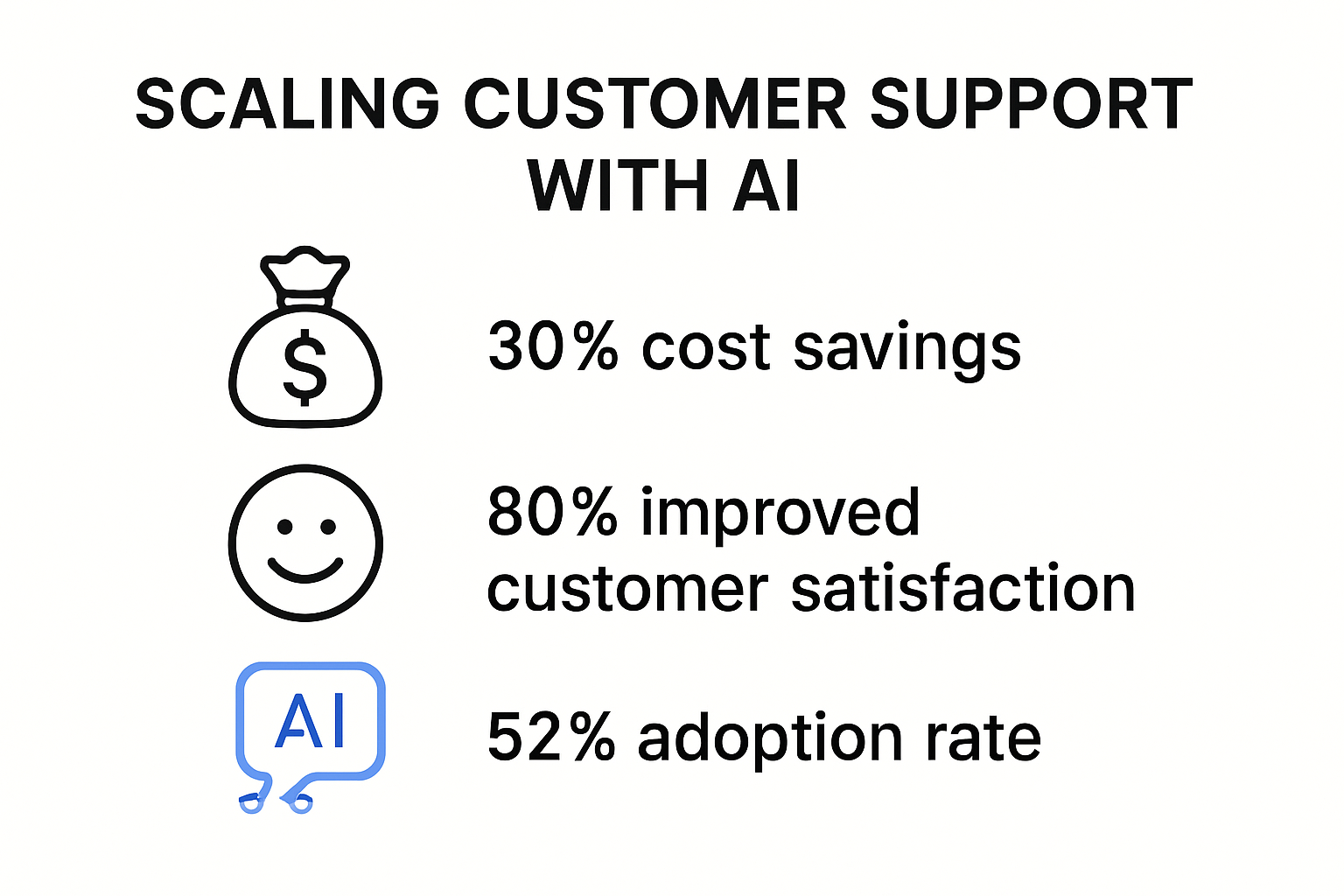
Why US Businesses Are Embracing AI in Support
The customer support landscape is undergoing a radical transformation, driven by artificial intelligence technologies that promise unprecedented efficiency and responsiveness. US businesses are rapidly recognizing the strategic advantages of scaling customer support with AI, motivated by compelling economic and operational imperatives.
The Economic Imperative of AI Support Solutions
Financial considerations are driving the adoption of AI in customer support. According to a comprehensive industry study, 34% of US businesses are already implementing AI in their support operations, with an additional 34.27% seriously evaluating such technologies. This isn’t just a trend, it’s a strategic revolution.
The potential cost savings are extraordinary. Research indicates that by 2025, approximately 80% of companies globally will utilize AI-powered chatbots to streamline customer interactions. For US businesses, this translates into significant operational efficiency. Companies currently lose an estimated $75 billion annually due to suboptimal customer service experiences, a financial hemorrhage that AI technologies can dramatically reduce.
Performance and Customer Experience Enhancement
Beyond pure cost reduction, AI support solutions offer transformative performance improvements. Intelligent voice agents can provide 24/7 support, handle multiple customer inquiries simultaneously, and deliver consistently high-quality interactions. These systems learn and adapt rapidly, gaining an increasing sophistication in understanding nuanced customer needs.
The true competitive advantage emerges from AI’s ability to personalize interactions. Advanced AI systems analyze previous interactions, customer history, and contextual cues to deliver responses that feel genuinely human. This isn’t about replacing human agents but augmenting their capabilities, allowing support teams to focus on complex, high-value interactions that require deep empathy and problem-solving skills.
Strategic Technological Integration
US businesses are not just adopting AI; they are strategically integrating these technologies into their broader customer engagement frameworks. Learn more about our AI call center solutions that demonstrate how intelligent voice agents can transform customer support ecosystems.
The most forward-thinking organizations view AI not as a cost-cutting measure, but as a sophisticated tool for building deeper, more meaningful customer relationships. By leveraging machine learning, natural language processing, and predictive analytics, businesses can create support experiences that are not just efficient but genuinely delightful.
As we move into 2025, the message is clear: it is no longer an optional scaling customer support with AI. It has become a critical strategic imperative for businesses seeking to remain competitive, responsive, and customer-centric in an increasingly digital marketplace.
Key AI Tools Transforming Customer Service
The customer service technology landscape is experiencing a revolutionary transformation, with AI tools rapidly redefining how businesses interact with their customers. These innovative solutions are not just incremental improvements but fundamental shifts in customer support methodology.
Intelligent Chatbots and Virtual Assistants
At the forefront of AI customer service transformation are sophisticated chatbots and virtual assistants. Research from industry experts reveals that these AI-driven tools have already achieved remarkable results. Businesses implementing these technologies report a 27% increase in customer satisfaction and a significant 56-second reduction in average handle time.
These intelligent systems go beyond simple scripted responses. Modern AI chatbots utilize natural language processing and machine learning to comprehend context, recognize emotional nuances, and deliver personalized responses. They can handle multiple inquiries simultaneously, operate 24/7, and continuously learn from each interaction to improve future performance.

Advanced Call Analytics and Sentiment Analysis Tools
Beyond direct customer interaction tools, AI is revolutionizing backend support through sophisticated call analytics and sentiment analysis platforms. According to industry studies, 92% of businesses report that generative AI has a significant impact on enhancing customer service capabilities.
These advanced tools can:
- Analyze conversation tone and emotional context
- Detect potential customer frustration in real time
- Provide real-time coaching and intervention suggestions
- Generate comprehensive performance reports
Sentiment analysis tools are particularly powerful. They can help businesses proactively identify potential service issues, understand customer emotions, and develop more empathetic support strategies.
Predictive Support and Personalization Engines
The most cutting-edge AI tools are now focusing on predictive support and hyper-personalization. By analyzing historical data, customer interactions, and behavioral patterns, these systems can anticipate customer needs before they even arise.
Discover our comprehensive AI resources to learn how predictive support is revolutionizing customer service paradigms. These intelligent systems can:
- Recommend solutions based on past interactions
- Flag potential issues before customers experience them
- Create personalized support experiences
As we move toward 2025, these AI tools are not just technological novelties. They represent a fundamental reimagining of customer support as a proactive, intelligent, and deeply personalized experience. With 73% of shoppers believing AI improves their service interactions, the message is clear: AI is no longer an optional enhancement but a critical competitive advantage.
Step-by-Step Approach to Scaling Support Teams
Scaling customer support with AI requires a strategic, methodical approach that balances technological implementation with human expertise. As businesses seek to transform their support operations, a carefully designed roadmap becomes crucial for successful AI integration.
Initial Assessment and Infrastructure Preparation
Research from leading business consultants indicates that 92% of companies intend to increase their AI investments in the coming years. The first critical step involves conducting a comprehensive audit of the existing support infrastructure. This involves evaluating current customer interaction channels, identifying bottlenecks, and pinpointing specific areas where AI can have the most significant impact.
Businesses should focus on:
- Mapping current support workflows
- Identifying repetitive customer inquiries
- Assessing team skill sets and training needs
- Evaluating existing technological capabilities
Understanding these foundational elements helps organizations create a targeted AI integration strategy that addresses specific operational challenges.
Phased AI Implementation and Team Empowerment
According to industry data, 86% of customer service professionals are already testing or implementing AI systems. A successful scaling customer support with AI approach involves a measured, incremental rollout that prioritizes employee engagement and skill development.
Key implementation stages include:
- Pilot program with limited AI tool deployment
- Comprehensive team training on AI technologies
- Gradual expansion of AI-supported processes
- Continuous performance monitoring and adjustment
The goal is not to replace human agents but to augment their capabilities. By positioning AI as a collaborative tool, organizations can reduce resistance and create a more adaptive support ecosystem.
Continuous Learning and Optimization
Discover advanced AI integration strategies that transform support operations. Successful scaling customer support with AI goes beyond initial implementation. Organizations must establish robust feedback mechanisms, regularly analyze AI performance metrics, and remain agile in their approach.
This means:
- Tracking key performance indicators
- Soliciting team and customer feedback
- Regularly updating AI models
- Maintaining a flexible technological infrastructure
With 75% of U.S. business executives aiming to automate half or more of customer service inquiries within three years, a disciplined, strategic approach becomes paramount. Scaling customer support with AI is not a destination but an ongoing journey of technological and organizational transformation.
Measuring Success and ROI for AI Support Solutions
Measuring the return on investment for AI support solutions requires a comprehensive and nuanced approach that goes beyond traditional financial metrics. As businesses invest in transformative technologies, understanding the true value of AI becomes crucial for strategic decision-making.
Financial Performance Metrics
Research from leading business analysts reveals the remarkable economic benefits of implementing AI. Organizations deploying AI in customer service have witnessed a 68% decrease in the cost per interaction, reducing expenses from $4.60 to just $1.45 per interaction. This dramatic cost reduction represents a tangible financial advantage that extends far beyond initial technological investments.
Key financial metrics to track include:
- Operational cost reduction
- Cost-per-interaction savings
- Revenue growth correlation
- Customer acquisition and retention rates
Interestingly, Deloitte studies indicate that 75% of U.S. companies are strategically investing in AI and automation technologies specifically to drive efficiency and profitability.
Performance and Efficiency Indicators
Beyond pure financial measurements, businesses must evaluate AI support solutions through multifaceted performance indicators. Discover our AI call center solutions to gain a comprehensive understanding of performance tracking.
Critical performance metrics include:
- Average resolution time
- Customer satisfaction scores
- First contact resolution rates
- Agent productivity improvements
- Customer interaction complexity handled
Companies that strategically implement AI achieve remarkable outcomes. Research shows businesses can generate 3.5 times more revenue growth by treating customer service as a value center, even with minimal increased investment.
Long-Term Strategic Value Assessment
Measuring AI support solutions requires a forward-looking perspective that transcends immediate financial returns. The true value emerges through continuous learning, adaptability, and strategic transformation of customer interaction models.
Strategic assessment components include:
- Scalability of AI solutions
- Adaptability to changing customer needs
- Potential for continuous improvement
- Integration with broader technological ecosystems
With AI investments showing an average ROI growing from 41% in the first year to 124% by the third year, the long-term potential becomes increasingly compelling. Organizations must view AI not as a cost center, but as a strategic investment in future customer engagement capabilities.
The most successful businesses will be those who approach AI measurement holistically, combining financial metrics, performance indicators, and strategic potential to create a comprehensive evaluation framework that drives continuous innovation and customer satisfaction.
Unlock Human-Like AI Support for Real Customer Connections
Frustrated with lost revenue and overwhelmed support teams? In the article above, you learned how traditional customer service is costing U.S. businesses billions each year. The pain is real. Customers demand immediate, personalized responses, while your team gets bogged down in repetitive requests. Scaling customer support with AI with generic chatbots leaves gaps in empathy and fails to solve high-value problems. You need AI that empowers your people and delivers memorable customer experiences 24/7.

Make 2025 the year you elevate your support. Discover Voice AI Agents tailored for true omnichannel engagement. These next-generation solutions combine advanced natural language processing with a human-like touch to deliver fast, friendly service—every time. Visit Next Level AI to explore how you can quickly start reducing costs, boosting satisfaction, and future-proofing your support team. Ready to bring effortless, high-performance customer care to your business? Explore our resources and see what your team is missing. Act now and claim your spot at the front of the AI-driven support revolution.
Recommended Articles
- AI Insights & Resources | NextLevel.AI Blog
- Artificial Intelligence Call Center Agents | NextLevel
- NextLevel – Voice AI Agents Tailored for Your Business
- AI BDR Agent: Lead Qualification & Engagement – NextLevel.AI
- AI Corporate Training Agent – Rocket in Training Efficiency
- Voice AI for Mental Health Support – NextLevel.AI Agents
- Sales Outreach Workflows for B2B Teams: Scalable Strategies for 2025
- Automated Lead Generation: A Simple Guide for 2025
Frequently Asked Questions
What are the benefits of using AI in customer support?
Scaling customer support with AI improves efficiency, reduces costs, and creates personalized customer experiences. It allows support teams to focus on complex issues while handling routine inquiries through intelligent chatbots and virtual assistants.
How can US businesses implement AI in customer support?
Businesses should adopt a phased approach to implement AI, which includes an initial assessment of current support systems, pilot programs, team training, and continuous learning to optimize the technology.
What key AI tools are transforming customer support?
Key tools include intelligent chatbots, advanced call analytics, sentiment analysis tools, and predictive support engines that personalize interactions and proactively address customer needs.
How do I measure the ROI of AI in customer support?
ROI can be measured through financial performance metrics, such as cost-per-interaction savings and operational cost reductions, as well as performance indicators like customer satisfaction scores and resolution times.