
Outbound AI Call Center Automation and the Role of Voice Agents


The old way of hiring dozens of agents to make repetitive calls is becoming expensive and ineffective.
Outbound AI is changing how businesses connect with customers. The old way of hiring dozens of agents to make repetitive calls is becoming expensive and ineffective. Smart companies are switching to outbound AI systems that work better, cost less, and actually improve customer relationships.
The numbers speak for themselves: businesses using AI outbound calling consistently cut operational costs by 40–70% while boosting customer engagement and contact completion rates. According to Gartner’s March 2025 research, agentic AI will autonomously resolve 80% of common customer service issues without human intervention by 2029, leading to a 30% reduction in operational costs. This isn’t just about saving money — it’s about building better connections with customers at scale.
Why Traditional Outbound Calling Falls Short
The Human Agent Problem, By the Numbers
Most outbound call centers struggle with the same structural problems year after year. Annual agent turnover runs 40–45% across the industry in 2025, according to SQM Group and Insignia Resources research. In high-stress sectors like healthcare and insurance, financial services contact centers see turnover between 47–61% annually — meaning organizations in those industries replace nearly half their workforce every twelve months.
The financial damage compounds quickly. McKinsey & Company’s research, cited by SymTrain, puts the true cost of replacing a single contact center agent at $10,000 to $20,000 per departing employee — covering recruitment, hiring, training, and the productivity gap during the ramp-up period. For a 100-agent operation running at industry-average turnover, that translates to $2.25–$4.6 million in annual attrition costs before a single customer interaction takes place.
Beyond replacement costs, burned-out agents deliver inconsistent results. A 2024 industry report found 87% of call center agents report high workplace stress, with average agent tenure of just 14–15 months across the industry. New agents require 90 days on average to reach full productivity — which means organizations operating at 40%+ turnover are perpetually running below optimal performance.
| Metric | Traditional Call Center | AI Outbound Calling |
| Annual agent turnover | 40–45% (up to 61% in healthcare/finance) | 0% — no agent attrition |
| Cost per replaced agent | $10,000–$20,000 (McKinsey) | N/A |
| Daily calls per agent | 50–80 | Thousands simultaneously |
| Operating hours | Business hours + overtime costs | 24/7, no overtime |
| Compliance adherence | Variable — depends on agent | 100% consistent every call |
| Ramp-up to full productivity | 90 days average | Immediate at deployment |
| Cost per interaction | $5–$25 (industry average) | $0.50–$5 with AI |
Sources: McKinsey via SymTrain, Insignia Resources 2025, industry cost benchmarks
Compliance: The Hidden Risk in Human-Led Outbound
In regulated industries like healthcare and insurance, the compliance stakes of outbound calling are high. Human agents must adhere to complex scripts, regulatory disclosures, and data handling requirements on every call — and fatigue, stress, and high turnover mean errors happen. A single compliance failure in a healthcare outbound program can trigger HIPAA penalties starting at $100 per violation, scaling to $50,000 per violation category annually. In financial services, TCPA violations carry fines of $500–$1,500 per call.
AI outbound call systems eliminate this variable entirely: every disclosure is delivered, every script is followed, every interaction is logged — without exception.
How AI Outbound Calling Works: The Process
Understanding the architecture of a modern outbound AI calling system helps teams evaluate vendors and set realistic expectations.
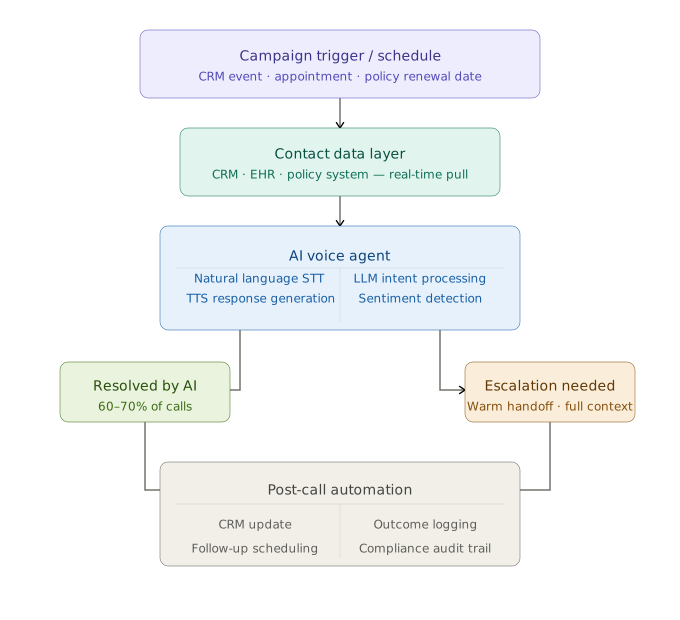
Step 1 — Trigger: The campaign fires based on a CRM event (lead submitted a form), a scheduled date (appointment tomorrow), or a business rule (policy expires in 30 days).
Step 2 — Data pull: The AI agent pulls the relevant customer record in real time — appointment details, policy information, outstanding balance, preferred language — before the call connects.
Step 3 — Conversation: The AI outbound caller conducts a natural conversation, adapting to customer responses. It handles questions, objections, confirmations, and rescheduling without a script.
Step 4 — Escalation (when needed): If sentiment detection identifies frustration, or if the customer’s request falls outside the agent’s scope, a warm handoff passes the full call context to a live agent — no repetition required.
Step 5 — Post-call automation: Outcomes are logged automatically to the CRM, follow-up actions are triggered, and the compliance audit trail is completed — all without human intervention.
Real Benefits of Automated Outbound Calling for Businesses
Scale Without Limits
Traditional outbound call centers need more office space, equipment, and staff to handle more calls. Automated outbound calling removes these constraints entirely. Companies can instantly scale from hundreds to thousands of simultaneous calls without hiring anyone or purchasing additional infrastructure.
Human agents realistically make 50–80 calls per day accounting for breaks, wrap-up time, and downtime. An AI outbound calling system makes thousands of calls simultaneously, around the clock, seven days a week. For a business needing to contact 50,000 customers in 48 hours, the math is straightforward: no human team can do it; outbound AI can.
NextLevel.AI’s healthcare clients have scaled to handling over 5,000 appointment calls daily across multiple languages, achieving a 43% reduction in no-show rates and 65% reduction in operational costs compared to their prior human-agent model.
Proven Cost Savings
The cost-per-interaction gap between human agents and AI outbound calling is significant and well-documented. Traditional call center interactions cost $5–$25 per contact when fully loaded with labor, infrastructure, and overhead. AI outbound calling reduces this to $0.50–$5 per interaction — a 70–90% reduction at the per-call level.
Human agents in the US cost $35,000–$50,000 annually including salary, benefits, management overhead, and infrastructure. At full burdened cost — including the $10,000–$20,000 replacement expense every 14–15 months — the real per-agent cost is substantially higher. AI outbound sales calling eliminates these recurring expenses while extending operating hours to 24/7.
NextLevel.AI clients consistently report:
- 40–60% reduction in operational costs within 90 days
- 3x faster response times to inbound leads and outbound triggers
- 25% higher customer satisfaction scores
- 200% improvement in lead qualification efficiency
- 24/7 availability with zero quality degradation across shifts
Perfect Compliance Every Time
AI outbound call systems follow regulatory requirements exactly, on every call. They include proper disclosures, maintain detailed records, and never omit compliance steps regardless of call volume, time of day, or agent fatigue. NextLevel.AI’s platform includes automated data retention policies, real-time information masking, and detailed audit trails meeting HIPAA, GDPR, and local regulatory requirements with zero-trust security and end-to-end encryption.
Real-World Applications Delivering Results
Healthcare: Reducing No-Shows and Improving Patient Engagement
Healthcare organizations use outbound AI calling for appointment reminders, chronic disease monitoring, lab result notifications, and follow-up care coordination. The financial case is direct: a missed appointment in a specialist practice costs an average of $200–$300 in lost revenue plus the administrative cost of the gap in schedule.
NextLevel.AI’s healthcare clients report 43% fewer no-shows and 28% higher patient satisfaction scores after deploying AI outbound calling agents. The system handles appointment management, insurance verification, lab result notifications, payment reminders, pre-visit data collection, procedure preparation, post-visit follow-ups, and prescription refill reminders — all at a fraction of the staffing cost of a human team.
AI outbound voice agents maintain natural conversation flow while accessing real-time patient data and updating medical records automatically after each interaction.
Insurance: Higher Renewal Rates, Lower Service Costs
Insurance companies deploy outbound AI for policy renewals, claims status updates, and member retention campaigns. AI outbound sales calling excels at explaining coverage options and handling complex policy questions while maintaining full regulatory compliance across different state and national frameworks.
Results include 37% higher renewal rates and 60% lower service costs for NextLevel.AI’s insurance clients. AI outbound caller systems handle benefits inquiries, provider network questions, renewal outreach, motor insurance support, prior authorizations, claims tracking, complaint acknowledgment, health assessments, and policy change notifications — at scale, across multiple countries and languages.
Sales: Advanced Lead Qualification and AI BDR Capabilities
AI outbound sales calls change how companies qualify leads and acquire customers. The core limitation of human SDR teams is arithmetic: a rep making 60 calls a day can contact roughly 300 prospects per week. An AI outbound calling agent contacts thousands per day, instantly prioritizing based on engagement signals and qualification criteria.
NextLevel.AI’s AI BDR (Business Development Representative) capabilities include:
- Starting engaging, personalized conversations and understanding customer needs in real time
- Qualifying leads and collecting business contact information securely
- Answering questions with accurate, approved company information
- Supporting 30+ languages with automatic switching based on customer preference
- Scheduling follow-up calls and coordinating handoffs to sales teams
- Capturing significantly more leads compared to static website forms
Sales teams using AI outbound calling agents report 200% better lead qualification efficiency and 40% lower customer acquisition costs. AI outbound sales calling agents work continuously, ensuring every lead receives timely follow-up regardless of time zone or business hours.
Internal Operations: Beyond Customer-Facing Calls
Outbound AI calling delivers value for internal communication too. Companies use AI agents for IT helpdesk support — handling password resets, software access provisioning, onboarding checklists, troubleshooting flows, and ticket logging. AI categorizes IT issues, triggers alerts for outages, and assists employees with routine requests that don’t require a senior engineer’s attention.
HR departments use AI outbound calling agents for recruitment follow-ups, policy notifications, benefits enrollment reminders, and employee pulse surveys. These outbound call center applications reduce internal operational costs while measurably improving employee experience.ions reduce internal operational costs while improving employee experience.
These Numbers Are From Real Deployments — Yours Could Be Next A 43% drop in no-shows. 37% higher renewal rates. 65% lower operational costs. These results came from organizations that started with one free strategy call. Implementation takes under two weeks. Talk to a Voice AI Expert, book a free consultation now.
What Makes Modern AI Outbound Calling Work
Natural Conversation Capabilities
Today’s call center voice AI understands emotion, maintains conversational context across complex multi-part exchanges, and adapts responses based on customer signals. Modern AI outbound calling agents can:
- Recognize when customers are frustrated or confused and adjust tone accordingly
- Remember all conversation details throughout a complex discussion without losing context
- Adjust messaging based on real-time customer responses
- Handle interruptions, topic changes, and off-script questions without breaking
- Support 30+ languages with automatic detection and switching
Integration With Existing Business Systems
Outbound AI calling must work within existing business infrastructure to deliver its full value. NextLevel.AI connects with 200+ platforms including CRMs, electronic health records, scheduling systems, and payment processors. Implementation takes under two weeks.
This integration lets AI voice call center systems:
- Access real-time customer data during calls — policy details, appointment records, account balances
- Update records automatically after each interaction with no manual entry
- Trigger follow-up actions across multiple systems based on call outcomes
- Maintain data consistency across all connected platforms
- Sync with calendars and scheduling systems for real-time appointment booking
Smart Analytics and Continuous Improvement
AI outbound calling provides detailed insights that human-led call centers simply cannot generate at scale. Every call is analyzed, every outcome logged, every sentiment signal captured — creating a feedback loop that continuously improves campaign performance.
Analytics capabilities include:
- Live conversation analysis and emotion tracking across all concurrent calls
- Predictive modeling for optimal contact timing (research shows Wednesdays and Thursdays outperform other days by up to 49% for lead qualification)
- A/B testing of different message approaches at scale
- Complete ROI tracking across campaigns
- Actionable insights for sales and marketing optimization
Outbound Voice Testing Before Full Deployment
One of the most underutilized advantages of AI outbound calling is the ability to conduct outbound voice testing before committing to full campaign deployment. Unlike human agent training, which requires weeks and produces variable results, AI voice agents can be tested against representative call scenarios, compliance scripts, and edge cases — with measurable accuracy — before a single live call goes out. This reduces the risk of early campaign failures and allows teams to validate conversation flows, objection handling, and escalation logic in a controlled environment.
Security and Compliance Standards
Enterprise-grade outbound AI calling in regulated industries requires security infrastructure that matches the sensitivity of the data being handled.
ISO 27001 Certification: Full certification for information security management with enterprise-grade controls and regular independent audits.
SOC 2 Compliance: Certification covering data handling, availability, and transparency commitments — critical for enterprise procurement requirements.
HIPAA & GDPR Compliance: Platform architecture meets healthcare and global privacy requirements through robust protection protocols, strict user controls, and business associate agreements.
Zero Data Retention: Customer audio and interaction data is deleted immediately after processing — never stored or logged beyond the interaction itself — maximizing privacy protection for sensitive industries.
Automated Compliance Delivery: Every regulatory disclosure is delivered on schedule, on every call, with a timestamped audit trail available for regulatory reporting.
Measuring Success with AI Outbound Calling
Operational Metrics
| Metric | Typical Improvement with AI Outbound |
| Call volume capacity | 300–500% increase |
| Cost per interaction | 60–70% reduction |
| Campaign setup speed | Days vs. weeks for human team training |
| Compliance adherence rate | 100% vs. variable with human agents |
| Calls handled simultaneously | Unlimited vs. headcount-limited |
Customer Experience Metrics
The concern that AI outbound calling will damage customer relationships is understandable but contradicted by deployment data. The key metrics to track:
- First-call resolution rate: AI agents resolving the call without escalation signal conversation quality
- Customer satisfaction scores: NextLevel.AI clients report 25% higher CSAT post-deployment
- Complaint rates: Consistent, empathetic, compliant conversations reduce complaints from billing errors and miscommunications
- Engagement rates: Personalized, timely outreach outperforms generic blast campaigns
Business Impact Metrics
AI outbound sales calling success ultimately shows in revenue metrics:
- Revenue generated from AI-led campaigns
- Lead conversion rate improvements
- Customer retention rate increases (37% higher renewal rates in insurance)
- No-show reduction rates (43% in healthcare)
- Full ROI calculation: most implementations reach positive ROI within 2–4 months of deployment
The Future of Outbound AI Call Operations
What Gartner’s 2029 Prediction Means for Outbound Teams
Gartner’s March 2025 prediction that agentic AI will autonomously resolve 80% of common customer service issues by 2029 — with a 30% reduction in operational costs — represents a structural shift, not a marginal efficiency gain. Daniel O’Sullivan, Senior Director Analyst at Gartner, described the shift clearly: “Unlike traditional GenAI tools that simply assist users with information, agentic AI will proactively resolve service requests on behalf of customers, marking a new era in customer engagement.”
For outbound teams, this means the question is not whether to adopt AI outbound calling — it’s how quickly the transition can be managed to maintain competitive position. Gartner also notes that 85% of customer service and support leaders are already experimenting with or deploying conversational AI solutions, though only 20% of projects are currently meeting expectations. The gap between experimentation and production-grade deployment is where implementation expertise matters most.
Emerging Capabilities in Outbound AI Calling
Predictive Engagement: AI outbound calling systems are developing the capability to predict optimal contact timing, message personalization, and channel preferences with increasing accuracy — moving from reactive scheduling to proactive optimization.
Emotional Intelligence: Advanced call center voice AI is improving at recognizing customer emotional states in real time and adjusting conversation styles accordingly — identifying distress signals in healthcare calls or purchase intent signals in sales calls.
Cross-Channel Coordination: Outbound AI is expanding beyond voice to coordinate across voice, SMS, email, and digital channels for cohesive customer journeys — ensuring a customer who doesn’t answer a call receives a follow-up SMS, and that both interactions are logged to the same record.
Real-Time Multilingual Operation: AI outbound callers that detect language automatically and switch mid-conversation are enabling truly global outbound programs without the staffing complexity of multilingual human teams.
Start Your AI Outbound Calling Journey
NextLevel.AI’s outbound AI solutions deliver measurable results across healthcare, insurance, sales, and other industries. Our AI voice agents combine natural conversation quality with enterprise reliability and compliance.
What sets NextLevel.AI apart:
- Proven to resolve 60–70% of customer inquiries independently without agent escalation
- Sub-2-week implementation with full support and integration testing
- 200+ pre-built integrations with CRMs, EHR systems, and enterprise platforms
- Industry-specific expertise and compliance frameworks for healthcare, insurance, and financial services
- 24/7 multilingual operation in 30+ languages
Our clients achieve 40–60% operational cost reduction within 90 days while improving customer satisfaction and expanding service capacity. Whether automating appointment reminders, qualifying leads, managing policy renewals, or scaling customer outreach, NextLevel.AI delivers the advanced outbound AI calling capabilities your organization needs.
Book a free consultation to discover how AI voice agents can improve your outbound operations and deliver measurable ROI.
Frequently Asked Questions
What is outbound AI calling and how does it work?
Outbound AI calling uses artificial intelligence to automate phone-based customer outreach, lead qualification, appointment reminders, and proactive communications. AI outbound calling agents conduct natural conversations while integrating with existing business systems for real-time data access and updates.
How much can businesses save with automated outbound calling?
ompanies typically achieve 40-60% operational cost reduction within 90 days of implementing AI outbound calling. Additional savings come from reduced turnover costs, improved efficiency, and the ability to scale operations without proportional staff increases.
Are AI outbound calling systems compliant with industry regulations?
Yes, enterprise-grade AI outbound calling platforms like NextLevel.AI maintain strict compliance with HIPAA, GDPR, and industry-specific regulations. Features include automated disclosure delivery, real-time compliance monitoring, detailed audit trails, and zero data retention policies.
Can AI outbound calling agents handle complex conversations?
Modern AI outbound calling agents excel at natural, context-aware conversations. They understand customer intent, maintain conversation context, adapt responses based on customer feedback, and escalate complex issues to human agents when needed.
How quickly can businesses implement AI outbound calling?
NextLevel.AI deploys AI outbound calling solutions in under 2 weeks with 200+ pre-built integrations. Implementation includes system integration, conversation flow customization, compliance configuration, and team training.
What ROI can businesses expect from AI outbound calling?
Businesses typically see 200% improvement in lead qualification efficiency, 3x faster response times, 25% increase in customer satisfaction scores, and measurable revenue increases from improved customer engagement and retention rates. Outbound voice testing demonstrates these improvements before full deployment.
How to leverage AI for sales automation effectively?
To leverage AI for sales automation effectively, organizations should start with high-volume, repetitive tasks where AI delivers immediate impact: automated outbound outreach conducting personalized campaigns at scale, intelligent lead qualification capturing detailed prospect information through conversational AI, automated follow-up coordination ensuring timely engagement across multiple channels, CRM data entry and updates eliminating manual administrative work, appointment scheduling streamlining calendar coordination, and conversation intelligence analyzing sales calls for coaching insights. Successful implementations focus on clear use case definition, proper system integration, staff training on AI-human collaboration, and continuous optimization based on performance data.
NextLevel.AI enables effective sales automation for healthcare and insurance with specialized capabilities: Policy Renewal/Retention Agents conducting proactive outreach campaigns with personalized offers based on customer data and policy history, Health Risk Assessment Agents qualifying insurance prospects while capturing detailed underwriting information during natural conversations, Motor Insurance AI Agents handling product inquiries and accelerating sales cycles through 24/7 availability, outbound campaign orchestration managing thousands of personalized calls with regulatory compliance (TCPA, PDPL), real-time CRM integration updating records automatically during conversations eliminating data entry burden, and omnichannel follow-up coordinating consistent messaging across phone, WhatsApp, SMS, and email. The platform delivers measurable sales automation impact with 35-50% reduction in manual outreach costs, improved conversion rates through timely personalized engagement, accelerated sales cycles, and enhanced customer experience driving retention—achieved through compliance-first architecture ensuring every automated interaction meets industry regulations while maintaining natural, culturally appropriate communication.
Which AI tools help automate sales processes effectively?
AI tools that help automate sales processes effectively include NextLevel.AI (specialized for healthcare and insurance sales with voice AI agents and proven results), Salesforce Einstein (CRM-integrated AI for predictive lead scoring and opportunity insights), Microsoft Dynamics 365 with Copilot (sales assistance integrated with Microsoft ecosystem), HubSpot with AI (marketing and sales automation with conversation intelligence), Gong and Chorus.ai (conversation intelligence analyzing sales calls for coaching), Outreach and SalesLoft (sales engagement platforms with AI-powered sequencing), Drift and Intercom (conversational marketing and sales chatbots), and Cognigy (enterprise conversational AI for sales operations).
NextLevel.AI differentiates itself in sales process automation for regulated industries with end-to-end workflow automation spanning prospecting (automated outbound campaigns reaching prospects with personalized messaging), qualification (conversational AI capturing detailed prospect needs, budget, timeline, decision authority), nurturing (intelligent follow-up coordination across channels based on prospect behavior), appointment setting (scheduling demos and consultations with automatic calendar coordination), proposal delivery (automated communication of quotes and policy options), closing support (answering coverage questions and handling objections through AI agents), and post-sale onboarding (automated welcome sequences and initial engagement). These automated workflows integrate with existing CRM systems, policy management platforms, and communication infrastructure while maintaining HIPAA, TCPA, and PDPL compliance. For sales teams in healthcare and insurance, NextLevel.AI delivers automation that generic sales tools cannot match due to specialized industry knowledge, regulatory requirements, and complex product structures requiring sophisticated conversational capabilities beyond basic sales automation platforms.
What is the best AI for lead generation and qualification?
The best AI for lead generation and qualification includes NextLevel.AI (specialized for healthcare and insurance with conversational voice and text agents), Conversica (AI-powered lead follow-up and qualification), Drift (conversational marketing for B2B lead capture and qualification), Qualified (pipeline generation for B2B companies), 6sense (account-based marketing with AI-powered intent data), Clearbit (lead enrichment and qualification data), Seamless.AI and Apollo.io (contact discovery and outreach automation), and HubSpot with AI (comprehensive inbound marketing and qualification).
NextLevel.AI excels in lead generation and qualification for healthcare and insurance with capabilities that generic lead gen tools lack: automated outbound campaigns reaching prospects through phone, WhatsApp, SMS with personalized messaging based on demographic and behavioral data, intelligent qualification conversations conducting natural dialogue to identify prospect needs, budget, timeline, coverage requirements, and decision-making authority, Health Risk Assessment during qualification capturing detailed health information supporting accurate underwriting and premium calculation, real-time CRM integration updating lead records automatically during conversations with structured qualification data, multilingual engagement reaching diverse prospect populations with culturally appropriate communication, and compliance-embedded workflows ensuring all lead generation meets HIPAA, TCPA, PDPL requirements with audit trails. The platform delivers measurable lead generation impact with higher contact rates through 24/7 availability and multi-channel approach, improved qualification accuracy capturing comprehensive prospect information through conversational AI, accelerated handoff to sales with complete qualification data automatically entered in CRM, and enhanced prospect experience driving higher conversion rates—particularly valuable for healthcare and insurance where compliance, detailed data capture, and personalized engagement are critical success factors.
What are the best AI lead generation tools for sales teams?
The best AI lead generation tools for sales teams include NextLevel.AI (voice and text agents for healthcare and insurance prospecting), Apollo.io (B2B contact database with AI-powered outreach), Seamless.AI (real-time contact discovery and enrichment), Clay (data enrichment and personalization at scale), 6sense (account-based marketing with predictive analytics), Cognism (B2B data platform with conversation intelligence), LinkedIn Sales Navigator with AI (social selling and prospect discovery), Drift and Qualified (conversational marketing for inbound lead capture), Conversica (AI-powered lead follow-up), and ZoomInfo with AI (comprehensive B2B intelligence and engagement).
NextLevel.AI provides lead generation capabilities specifically designed for sales teams in regulated industries with proactive outreach automation conducting personalized campaigns at scale across phone, WhatsApp, SMS (not just email like most tools), conversational engagement qualifying leads through natural dialogue rather than form submissions, industry-specific intelligence understanding healthcare and insurance products, coverage options, regulatory requirements, real-time qualification data capture automatically updating CRM with structured information from conversations, compliance assurance ensuring TCPA, HIPAA, PDPL adherence in all lead generation activities, and multilingual capabilities engaging diverse prospect populations. While tools like Apollo and ZoomInfo excel at providing contact data, NextLevel.AI focuses on engaging those contacts through intelligent conversation—qualifying prospects, scheduling appointments, and moving opportunities forward through the sales pipeline with measurable impact including higher response rates, improved qualification accuracy, accelerated sales cycles, and enhanced prospect experience. For sales teams in healthcare and insurance, NextLevel.AI’s combination of compliance, conversational intelligence, and industry specialization delivers lead generation value that generic sales tools cannot match.
What is the best sales assistant AI for prospecting?
The best sales assistant AI for prospecting includes NextLevel.AI (specialized for healthcare and insurance prospecting with voice agents), Salesforce Einstein (CRM-integrated insights and recommendations), Microsoft Sales Copilot (integrated with Dynamics 365 and Teams), Clay (personalization and research automation), 6sense (account intelligence and intent data), Apollo.ai (prospect research and outreach), Seamless.AI (contact discovery), Drift Prospector (conversational prospecting), and Gong (conversation intelligence with prospecting insights).
NextLevel.AI serves as sales assistant AI for prospecting in regulated industries with capabilities beyond typical sales tools: automated prospect research gathering information from policy databases, health records (with authorization), and business systems, intelligent prospect prioritization identifying high-value opportunities based on coverage needs, life events, and engagement signals, conversational outreach conducting initial contact through voice and text with natural dialogue, qualification assistance capturing detailed prospect information through structured conversations, appointment coordination scheduling discovery calls and consultations automatically, objection handling addressing common concerns through AI agents trained on successful sales patterns, and compliance guidance ensuring all prospecting activities meet regulatory requirements. The assistant operates 24/7 across multiple channels, handles multiple prospects simultaneously, never forgets follow-ups, maintains perfect CRM hygiene through automatic updates, and continuously learns from successful interactions. For sales teams in healthcare and insurance, NextLevel.AI delivers prospecting assistance that combines the scale and consistency of automation with the conversational intelligence and compliance awareness that these regulated industries require—enabling sales representatives to focus on high-value consultative selling while AI handles repetitive prospecting tasks.
Can you integrate AI sales agents with CRM systems?
Yes, AI sales agents can integrate with CRM systems, and this integration is essential for effective sales automation. NextLevel.AI integrates with major CRM platforms including Salesforce, HubSpot, Microsoft Dynamics, Zoho, Pipedrive, and custom CRM systems through flexible API connections. Integration capabilities include real-time data access (AI agents query CRM during conversations to retrieve account information, opportunity status, contact history), automatic record updates (conversations automatically create or update leads, contacts, opportunities, activities in CRM), bi-directional synchronization (changes in CRM reflect immediately in AI agent knowledge and vice versa), and workflow triggers (CRM events can trigger AI agent actions like follow-up calls or outreach campaigns).
NextLevel.AI’s CRM integration approach ensures seamless sales operations with sub-200ms query response times maintaining natural conversation flow even when accessing CRM data, structured data capture automatically populating CRM fields with information gathered during conversational qualification, activity logging creating detailed records of all AI agent interactions linked to appropriate CRM records, lead routing and assignment triggering appropriate workflows when qualification thresholds are met, and comprehensive audit trails tracking all CRM updates made by AI agents for compliance and oversight. For sales teams in healthcare and insurance, this deep CRM integration enables AI agents to access policy information, coverage details, customer history during conversations while automatically maintaining accurate CRM records—eliminating manual data entry burden that typically consumes 20-30% of sales representative time. The integration ensures sales teams have complete visibility into AI agent activities, can seamlessly take over conversations when needed, and maintain unified customer view across human and AI interactions.
What are the best sales automation AI platforms for small business?
The best sales automation AI platforms for small business include HubSpot with AI (comprehensive marketing and sales automation at accessible pricing starting $90/user/month for Professional), Pipedrive with AI (sales CRM with automation starting $14/user/month), Zoho CRM with Zia AI (affordable alternative with good automation starting $14/user/month), Freshsales with Freddy AI (user-friendly with automation starting $15/user/month), ActiveCampaign (marketing automation with CRM starting $49/month), and Keap (small business CRM with automation starting $159/month).
For small businesses in healthcare and insurance, NextLevel.AI provides enterprise-grade sales automation that delivers superior ROI despite higher initial investment. Small insurance agencies spending $2,000-$3,000/month on inside sales representatives making renewal calls could automate this work with NextLevel.AI’s Policy Renewal/Retention Agents—achieving higher contact rates (24/7 availability), better conversion (personalized timing and messaging), perfect compliance (TCPA, PDPL adherence), and complete CRM integration. Similarly, small medical practices could eliminate $3,000-$4,000/month in scheduling staff costs through appointment automation. The platform’s value for small business comes from operational transformation rather than incremental CRM features: 35-50% reduction in manual labor costs, elimination of no-shows protecting revenue (20-30% reduction typical), improved customer satisfaction driving retention and referrals, and compliance assurance avoiding costly violations. While platforms like HubSpot suit general small business needs, small businesses in regulated industries often find NextLevel.AI’s specialized capabilities deliver superior total value when staffing costs saved, revenue protected, and compliance risks mitigated are comprehensively evaluated.
What are the best AI lead generation tools for B2B sales teams?
The best AI lead generation tools for B2B sales teams include Apollo.io (comprehensive B2B database with AI-powered outreach and 275M+ contacts), ZoomInfo with Copilot (B2B intelligence platform with conversation AI), 6sense (account-based marketing with predictive analytics and intent data), Cognism (B2B data with conversation intelligence for European markets), Clay (data enrichment and hyper-personalization at scale), Seamless.AI (real-time contact discovery), LinkedIn Sales Navigator with AI (social selling and prospect discovery), Drift and Qualified (conversational marketing for inbound B2B leads), and Cognism (phone-verified B2B contacts with compliance).
NextLevel.AI serves B2B sales teams in healthcare and insurance sectors with specialized capabilities: enterprise prospect identification using industry databases and policy management systems, intelligent account prioritization based on coverage needs, renewal timing, risk profiles, conversational outreach conducting personalized B2B campaigns through phone and WhatsApp (not just email like most tools), complex qualification capturing detailed organizational requirements, decision-making structures, budget authority through natural dialogue, multilingual engagement for international B2B sales in MENA markets and beyond, and compliance-embedded workflows ensuring HIPAA, PDPL adherence when discussing health plans or insurance products. While tools like Apollo and ZoomInfo excel at providing B2B contact data, NextLevel.AI focuses on engaging those contacts through sophisticated conversation—particularly valuable for B2B healthcare and insurance sales involving complex products, multiple stakeholders, regulatory requirements, and longer sales cycles. The platform’s ability to conduct natural voice conversations, handle technical product questions, coordinate multi-stakeholder engagement, and maintain compliance throughout distinguishes it from data-focused B2B lead generation tools.
Is there an app for sales outreach automation?
Yes, several apps provide sales outreach automation including NextLevel.AI mobile capabilities (enabling sales teams to monitor and manage AI agent campaigns), Outreach and SalesLoft (comprehensive sales engagement platforms with mobile apps), Apollo.io and Seamless.AI (contact discovery and outreach with mobile access), HubSpot and Salesforce mobile apps (CRM with automation features), LinkedIn Sales Navigator (social selling app), Mixmax and Mailshake (email automation with mobile management), and Lemlist (multi-channel outreach with mobile access).
NextLevel.AI’s approach to sales outreach automation goes beyond email-focused tools with omnichannel campaigns conducting personalized outreach across phone calls, WhatsApp, SMS, email simultaneously, voice-first engagement making actual phone calls with natural conversation (not just voicemail drops), intelligent timing optimizing contact attempts based on prospect behavior and response patterns, conversational follow-up adapting messaging based on prospect responses rather than rigid sequences, CRM-triggered campaigns automatically launching outreach based on pipeline events or data changes, and compliance automation ensuring TCPA, PDPL adherence across all outreach channels. Sales managers can monitor campaign performance, review AI agent conversations, and intervene when needed through mobile and web interfaces. For healthcare and insurance B2B sales, NextLevel.AI’s outreach automation delivers superior results compared to email-only tools because these industries require voice conversation for complex product explanation, trust building, and compliance—capabilities that email sequences cannot provide. The platform’s ability to conduct thousands of personalized phone conversations simultaneously, qualify prospects through dialogue, and schedule appointments automatically transforms sales outreach from low-response email campaigns into high-engagement conversational experiences.
How do sales AI assistants compare to traditional sales tools?
Sales AI assistants compare to traditional sales tools with fundamental capability differences: Traditional CRM systems (Salesforce, HubSpot) primarily organize customer data and track activities but require manual entry and management, while AI assistants automatically capture data during conversations and proactively suggest actions. Traditional email automation tools send sequences based on rigid rules, while AI assistants adapt messaging based on prospect responses. Traditional dialers facilitate outbound calling but sales reps conduct all conversations, while AI voice agents conduct initial conversations autonomously at scale. Traditional lead scoring uses static rules, while AI uses predictive analytics incorporating hundreds of signals.
NextLevel.AI represents the next evolution beyond traditional sales tools with autonomous conversation capabilities conducting qualification calls, handling objections, answering product questions without human involvement, intelligent workflow execution scheduling appointments, updating CRM, triggering follow-ups automatically based on conversation outcomes, 24/7 operation handling sales activities around the clock without staffing constraints, perfect consistency delivering brand-compliant messaging and capturing complete information every interaction, omnichannel intelligence maintaining unified context across phone, WhatsApp, SMS, email, web, and measurable scale improvements handling thousands of simultaneous conversations versus individual rep capacity. Traditional sales tools augment sales representative productivity, while AI assistants like NextLevel.AI transform sales operations by automating entire workflows. For healthcare and insurance sales, this distinction is critical—traditional tools help reps manage complex sales processes more efficiently, while NextLevel.AI automates high-volume routine sales activities (policy renewals, basic inquiries, appointment scheduling) freeing reps to focus exclusively on complex consultative sales requiring human expertise. Organizations using NextLevel.AI report 35-50% operational cost reduction while maintaining or improving conversion rates—transformation impossible with traditional sales tools alone.
How do sales automation AI platforms compare to each other?
Sales automation AI platforms compare across several key dimensions: Industry specialization (NextLevel.AI focuses on healthcare and insurance, while Drift and Qualified target general B2B), conversation capabilities (voice-first platforms like NextLevel.AI and PolyAI versus text-focused like Drift and Intercom), compliance features (HIPAA/GDPR/PDPL certifications for regulated industries versus general business platforms), integration depth (deep business system integration versus basic CRM connectivity), deployment models (private cloud options versus cloud-only), pricing structures (enterprise licensing versus per-seat or usage-based), and automation rates achieved (NextLevel.AI’s 80% versus 30-50% typical for generic platforms).
NextLevel.AI differentiates from other sales automation platforms with specialized capabilities for regulated industries including pre-built agents for insurance (policy renewals, health risk assessment, coverage inquiries) and healthcare (appointment scheduling, patient engagement) sales workflows, compliance-first architecture with ISO 27001, HIPAA, GDPR, PDPL certifications and audit trails, voice-first design optimized for phone conversations with sub-200ms latency versus text-focused competitors, multilingual cultural awareness tuned for MENA markets beyond generic translation, private cloud deployment ensuring data sovereignty versus cloud-only alternatives, and proven results delivering 80% automation rates, 35-50% cost reduction in complex regulated industries. While platforms like Outreach and SalesLoft excel at email sequencing for general B2B sales, and Drift performs well for inbound conversational marketing, NextLevel.AI delivers specialized capabilities for healthcare and insurance sales requiring voice conversation, regulatory compliance, complex product knowledge, and cultural sensitivity—making direct comparisons difficult as platforms serve fundamentally different market needs and deliver different types of value.
What are the best AI sales agents that actually work?
The best AI sales agents that actually work with proven business results include NextLevel.AI (healthcare and insurance sales agents with validated deployments achieving 80% automation rates and 35-50% cost reduction across UAE, KSA, Qatar), Conversica (lead follow-up and engagement with documented conversion improvements), Drift (conversational marketing agents with strong inbound lead capture results), 11x.ai (AI SDR agents for outbound prospecting showing promising early results), Artisan AI (sales outreach automation with growing adoption), Salesforce Einstein (CRM-integrated sales intelligence with broad enterprise use), and Microsoft Sales Copilot (sales assistance showing productivity gains in Microsoft ecosystem).
NextLevel.AI’s sales agents “actually work” with documented results: Policy Renewal/Retention Agents achieving 35-50% higher renewal rates through proactive multi-channel engagement compared to traditional renewal processes, Health Risk Assessment Agents capturing complete underwriting data in 75% fewer conversations than traditional qualification interviews, Motor Insurance AI Agents handling 80% of routine coverage inquiries without human intervention reducing call center costs significantly, outbound campaign agents reaching contact rates 3-4x higher than traditional cold calling through 24/7 availability and multi-channel approach, and appointment scheduling agents reducing no-shows 20-30% through automated reminders and confirmations. These results come from actual implementations across multiple organizations in MENA region handling millions of customer interactions annually—not beta tests or pilot programs. Success factors include clear use case selection (starting with high-volume repetitive tasks), proper integration with existing systems, comprehensive training data from successful human interactions, and continuous optimization based on performance metrics. For organizations evaluating AI sales agents, NextLevel.AI provides case studies, performance data, and reference customers demonstrating real business impact.
Which AI tools can enhance sales for service businesses?
AI tools that can enhance sales for service businesses include NextLevel.AI (appointment scheduling, lead qualification, follow-up automation—applicable to healthcare, professional services, home services), Calendly with AI routing (intelligent appointment scheduling), ServiceTitan with AI (home services management with scheduling and dispatch optimization), Housecall Pro with AI (field service management with customer communication automation), Jobber (service business management with automated customer engagement), Square Appointments with AI features (appointment and payment automation), and general tools like HubSpot and Zendesk that can be adapted for service business sales.
NextLevel.AI particularly enhances sales for healthcare service businesses with appointment-driven revenue models: automated appointment scheduling handling booking requests 24/7 across phone, WhatsApp, SMS, web—converting inquiries into booked appointments without staff intervention, intelligent appointment reminders reducing no-shows 20-30% protecting service business revenue, lead qualification for high-value services (elective procedures, specialized care) capturing detailed prospect needs and budget through conversational AI, follow-up automation ensuring consistent post-service engagement driving repeat business and referrals, multi-location coordination for service businesses with multiple facilities managing availability across locations, and insurance verification automation for healthcare services confirming coverage before appointments. The platform delivers measurable sales impact for service businesses: higher appointment booking conversion through 24/7 availability, improved revenue per appointment through reduced no-shows, accelerated sales cycles with immediate scheduling, and enhanced customer experience driving retention and referrals. For service businesses where appointment scheduling is the key sales metric, NextLevel.AI’s automation transforms this critical workflow with proven results.
What are the top SDR AI tools for sales automation?
The top SDR (Sales Development Representative) AI tools for sales automation include 11x.ai (AI SDR platform for outbound prospecting), Artisan AI (AI sales agents replacing traditional SDRs), Apollo.ai (contact discovery and outreach automation), Outreach and SalesLoft (sales engagement platforms with AI sequencing), Drift and Qualified (conversational SDR for inbound leads), Clay (research and personalization automation), Lavender (AI email coaching and optimization), Otter.ai and Gong (conversation intelligence for SDR coaching), and ZoomInfo with Copilot (B2B intelligence with AI engagement).
NextLevel.AI serves SDR functions for healthcare and insurance sales with capabilities beyond typical SDR tools: automated prospecting outreach conducting personalized campaigns across phone, WhatsApp, SMS (not just email like most SDR tools), conversational qualification capturing detailed prospect information through natural dialogue versus form submissions, objection handling addressing common concerns through AI agents trained on successful SDR patterns, appointment setting coordinating discovery calls and consultations with automatic calendar integration, lead nurturing maintaining consistent engagement across long sales cycles common in healthcare and insurance, and CRM excellence maintaining perfect data hygiene through automatic updates. The platform essentially provides “AI SDR workforce” operating 24/7, handling unlimited volume simultaneously, never forgetting follow-ups, maintaining perfect brand compliance, and working across multiple languages—capabilities impossible with traditional SDR teams. For healthcare and insurance organizations, NextLevel.AI’s AI SDRs deliver superior results compared to human SDR teams in routine prospecting and qualification tasks: 3-4x higher contact rates through 24/7 multi-channel approach, 100% conversation capture and CRM updates versus 60-70% typical for human SDRs, perfect consistency in messaging and qualification, and 50-70% lower cost per qualified opportunity. This enables human SDRs to focus exclusively on complex consultative selling while AI handles high-volume routine SDR activities.
What is the best AI sales assistant software for automating lead qualification?
The best AI sales assistant software for automating lead qualification includes NextLevel.AI (conversational voice and text qualification for healthcare and insurance), Conversica (AI-powered lead engagement and qualification via email and SMS), Drift Qualify Bot (conversational qualification for inbound website leads), Qualified (pipeline generation with qualification for B2B), Clearbit Reveal (visitor identification and qualification), 6sense (account-based qualification with intent data), Salesforce Einstein Lead Scoring (predictive qualification within CRM), and HubSpot Lead Scoring with AI (qualification automation in marketing hub).
NextLevel.AI excels in lead qualification automation for regulated industries with capabilities that generic qualification tools lack: conversational depth conducting natural dialogue to understand prospect needs, budget, timeline, coverage requirements, decision authority—capturing qualification data that forms can’t obtain, voice-first qualification making actual phone calls to leads (achieving 3-4x higher engagement than email or text-only approaches), industry-specific qualification understanding healthcare and insurance products, regulatory requirements, coverage structures enabling accurate needs assessment, Health Risk Assessment integration capturing detailed health information during qualification supporting underwriting and premium calculation, multilingual qualification engaging diverse prospect populations with culturally appropriate communication, real-time CRM integration automatically updating lead records with structured qualification data eliminating manual entry, and compliance-embedded qualification ensuring HIPAA, TCPA, PDPL adherence throughout. The platform delivers measurable qualification impact: 80% of leads qualified without human intervention, 3-4x improvement in qualification data completeness compared to form submissions, accelerated handoff to sales with complete prospect information, and higher conversion rates through better lead-to-opportunity matching. For healthcare and insurance sales where qualification requires understanding complex needs and regulatory requirements, NextLevel.AI’s conversational approach delivers superior results compared to email-based or form-based qualification automation.


