
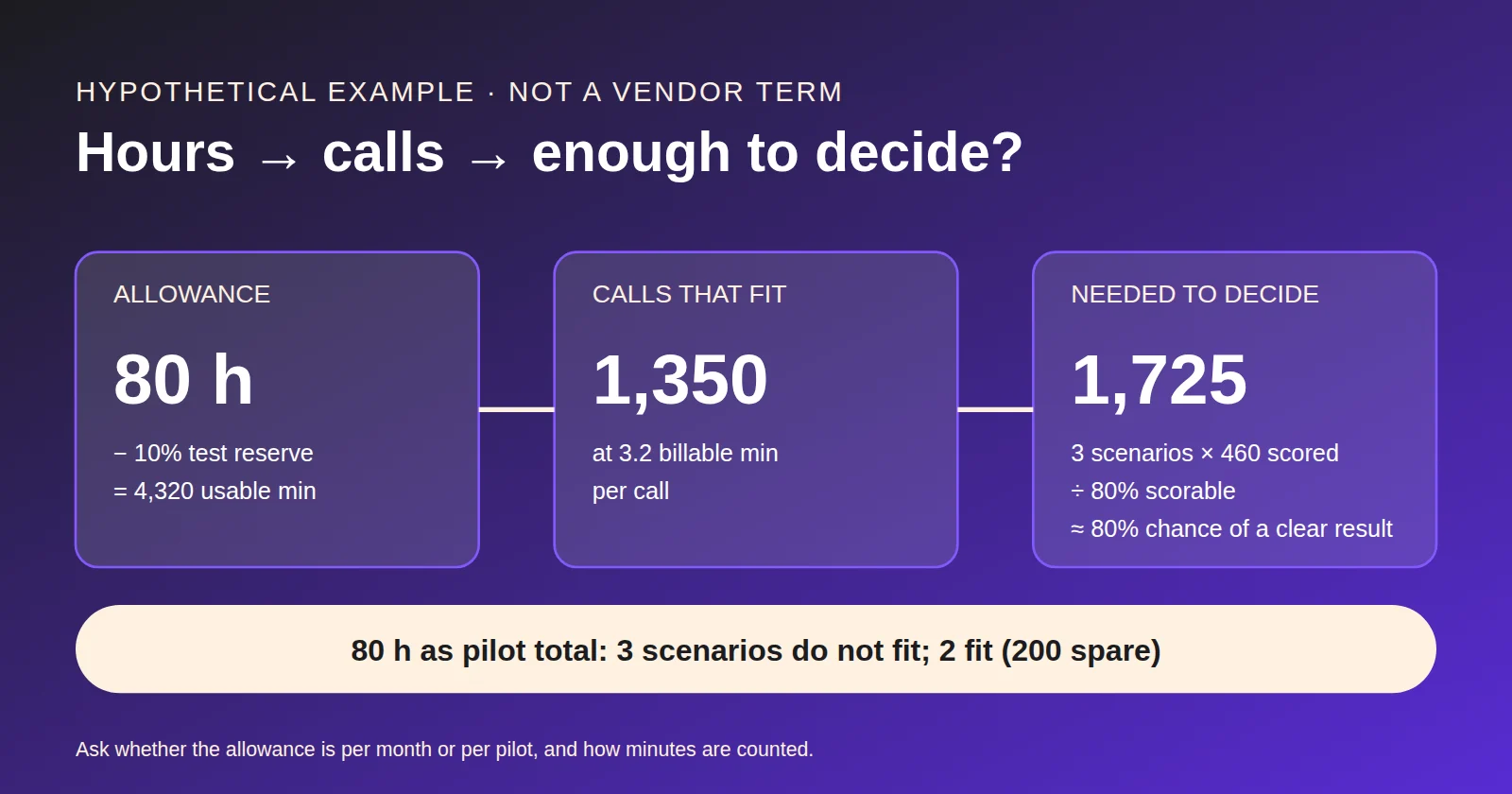
Your voice AI pilot comes with a fixed allowance of voice hours. The sponsor wants to know two things before routing a single call: how many calls will that allowance cover, and will that be enough to decide whether to go to production?
The answer is a short calculation, but three of its inputs are easy to get wrong: what the vendor counts as a billable minute, whether the allowance is per month or for the whole pilot, and how many scored calls each scenario needs before the result means anything. This guide walks through each with a worked example on clearly labelled assumptions, then shows what to do when the allowance is too small.
It is written for the pilot owner in a contact centre who has already chosen the scenarios and acceptance criteria. Choosing those belongs to the voice AI pilot guide. This article sizes the traffic.
Every number below is hypothetical. None is a NextLevel term, a typical value or a benchmark. A blank worksheet with every step, and what to do when an input is blank, zero or invalid, is available to download (CSV).
Convert the allowance into calls
The basic conversion is:
calls that fit = allowance hours × 60 × (1 − reserve share) ÷ billable minutes per call
The reserve is the part of the allowance you keep back for test calls, regression checks after a change, and staff training calls. Those calls may use the same allowance as customer calls, depending on the contract, and they are easy to forget.
Worked example (hypothetical):
- Allowance: 80 voice hours.
- Reserve for testing and regression: 10%.
- Usable minutes: 80 × 60 × 0.9 = 4,320.
- Billable minutes per call: 3.2 (see the next section for where this comes from).
- Calls that fit: 4,320 ÷ 3.2 = 1,350.
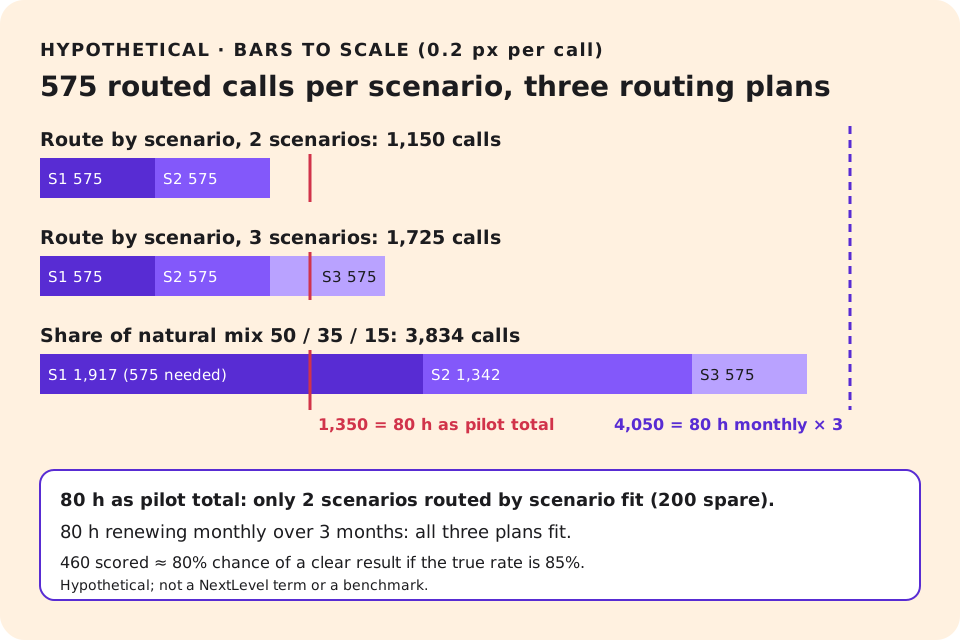
Now ask the question that changes the answer by a factor of three: is the allowance per month, or for the whole pilot? If the 80 hours renew monthly over a three-month pilot, the same arithmetic gives 4,050 calls across the pilot. If 80 hours is the total, it is 1,350. Get the answer in writing from the vendor's current pricing page or contract, on the day you plan.
Which minutes count
Billable minutes per call are not the same as average call length on your contact-centre dashboard. Ask the vendor for its definition, covering four points:
- Which leg counts. Often the time the AI is on the call, but ask. Ask also whether time in your queue before the AI answers, or after the AI transfers, is included.
- Rounding. Per second, or rounded up per call to the next minute? In the example below, rounding alone adds a fifth to usage.
- Transfers. In a warm transfer, the AI may stay on the line while it introduces the caller to a person. Ask whether that time counts.
- Test traffic. Whether calls from your own test numbers draw on the allowance.
Here is how the definition moves the example. Ten synthetic calls have AI-leg durations of 95, 130, 150, 70, 210, 145, 160, 125, 300 and 115 seconds. Two of them (the 210- and 300-second calls) end in a warm transfer where the AI stays on for 45 more seconds.
| Definition | Minutes per call | Calls that fit in 4,320 usable minutes |
|---|---|---|
| A. Per second, AI leg only | 2.5 | 1,728 |
| B. Rounded up per call, AI leg only | 3.0 | 1,440 |
| C. Rounded up per call, including AI time during warm transfer | 3.2 | 1,350 |
Same calls, same allowance: the definition alone moves capacity by 378 calls, or 22% of the most generous figure. Use your own call recordings or your platform's duration export to compute the figure for your scenarios, under the vendor's definition. Do not use an industry average.
How many calls you need per scenario to decide
An allowance is enough only if it produces enough scored calls in each scenario to support the decision you wrote into the acceptance criteria. Two kinds of criteria need two kinds of sample.
A rate with a threshold. Suppose a scenario passes if the verified resolution rate is at least 80%, and you expect the agent to achieve around 85%. Write the pass rule as: the lower end of the 95% interval must be above 80%. The table uses the Wilson interval for a proportion, the same method the contact-centre KPIs guide uses for error rates (NIST/SEMATECH handbook, 7.2.4.1).
The table answers two questions: what an observed 85% would show, and how often a pilot of that size passes when the agent truly performs at 85%. The second protects the decision.
| Scored calls | If 85% is observed: 95% interval (Wilson) | Fewest passes that clear 80% | Chance of clearing if the true rate is 85% |
|---|---|---|---|
| 100 | 76.7% – 90.7% | 88 | 25% |
| 200 | 79.4% – 89.3% | 172 | 39% |
| 300 | 80.5% – 88.6% | 254 | 60% |
| 400 | 81.2% – 88.2% | 336 | 74% |
| 460 | 81.4% – 88.0% | 385 | 80% |
| 600 | 81.9% – 87.6% | 500 | 88% |
At 300 scored calls an observed 85% clears the bar, so 300 looks like enough. It is close to break-even: an agent that truly performs at 85% misses the bar in about four pilots out of ten, which reads as an inconclusive result or a false fail. For about an 80% chance, plan for about 460 scored calls per scenario. These chances assume independent calls and a true rate of 85%; closer to the threshold you need far more (at 82%, 460 calls clear about one time in five). Choose break-even or the stronger plan before the pilot starts, not after you see the numbers. This example uses 460.
A rare critical error. If the criterion is "no critical errors", zero errors in a small sample proves little. With zero errors in n calls, the upper end of a 95% one-sided bound on the error rate is 1 − 0.05^(1/n), roughly 3 ÷ n: about 3% at 100 calls, 1% at 300, 0.5% at 600. Decide what upper bound your risk owner can accept, and size for it.
Not every routed call is scorable. Some calls are out of scope, cut off, or missing the evidence needed to score them. If 80% of routed calls are scorable, 460 scored calls means routing 575.
Choose the slice and the schedule
The scenario mix is where allowances often run out. Three scenarios at 575 routed calls each need 1,725 in total, more than the 1,350 an 80-hour pilot total covers. Deferring the rarest scenario leaves two, at 1,150 calls with 200 to spare. If the 80 hours renew monthly over three months, all three fit within 4,050. Keeping 300 scored calls would fit three scenarios with 225 to spare, but with only about a 60% chance of a clear result in each.
Routing by scenario also assumes you can select calls by reason. If you route a share of all incoming calls and the mix is 50% / 35% / 15%, the rarest scenario sets the total. Reaching 575 calls in the 15% scenario takes 575 ÷ 0.15, rounded up to 3,834 routed calls, or roughly 12,270 minutes at 3.2 minutes each: 2.8 times the usable allowance of an 80-hour total. It fits only if the hours renew monthly over three months.
Once the total fits, set the schedule from your volume and routing rule. Say the queue receives 1,200 eligible calls a business day: 600 in the first scenario, 420 in the second and 180 in the third. With routing by scenario and the third deferred, cap each of the two scenarios at 29 calls a day, about 4.8% and 6.9% of their eligible calls. The agent takes 58 calls a day, using about 186 minutes, and both scenarios reach 575 in 20 business days. If you keep all three and route a uniform 5% slice of every eligible call instead, that is natural-mix routing: 60 calls a day, only 9 of them in the rarest scenario, which reaches 575 after about 64 business days. Check that the pilot window leaves time after collection for review, fixes and a retest.
Two cautions. A slice chosen by time of day or by caller type can bias results; keep the slice comparable to the population you will run in production. And spread the slice across the weeks so a single busy day does not dominate the sample.
When the allowance is too small
If the arithmetic does not fit, change the plan before the pilot, not halfway through it. The honest options are:
- Route by scenario. If your contact-centre routing or IVR can identify the call reason before the AI answers, cap each scenario at its target and stop routing it once reached.
- Drop or defer a scenario. Two well-measured scenarios support a better decision than three under-measured ones.
- Accept a lower chance of a clear result, explicitly. Write down that a scenario will be judged on a smaller sample, the chance that gives of clearing the bar, and what an inconclusive result will mean for the decision. Do not quietly lower the bar after seeing the data.
- Extend the pilot, if the allowance renews monthly.
- Ask the vendor about a larger allowance. Get any change in writing.
What not to do: shorten calls artificially, exclude difficult calls to save minutes, or stop counting test calls. Each makes the pilot cheaper and the decision worse.
Where NextLevel fits
NextLevel.AI runs enterprise pilots and has a commercial interest in them. The current pilot terms, including the voice-hour allowance and how it applies, are on the live pricing page. Read them there on the day you plan and confirm the minute definition in writing before you size traffic. This article does not quote them.
Next step: plan pilot volume on a scoping call booked from the pricing page. Bring your scenario mix, your daily eligible volume and an export of call durations.
Frequently asked questions
How many calls does a voice AI pilot need?
Enough scored calls in each scenario to give a good chance of a clear result under the rule in your acceptance criteria. In the hypothetical example here (pass if the Wilson lower bound is above 80%, true rate 85%), about 300 per scenario is close to break-even, with roughly a 60% chance of clearing; about 460 gives roughly 80%.
Do test calls use the pilot allowance?
It depends on the contract. Ask the vendor, and keep a reserve for test and regression calls either way.
Why not use the average handle time from our dashboard?
Handle time measures your agents' work. Billable AI minutes depend on the vendor's leg, rounding and transfer rules. Compute minutes from your call durations under the vendor's definition.
What if the allowance runs out mid-pilot?
Plan so it does not: compute the total before routing calls and set per-scenario caps. If it happens, stop and replan rather than cut difficult calls.
Sources
- NIST/SEMATECH e-Handbook of Statistical Methods, 7.2.4.1 Confidence intervals for proportions, read 9 Nov 2026.
- NextLevel contact-centre KPIs for AI agents (Wilson interval usage), read 9 Nov 2026.
- NextLevel pricing page, read 9 Nov 2026; linked for current terms, none quoted.