
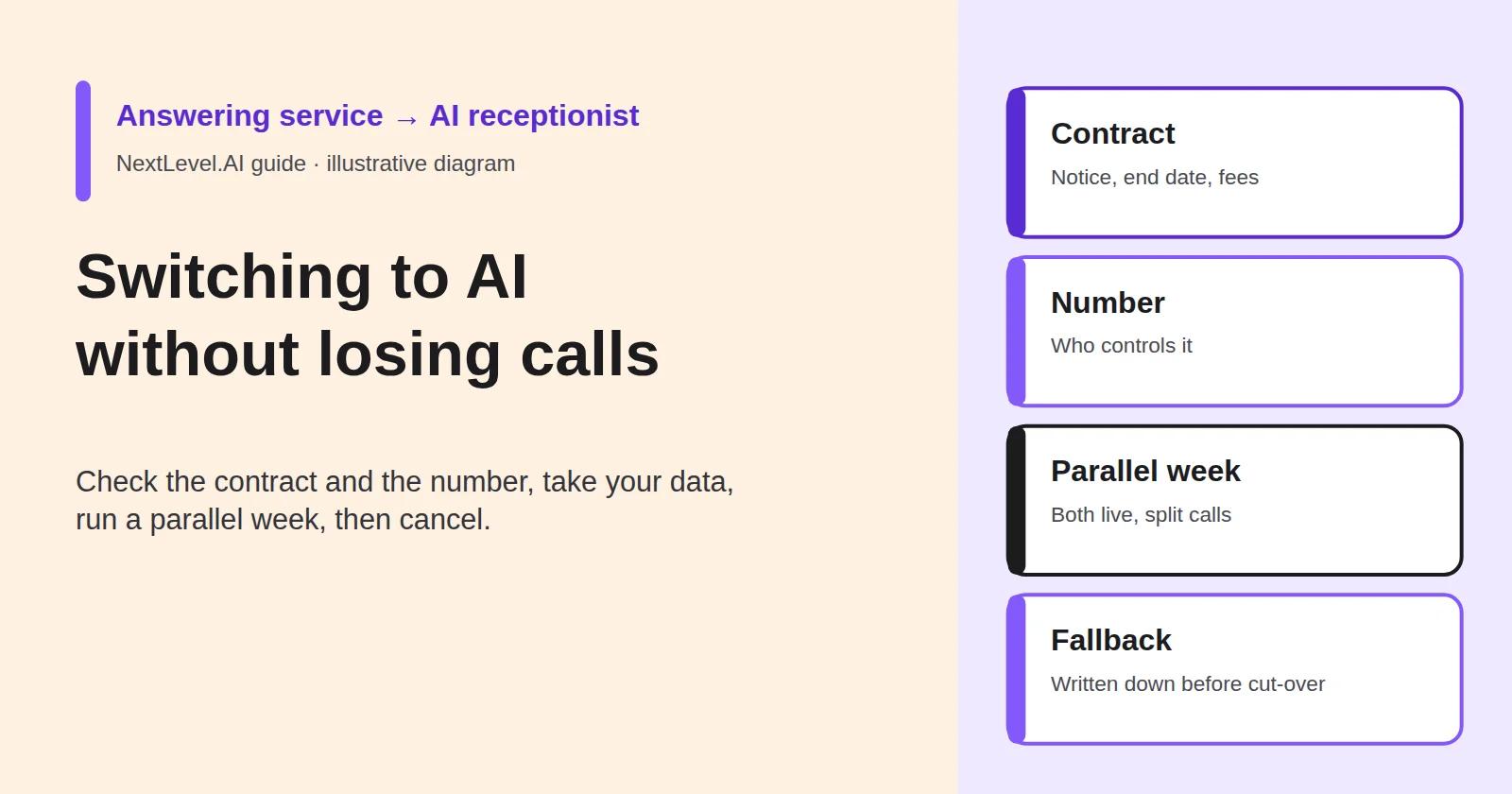
You already pay a human answering service, and you're thinking of moving to an AI receptionist. The risk isn't the AI's first conversation. It's the gaps in the move: a notice period you didn't know about, a phone number the service controls, message history left behind, or a cut-over day when calls go nowhere. This guide covers the four questions to answer before you give notice, how to find out who controls your number, what to take with you, and how to run a parallel week with a fallback before you cancel. It's written for small-business owners in the US and UK. It isn't legal advice. NextLevel publishes this guide and sells AI receptionist services.
Before you give notice: four questions about your current service
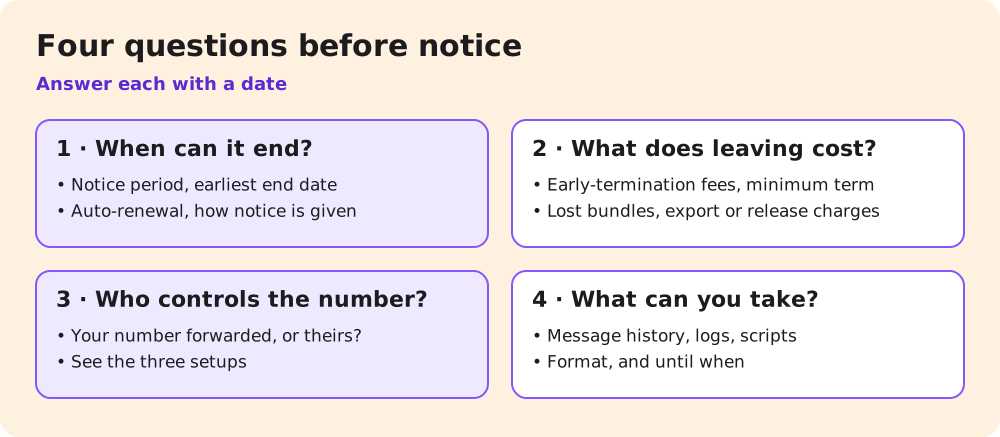
Don't give notice until you can answer these four questions from your agreement and your account. The US regulator's porting guide, written about phone companies, opens with the same step: "Review your current contract." (FCC)
- When can the contract end, and how? Find the notice period, the earliest end date, whether it renews automatically, and how notice must be given (email, letter, a portal).
- What does leaving cost? Look for early-termination fees, minimum terms, unused minutes or call bundles you lose, and any charge for exporting your data or releasing a number.
- Who controls the number your customers dial? Is it your own number forwarded to the service, or a number the service gave you? The next section shows why this matters most.
- What can you take with you, and in what form? Ask how you can export message history, call logs, scripts and your customer instructions, and by when. Some data may only be kept for a fixed period after you leave.
Write the answers down with dates. The latest date you can give notice, and the date the service stops answering, set the outer edge of your plan. Everything else, including the parallel week, has to fit inside them. If a term is unclear, ask the service in writing and keep the reply. If the stakes are high, have someone qualified read the agreement.
Who controls your number and the forwarding
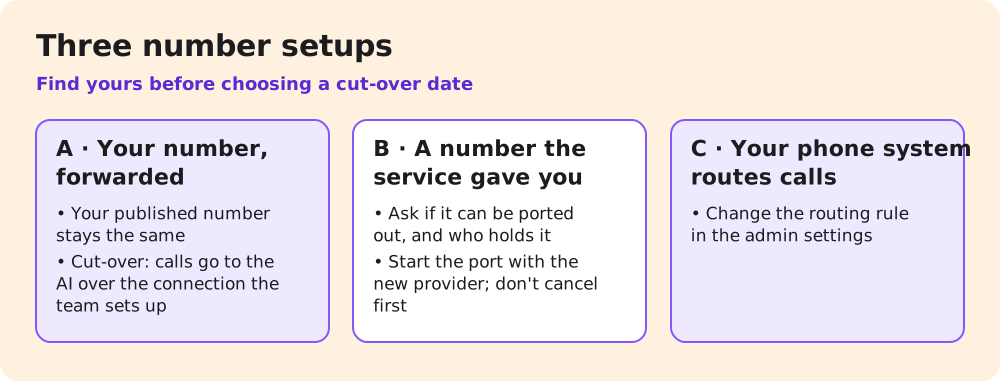
How you leave depends on how calls reach the service today. There are three common setups:
A. Your number, forwarded to the service. Your customers dial your own number, and your phone or carrier forwards calls to the service. This is the easiest case, because you control where calls go and your published number stays the same. On cut-over day, calls go to the AI receptionist instead. NextLevel supports both call forwarding and a SIP trunk, and its team sets up the connection for your line. NextLevel's guide to connecting your business number covers forwarding codes.
B. A number the service gave you. You publish a number the service provides, on your van, your website or your listings. Ask whether the number can be ported out to a provider you choose, who is named as the account holder, and what the service needs from you to release it. In the US, porting starts with the provider you're moving to. The FCC's advice is to "contact the new company to start the process of porting your number" and not to cancel the old service first (FCC). In the UK, ask the provider you're moving to how porting would work for your number before you give notice. NextLevel's number guide states that NextLevel "does not supply phone numbers": you provide the number and telephony. So in this setup the number moves to a phone provider you control, not to NextLevel.
C. A phone system you control routes to the service. A hosted VoIP or office phone system sends some calls to the service. You change the routing rule in that system's admin settings.
If the number can't be ported, plan a change of number early. Update your listings and signage, and keep the old number answering for as long as the service allows.
What to take with you: scripts, FAQs, message history, urgent rules
A human service holds more of your business than its invoice suggests. Before you leave, collect:
- Scripts and greetings: what operators say, including how they describe your business and your hours.
- The answers they give: prices, service area, what you do and don't do. These become the AI's approved information, so correct anything out of date.
- Message history: recent messages, especially open ones and repeat callers. You'll need them for callbacks during the switch.
- Urgent rules and the on-call list: what the operators treat as urgent, and who they contact.
- Special instructions: callers they put straight through, callers they decline, and anything else they do on request.
- Usage: calls and minutes per month. Compare those with the minutes in the plan you're considering.
Ask for an export in a format you can open. A spreadsheet beats a PDF of screenshots. Keep your own copy, independent of either provider.
Read the answers before you hand them over. Operators sometimes give answers you would never approve, such as an old price or a service you stopped offering, and the AI will repeat whatever it is given. Ask the service, too, how messages taken in your final days will reach you, and for how long after the end date. A caller who left a message on the service's last day still expects a reply.
Run a parallel week
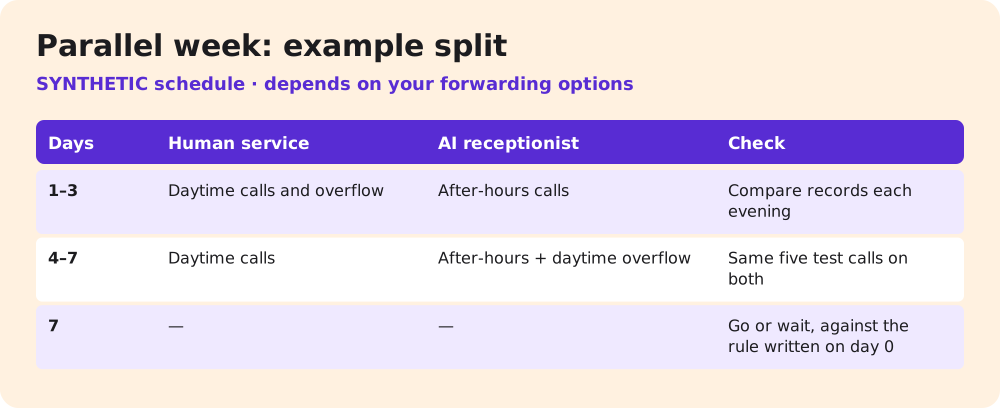
A parallel week doesn't mean two receptionists answering the same call. A call can only go to one destination at a time. It means both services are live for a week, each with a defined share of your calls, while you compare results:
- Split by condition. Keep the human service on daytime overflow, and send after-hours calls to the AI. Or the other way round.
- Split by day. Send one or two days a week to the AI and the rest to the service.
- Test calls on both. Ask friends to place the same five calls (a new enquiry, a booking, an urgent job, a question the answer list doesn't cover, a request for you by name) to each route, and compare the records.
How you split depends on what your phone setup can do. Some forwarding settings allow different destinations for busy, no answer and all calls. Others don't. Check before you plan the week.
At the end of each day, compare the records side by side. Ask three questions. Was every caller's need captured? Did urgent calls reach someone? Did anything get promised that nobody will deliver? Write down your switch-or-wait rule before the week starts, for example "no lost urgent calls, and every enquiry has a usable callback number." That way the decision doesn't come down to mood.
Cut over, keep a fallback, then cancel
Cut over on a quiet day with someone available, not on a Friday evening. On the day:
- Move all calls to the AI receptionist: change the forwarding, or the routing rule if a phone system handles it.
- Make test calls straight away and check the records arrive.
- Keep your fallback ready. The number guide notes that plain carrier forwarding has no automatic fallback. Agree a manual plan, such as turning forwarding off or pointing it at a staff phone, and write down how to do it.
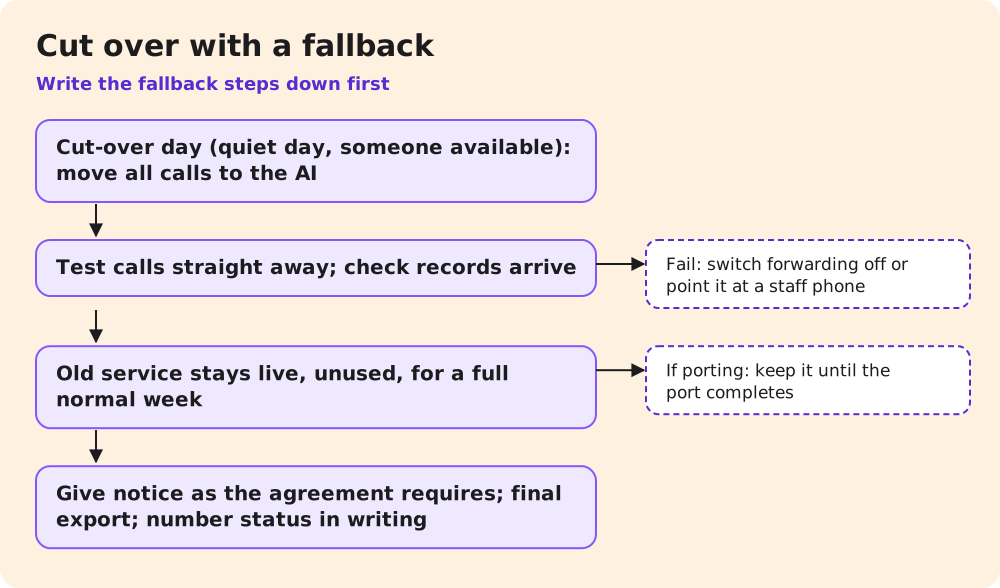
Don't cancel the human service on the same day. Keep it running, unused, until the AI has handled a full normal week. If your number is being ported, keep it running until the port is complete. In the US, the FCC warns: "Do not terminate your service with your existing company before initiating new service with another company." Then give notice the way your agreement requires, confirm the end date and the status of any number in writing, and take a final export.
| Day (synthetic) | Step |
|---|---|
| Day −30 | Answer the four questions; request exports; check number control |
| Day −10 | NextLevel prototype tested with your scripts and urgent rules |
| Days 1–7 | Parallel week; daily record comparison |
| Day 8 | Cut over; test calls; fallback written down |
| Day 15 | Full normal week reviewed; give notice to the old service |
| Notice end | Final export; confirm number status in writing |
Getting set up with NextLevel
NextLevel's receptionist is set up with NextLevel's help. For qualified prospects, a working prototype is typically ready in about 2 weeks; NextLevel then tunes it to your business. This is a typical time, not a guarantee. On 9 November 2026 the pricing page listed Phone AI Business Receptionist plans from $49/mo (Starter, 1 phone line, 300 voice minutes a month), from $175/mo (Standard, 1,000 minutes) and from $385/mo (Business, 2,500 minutes). The page also says that Voice AI agent tuning, post-acceptance fixes, improvements and integrations are billed as professional services; ask on the call which of these your plan includes. Check the page on the day you decide.
Next step: book a 30-minute call from the pricing page and bring your four answers. The team can build a prototype from your current scripts, so you can run it on your line during your parallel week.
FAQ
Can I keep my number when I leave the answering service?
If it's your own number forwarded to the service, yes: your published number stays the same, and calls can reach the AI by call forwarding or over a SIP trunk; NextLevel supports both. If the service gave you the number, ask whether it can be ported to a provider you choose before you give notice.
How long should the parallel run last?
At least one normal week, so every weekday and an evening rush are included. Extend it if your switch rule isn't met.
What if the AI can't handle something the operators did?
List it during the parallel week. Then move it to a person, change the AI's rules or keep that task with a human. Don't cut over until the list is settled.
Do I need a lawyer to cancel?
This guide can't decide that, and it isn't legal advice. Get advice if the contract is unclear or the stakes are high.
Sources
- FCC, Porting: Keeping Your Phone Number When You Change Providers (US), last reviewed 10 December 2025, read 9 November 2026.
- NextLevel: connect your business number, pricing, all read 9 November 2026. For choosing between the two models, see AI phone agent or answering service.