
Your AI receptionist has been answering the phone for a few weeks. Nobody has complained, the calendar has new bookings in it, and you have not opened a single call record since launch. That is the moment small errors start to add up unnoticed: a price the agent states slightly wrong, an urgent message that reached nobody, a booking that landed on the wrong day.
You do not need a quality team to catch them. This guide sets out a fixed weekly routine for an owner-operator: which calls to open, five checks in order of what they cost you, one change a week and a simple log, plus a clear line for when to ask for help. NextLevel sells voice agents; the example week below is fictional.
Why a short routine beats an occasional deep look
An occasional deep look happens after something has already gone wrong, usually a customer telling you about it. By then the same mistake may have run for weeks. A short fixed routine finds problems while they are still one or two calls old, and it is small enough to survive a busy season. It also leaves a record: after a month you have four weeks of notes showing what went wrong, what you changed and whether it held, which is what you need when deciding whether to keep, extend or change the setup.
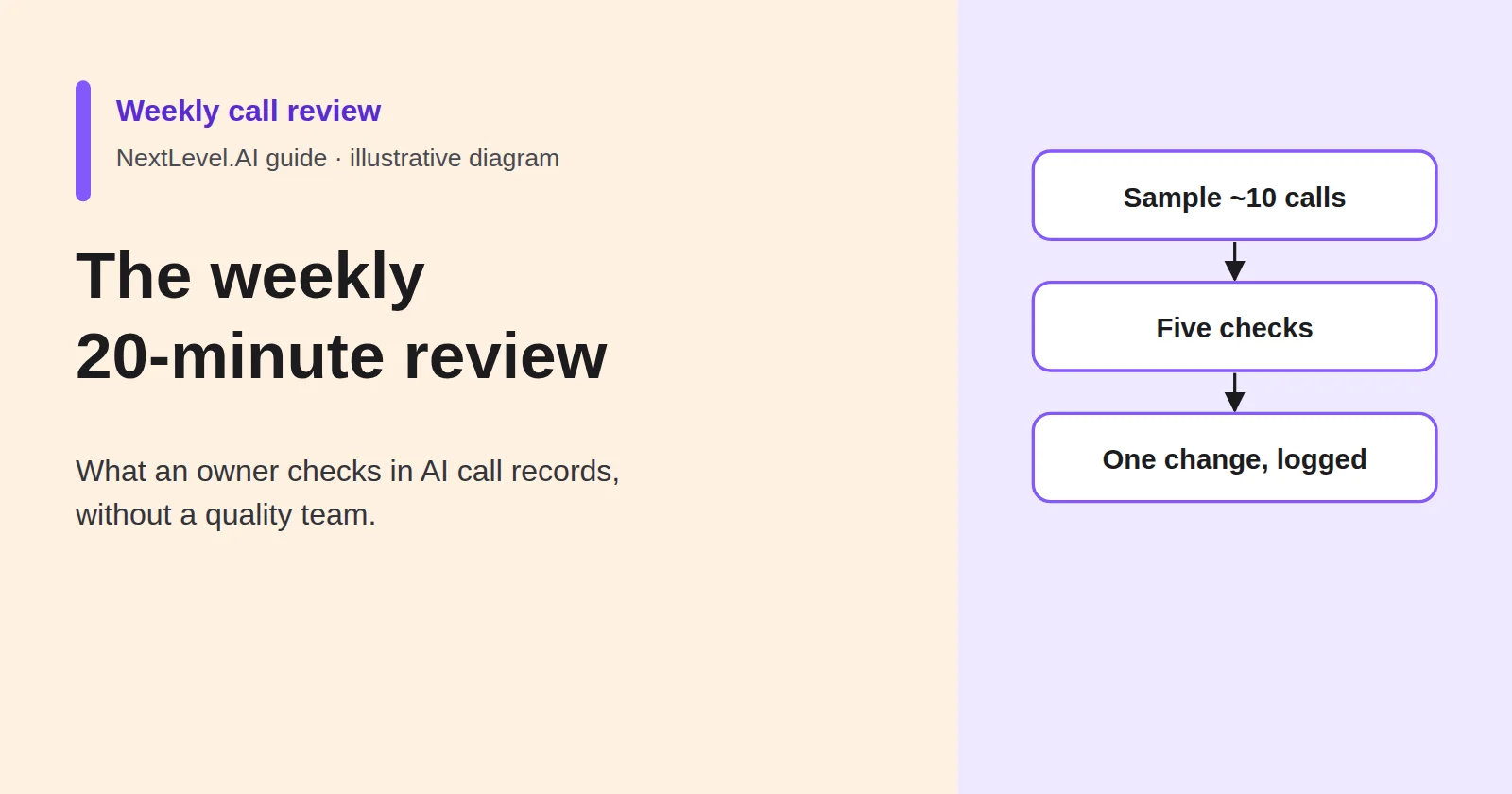
The routine has a time budget: about 5 minutes to pick the calls, about 10 minutes for the checks and about 5 minutes to make one change and write it down. The budget assumes you read summaries or transcripts and open a recording only where something looks wrong; with recordings only, open fewer calls, in sample-rule order, and stop at 20 minutes. These are planning figures, not measurements; adjust them to your own volume, but keep the routine short enough that you do it every week.
Pick the sample: which calls to open each week
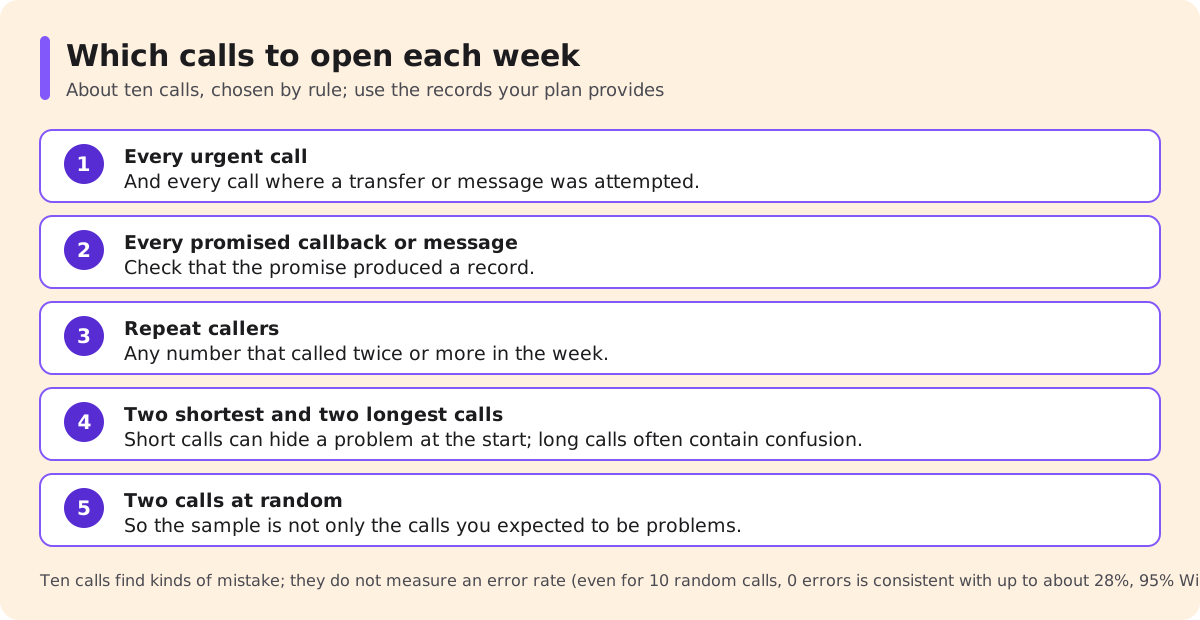
Open about ten calls a week, chosen by rule rather than by mood. Use whatever records your plan provides (recordings, transcripts or summaries) and check your plan for which of these you have.
- Every call flagged as urgent, and every call where a transfer or message was attempted.
- Every call where the agent promised a callback or took a message.
- Repeat callers: any number that called twice or more in the week.
- The two shortest and two longest calls. Very short calls can hide a problem at the start of the call; very long ones often contain confusion.
- Two calls at random, so the sample is not only the calls you expected to be problems.
If the first three groups already exceed ten, review those first and skip the rest that week.
Be clear about what ten calls can tell you. They are for finding kinds of mistake, not for measuring how often the agent is right. Ten clean calls do not prove the agent is right nine times in ten. Even if the ten calls were picked at random, zero errors would still be consistent with an error rate as high as about 28% (95% Wilson interval). If you want a rate, NextLevel's guide to contact centre KPIs for AI agents explains how to sample for one. For a small business, finding and fixing each new kind of mistake is the more useful goal.
Five checks, in order of cost to you
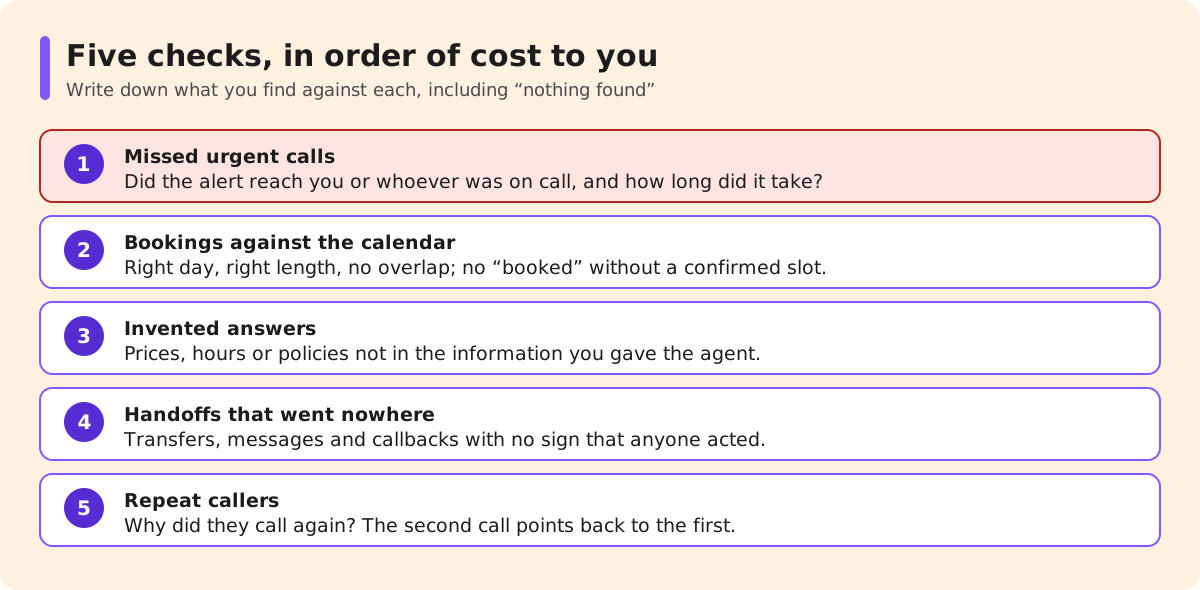
Run the checks in this order. It puts first the failures that cost you most when missed.
1. Missed urgent calls. For every urgent call, did the alert reach you or whoever was on call, and how long did it take? An urgent job that waited until morning is the most expensive failure on this list, and it is invisible unless you look.
2. Bookings against the calendar. For every booking in the sample, is it in the calendar, on the right day, at the right length, without overlapping another booking? Where the agent could not confirm a slot, did it say so instead of telling the caller they were booked? A booking that exists only in the conversation produces a customer at the door and nobody there. Keep the calendar open beside the record while you check.
3. Invented answers. Did the agent state a price, an opening time or a policy that is not in the information you gave it? Compare against your own price list and hours. An unknown price should stay unknown, with a callback offered. Once a month, add a test call of your own: ask the agent ten price questions, including two it should not know, and count the answers it invented.
4. Handoffs that went nowhere. For every transfer, message or promised callback, is there evidence that someone acted on it? A message that sits unread is a lost enquiry that the agent recorded perfectly well. Check the time on each one: a message older than a working day is probably already late for the caller.
5. Repeat callers. Why did they call again? Usually the first call left something unresolved: a question the agent could not answer, a booking the caller was not sure about, or a callback that did not happen. The second call points back to the first.
Write down what you find against each check, including "nothing found". A week with nothing found is useful too; it tells you which checks to keep and which to rotate.
| Fictional week (10 calls opened) | Finding | Decision |
|---|---|---|
| Urgent calls (1) | Alert reached the owner within minutes | Nothing to change |
| Bookings (3) | One 30-minute booking for a 60-minute service | Fix the service length |
| Invented answers | Agent said "open until 6 on Saturdays"; hours changed to 4 last month | Fix this week |
| Handoffs (2) | One message with no follow-up after two days | Owner calls back today |
| Repeat callers (1) | Caller rang twice because the address was misheard | Watch next week |
Turn one finding into one change and log it
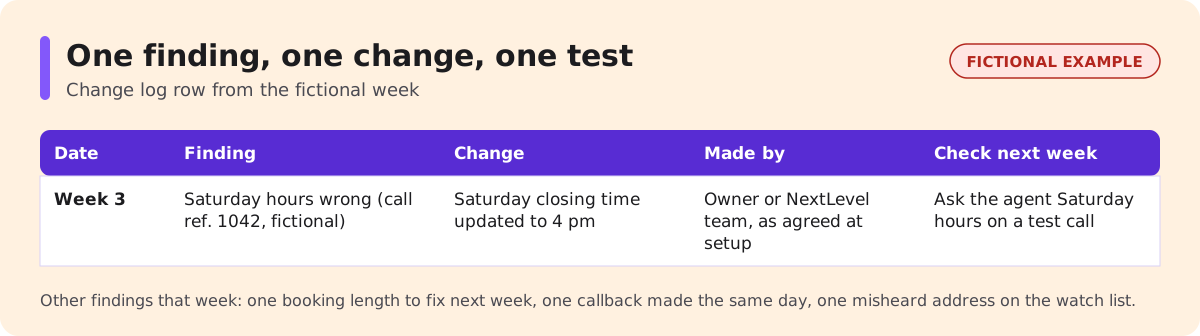
In the fictional week above there are four findings, but only one change goes in this week: the Saturday hours. It is wrong on every call that asks, it is quick to correct, and it is easy to check next week. The message with no follow-up is not a change to the agent; it is a callback the owner makes today. The service length goes into next week's change. The misheard address stays on a watch list until it happens again.
One change a week has a reason. If you change three things at once and next week looks better or worse, you cannot tell which change did it. Write down the findings you chose not to act on as well, so a pattern that repeats over three weeks is visible.
Keep the log simple:
| Date | Finding | Call | Change | Made by | Check next week |
|---|---|---|---|---|---|
| Week 3 | Saturday hours wrong | Call ref. 1042 (fictional) | Saturday closing time updated to 4 pm | Owner or NextLevel team, as agreed at setup | Ask the agent Saturday hours on a test call |
How a change reaches the agent depends on your setup. How business facts you supply, such as new hours or a new price, get to the agent is agreed during setup, which is done with NextLevel's help, and the log is what you bring to that conversation. Whoever makes the change, the final column matters most: every change needs a test call that proves it worked.
When to ask for help instead of editing yourself
Some findings are not yours to fix with a new line of business information. Ask for help when:
- the same mistake comes back after you corrected the facts behind it;
- the problem is in a connection, such as the calendar, transfers or the phone line;
- the agent says something unsafe or inappropriate, or gets the AI disclosure or recording notice wrong;
- the fix means changing how the agent behaves, not what it knows.
Be clear about cost before you ask. NextLevel's pricing page says that Voice AI agent tuning, post-acceptance fixes, improvements and integrations are billed as professional services. Bring your log to that conversation: a dated finding, the call it came from, what the agent said and what it should have said make the request specific and quicker to scope.
FAQ
How many calls should I review?
About ten a week, chosen by the sample rule. More helps only if you have time to act on what you find.
What if I find nothing for several weeks?
Keep the urgent and booking checks, and rotate the rest.
Can I skip a week?
Yes, but review the urgent calls first the following week.
Should my staff review calls too?
If someone else handles urgent alerts or messages, ask them to run checks 1 and 4. One person still owns the log.
Do I need recordings?
Use whichever records your plan provides; check your plan for recordings, transcripts or summaries.
Next step
If you are about to go live, book a 30-minute call with the NextLevel team from the pricing page, bring this checklist and agree who handles which kind of fix. For what the receptionist does, see the AI answering service page. If you are already live, start this week's review with your urgent calls.