
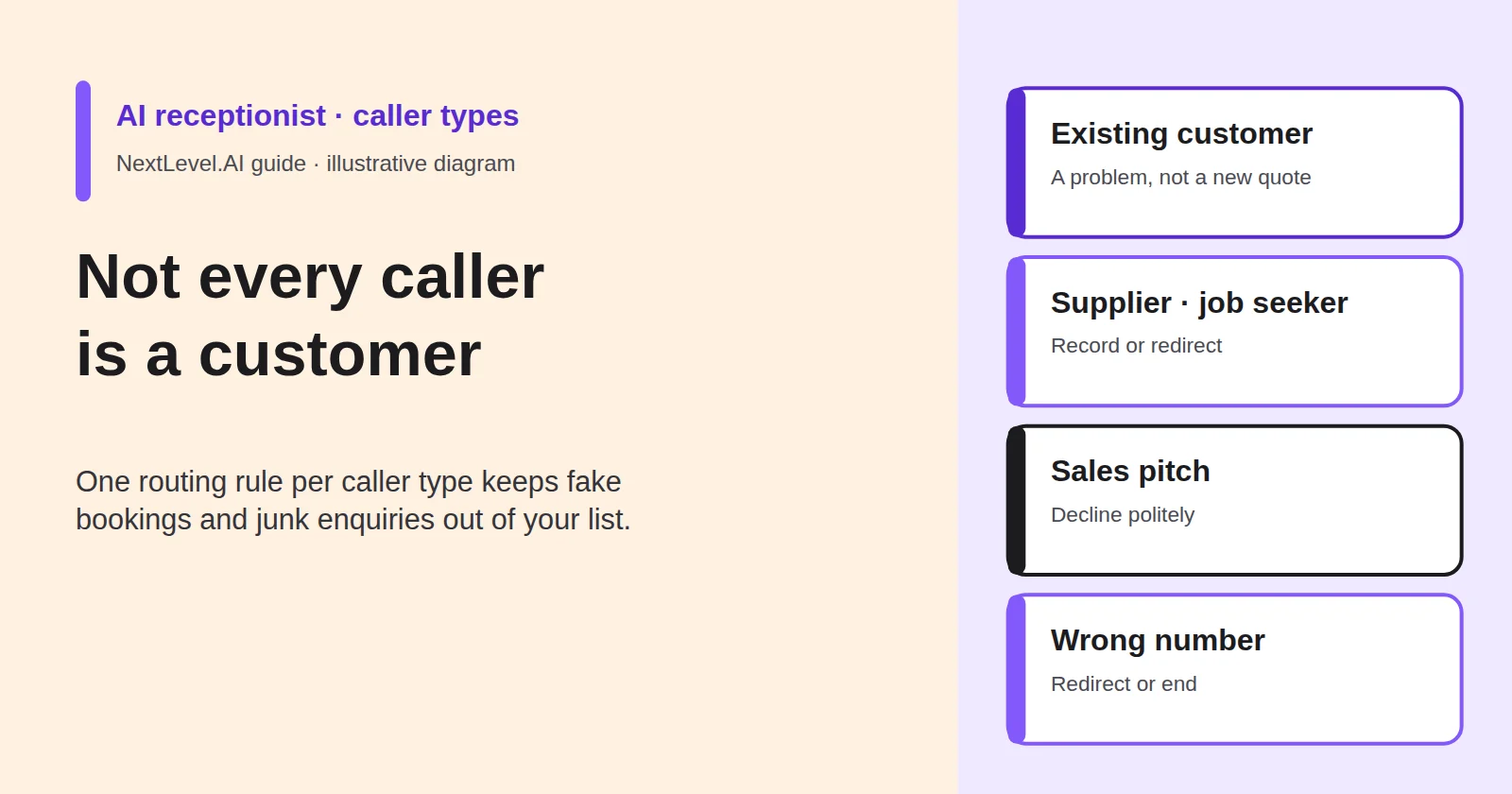
Not every call to a small business comes from a new customer. A supplier is checking a delivery. Someone wants a job. A rep wants ten minutes of your time. A customer whose repair failed is calling back angry, and some callers simply dialled the wrong number. An AI receptionist set up only for new enquiries will try to turn every one of them into a booking. This guide gives you one short routing rule per caller type, so these calls reach the right place and stop filling your enquiry list. NextLevel publishes this guide and sells AI receptionist services.
Why non-customer calls break your enquiry list
When an agent treats every caller as a lead, the mistakes are predictable. It offers the tile supplier a quote visit. It logs the job applicant as an enquiry. It sends you an urgent text because a sales rep said the call was "important." You pay twice: once on the call and again when you clean up the records.
The numbers suffer too. NextLevel's guide to the cost of missed calls separates new enquiries from everything else before it puts a value on a missed call. If the AI's records mix the two, you can't tell whether the receptionist is winning work or just answering the phone.
The fix isn't to make the AI suspicious of callers. Give it a short rule for each type of caller who isn't a new customer, so the call ends in the right place and the record says what the call was. A booking should only ever be made for a real customer.
Six caller types and the one question that separates them
New customers follow your normal booking or enquiry flow. These six types need their own rule:
- Existing customer with a problem: a complaint, a repeat fault, a missed appointment.
- Supplier or trade partner: deliveries, invoices, a subcontractor confirming a job.
- Job seeker: asking whether you're hiring, or following up an application.
- Sales pitch: someone selling advertising, software, energy or "a quick partnership chat."
- Wrong number: they meant to call someone else.
- Personal or official caller: family, your bank, your accountant, the council or another public body.
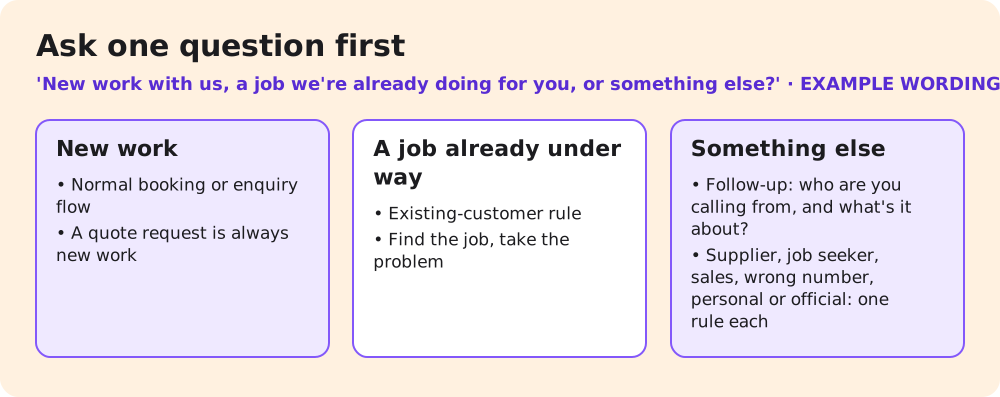
The agent doesn't need to sort callers from the first word. It needs one question, asked early and in plain language:
AI: "Are you calling about new work with us, a job we're already doing for you, or something else?"
"New work" goes to the normal flow. "A job you're already doing" goes to the existing-customer rule. "Something else" gets one follow-up: "Who are you calling from, and what's it about?" Most callers then sort themselves. A supplier names the company, a job seeker says they're looking for work, and a rep starts the pitch.
Don't make the question an interrogation. If a caller says they need a quote, they're a new customer. Book them as one even if they also mention they're "a bit of a supplier themselves."
Some calls fit two types. A customer complaining about last week's job may also want a second room done. A subcontractor may be calling about a job and also about a late invoice. Give the agent an order of precedence so it doesn't stall: anything urgent first, then the existing-customer issue, then new work, then everything else. It handles the higher one and adds the rest to the same record, so nothing is lost and the call isn't logged twice.
Routing rules: record, redirect, decline or hand over
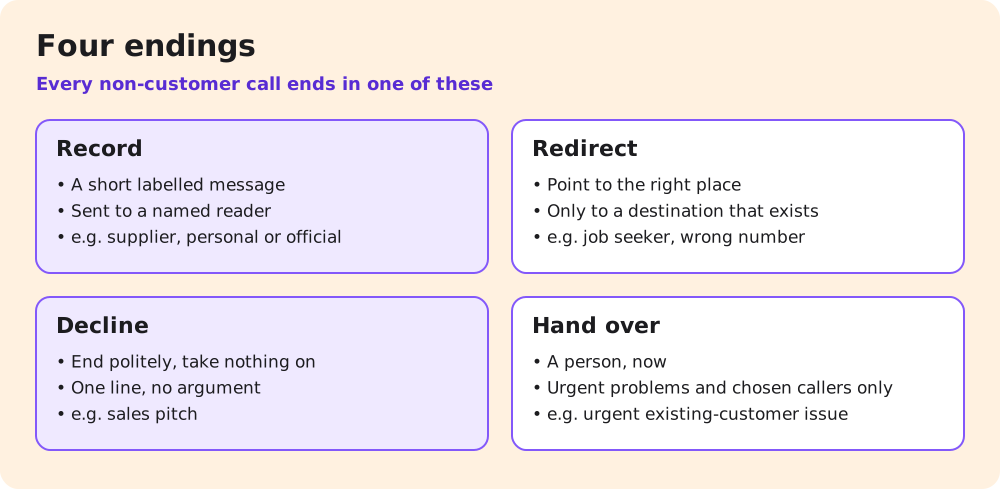
Every non-customer call should end in one of four ways:
- Record: take a short structured message and send it to the right person, labelled with the caller type.
- Redirect: tell the caller where they should go instead, such as your hiring email address or the number they actually wanted.
- Decline: end the call politely without taking anything on.
- Hand over: pass the call or the details to a person now, because it can't wait.
Each ending needs something real behind it. A recorded message is only useful if a named person reads that label. Supplier messages can go to the office inbox. They don't need to reach your mobile at ten at night. A redirect needs a destination that exists, such as a hiring email address you actually check. If you don't have one, the agent should say it will pass the details on, not invent a careers page. Declining is easiest when you've decided once whether you want sales pitches in writing at all. Handing over should be rare. Keep it for urgent problems and for the personal or official callers you've chosen to put through.
Whatever the ending, the agent should tell the caller what happens next without promising more than you'll deliver. NextLevel's phone scripts guide uses the same rule when a transfer fails: describe what happens, don't promise availability. And every record gets a caller-type label, so your enquiry list stays clean. Use the same six labels everywhere: in the agent's records, in the test below and when you count missed enquiries. If the labels change from week to week, the counts mean nothing.
| Caller type | What the AI asks | What it records | Where it goes | Never |
|---|---|---|---|---|
| Existing customer with a problem | Name, address or job reference, what went wrong, is it urgent | Type "existing customer – issue", job details, problem | Urgent route if urgent; otherwise the person who owns the job | Book a new quote; promise a refund or a visit time |
| Supplier or partner | Company, name, what it's about | Type "supplier", company, short message | Owner or office inbox | Accept a change to payment details |
| Job seeker | Name and contact, if they want to leave them | Type "job enquiry" (optional) | Your hiring route, such as an email address | Ask screening questions or judge the applicant |
| Sales pitch | What they're offering, in one line | Type "sales", one line | Decline, or give an email address if you want pitches in writing | Agree to a meeting, demo or trial |
| Wrong number | Who they were trying to reach | Type "wrong number" | Redirect if you know the right business; otherwise end | Take their details as a lead |
| Personal or official | Name, organisation, what it's about | Type "personal" or "official", message | Ring-through number or owner, by your rule | Give out personal numbers or schedules |
Two calls illustrate the rules (synthetic transcripts):
Caller: "Hi, it's Lee from the tile wholesaler. Your order for Thursday has changed."
AI: "Thanks, Lee. I'll pass that to the office now. What's changed, and what number should they call you back on?"
Expected record: type supplier; company; change described; callback number; no booking.
Caller: "I'm calling about advertising in our local directory."
AI: "Thanks for calling. We don't take sales calls by phone. You can email the office if you'd like to send details. Goodbye."
Expected record: type sales; one line; no message sent to the owner.
Put the route for each type into the setup brief for whoever configures the agent. NextLevel sets up its receptionist with your help, so the routing table above can go into that brief more or less as it is.
Existing customers with a problem are not new enquiries
The most expensive mix-up is treating an unhappy existing customer as a new lead. "Your engineer was here yesterday and it's leaking again" is not a request for a quote. If the agent offers one, the customer hears that you don't remember them.
Give the agent a separate path for callers who say a job is already under way or finished:
- Find the job: the name, the address with postcode or ZIP, and roughly when the work was done.
- Take the problem in the caller's words, and ask one question about urgency.
- If it's urgent under your rules, use your urgent route. A leak after a repair is still a leak.
- If it isn't urgent, send it to whoever owns the job, with the details already captured.
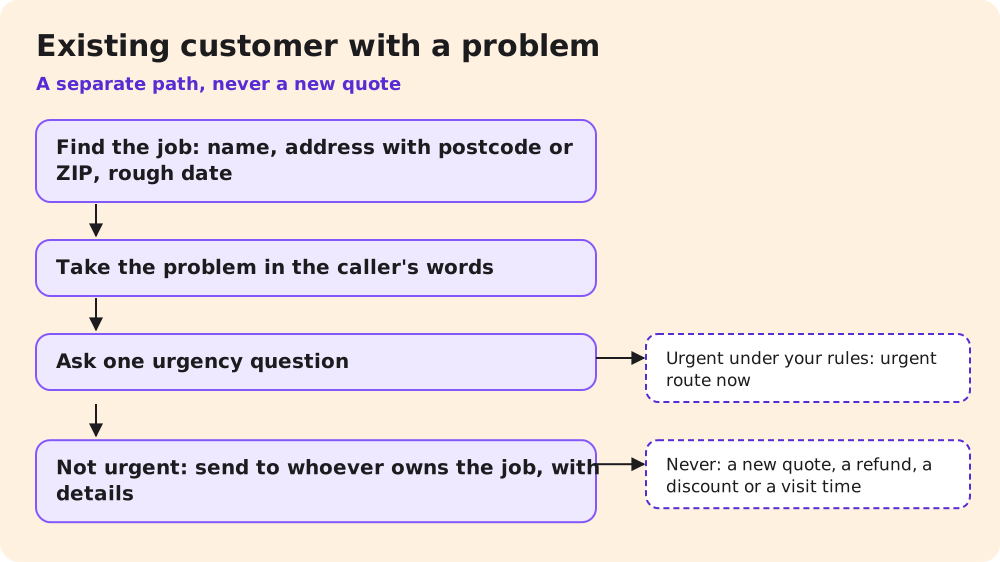
The agent shouldn't argue, apologise on your behalf for something it can't verify, or promise a refund, a discount or a visit time. It can say what happens next: "I've passed this to the team with your details. They'll be in touch." Promise a callback time only if someone has agreed to it.
Caller: "You fixed our boiler on Monday and it's off again." (synthetic)
AI: "I'm sorry it's playing up. Can I take your name and postcode or ZIP so I can find the job? Is there any heating or hot water at all right now?"
Expected record: type existing customer – issue; job found or not found; problem in the caller's words; urgency answer; route used; no new booking.
What the AI must not do: interview job seekers, accept offers, give staff details
Three lines hold for every non-customer call.
It doesn't interview job seekers. Screening applicants is a hiring decision. Questions about experience, availability or right to work don't belong in a receptionist call. The agent tells the caller how you hire, for example "send your details to the email address on our website," and stops there.
It doesn't accept offers. No meetings, demos, trials, contract renewals or price changes are agreed on a call the AI answered. The most it does is take a one-line message, if you want sales pitches recorded at all.
It doesn't give out staff details. That means personal mobile numbers, who is working today, home addresses and holiday dates. A caller who needs a specific person gets a message taken or a transfer under your rules.
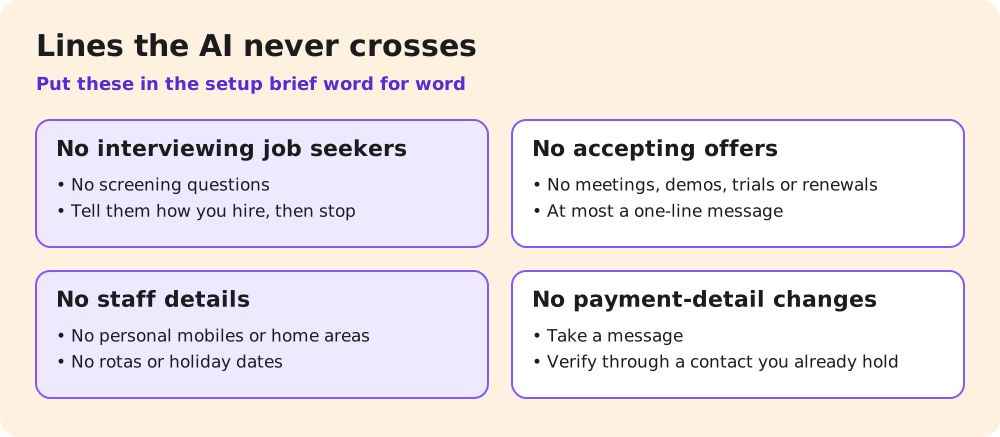
One more rule protects your money. Never accept a change to bank or payment details on the phone. Take a message, then verify through a contact you already hold. The FCC's general advice is to hang up and call back "using an official phone number" when someone says they're calling from a company (FCC).
Test it with six calls and check the records
Ask a friend to place six calls, one per type, and check two things after each: where the call went, and what the record says.
| # | Caller plays | Pass if |
|---|---|---|
| 1 | A supplier with a delivery change | Message reaches the office; labelled supplier; no booking |
| 2 | A job seeker | Redirected to your hiring route; no screening questions |
| 3 | A sales rep who insists it's important | Declined or one-line note; no urgent alert to you |
| 4 | An existing customer whose repair failed | Job details captured; routed as an issue, not a quote |
| 5 | A wrong number | Ended or redirected; not counted as an enquiry |
| 6 | Your accountant's office asking for you | Handled by your ring-through or message rule; not logged as an enquiry |
A call fails if either check fails. A polite call that still created a booking is a failure. Fix the rule, then repeat the calls it affects. Add one mixed call as well, such as a customer who complains and also asks for new work, and check that it produces a single record with both parts.
After the first real week, read the enquiry list once with the labels in mind. Any supplier, rep or wrong number that still shows up as a new enquiry points to a rule that needs a clearer question or a clearer label. Re-run all six calls after any change to your services, your urgent route or your staff.
Getting set up with NextLevel
NextLevel's receptionist is set up with NextLevel's help. For qualified prospects, a working prototype is typically ready in about 2 weeks; NextLevel then tunes it to your business. This is a typical time, not a guarantee. You can keep your number and connect it by call forwarding or over a SIP trunk; NextLevel supports both.
Next step: book a 30-minute call from the pricing page and bring your caller-type rules, so the team can build them into a prototype you can test with the six calls above. For what the receptionist does with new customers, see the AI receptionist page.
FAQ
Should the AI just hang up on sales calls?
End them politely, with one line. Hanging up mid-sentence sounds broken. A short "We don't take sales calls by phone, goodbye" is clear and quick.
Can the AI tell a supplier from a customer by their number?
Only if you give it a list, and even then caller ID can be wrong or spoofed. The opening question works without a list. Use any number match as a hint, not proof.
Should job seekers be recorded at all?
That's your choice. You may prefer a redirect to a hiring email address with no record kept. If you do record them, don't count them as enquiries.
What if a caller won't say why they're calling?
Offer to take a message for the office. Don't put them through on persistence alone.
Sources
- FCC, Stop Unwanted Robocalls and Texts, last updated 27 February 2026, read 9 November 2026.
- NextLevel: cost of missed calls, phone scripts, AI receptionist, pricing, all read 9 November 2026.