
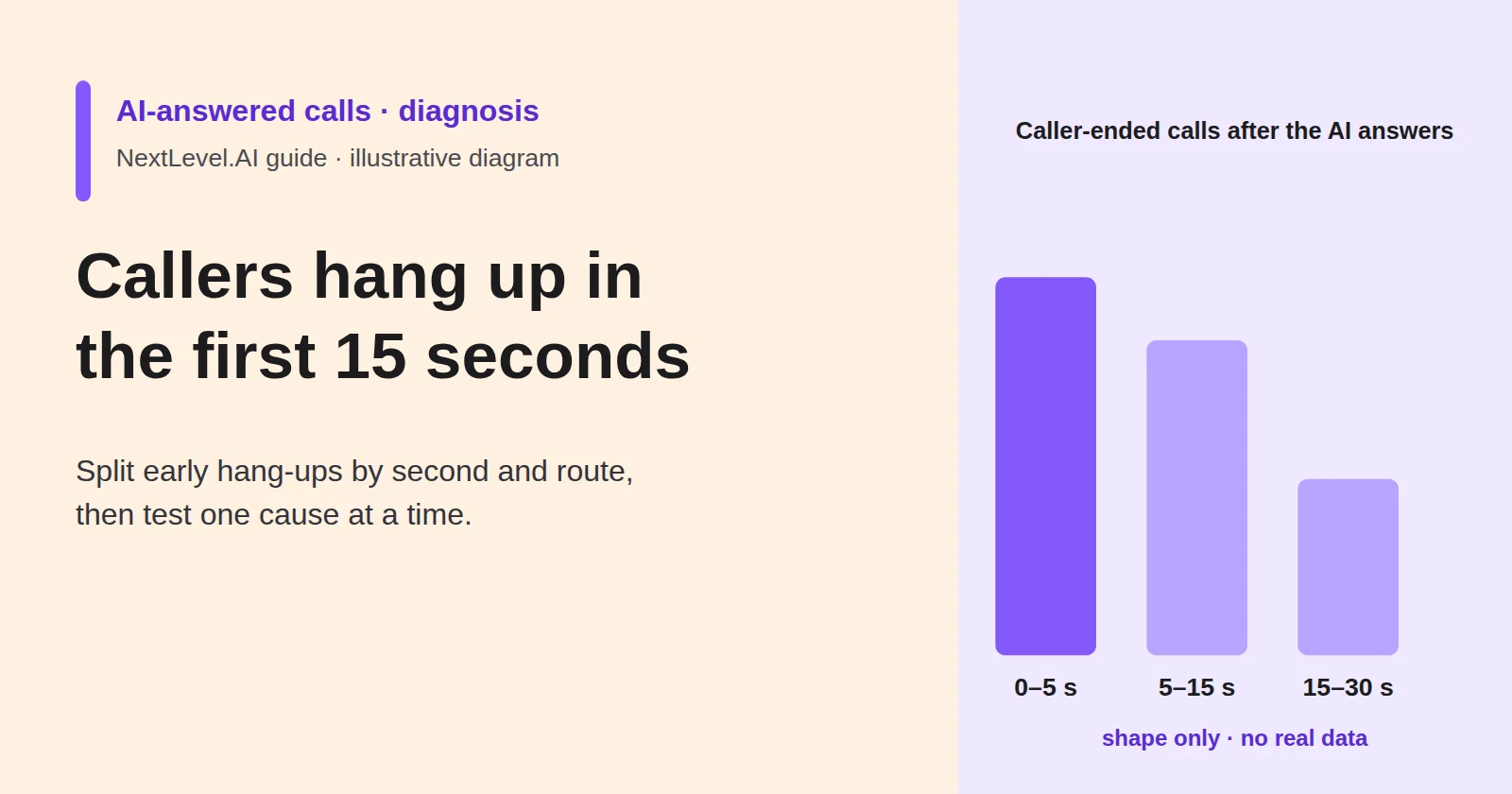
The voice agent went live two weeks ago, and one number on the dashboard keeps drawing attention: a large share of calls end within seconds of the AI answering. Someone suggests that callers simply dislike talking to AI. Someone else suggests shortening the opening line, including the part that says it is an AI.
Both reactions skip the diagnosis. Early hang-ups have several different causes, from silence on the line to a number that used to reach a different team, and each leaves a different trace in your call data. This guide shows how to define the measure, split it by second and by route, match the pattern to a likely cause and test one change at a time. The AI disclosure is not one of the things you change. NextLevel sells voice agents; every number below is fictional and shows the method, not a benchmark.
Define early abandonment and its denominator
Queue abandonment, where a caller hangs up before anyone answers, is a different problem with different fixes. NextLevel's guide to reducing call abandonment covers it. Here the call has been answered by the AI, and the caller leaves soon after. That guide's advice to exclude 5–10-second "false" abandons is for callers who hang up before anyone answers; after the AI has answered, a very short hang-up is the signal this guide is about, so keep it in the count.
A workable definition: early abandonment is a call that the caller ends within 30 seconds of the AI leg answering. Three parts of that sentence need care.
The caller ends it. Your telephony records should say which side hung up. Calls ended by an error, a failed transfer or a dropped connection are not abandonment. Count them separately and keep them visible, because they are a different kind of failure.
Time zero is the AI leg answering, not the first ring at the carrier. If your logs only hold total call duration, time spent ringing or in a menu before the AI will distort every bucket.
The denominator is every call connected to the AI leg in the period, minus test calls and minus the system-ended calls above. Caller-ended calls with no caller speech stay in both the count of early hang-ups and the denominator, because dead air on your side can produce exactly that pattern. Take a call out of both only when there is evidence it was not genuine, such as a known spam number or a recording that shows a misdial, and report how many you removed as a separate count. Write the rule down and keep it fixed, as the contact-center KPI guide recommends for abandonment generally. A rate whose denominator changes from week to week cannot show whether a fix worked.
Bucket by second and segment by route
A single early-abandonment rate hides the pattern you need. Split caller-ended calls into three buckets and line them up against your own call timeline:
- 0–5 seconds: usually during the greeting and AI disclosure. The caller may not yet have heard anything useful, or may have heard nothing at all.
- 5–15 seconds: usually around the first question and the caller's first answer.
- 15–30 seconds: after the first exchange, when a misunderstanding or a slow reply has had time to happen.
Those phases are typical, not fixed. Time your own greeting audio and the moment the agent's first word plays, and adjust the bucket edges so each one matches a real phase of your call.
Then segment. The most useful cuts are the number or route the caller dialled, time of day and after-hours calls, new versus repeat callers (for example, anyone who called in the previous 24 hours), and any carrier or trunk field your logs hold.
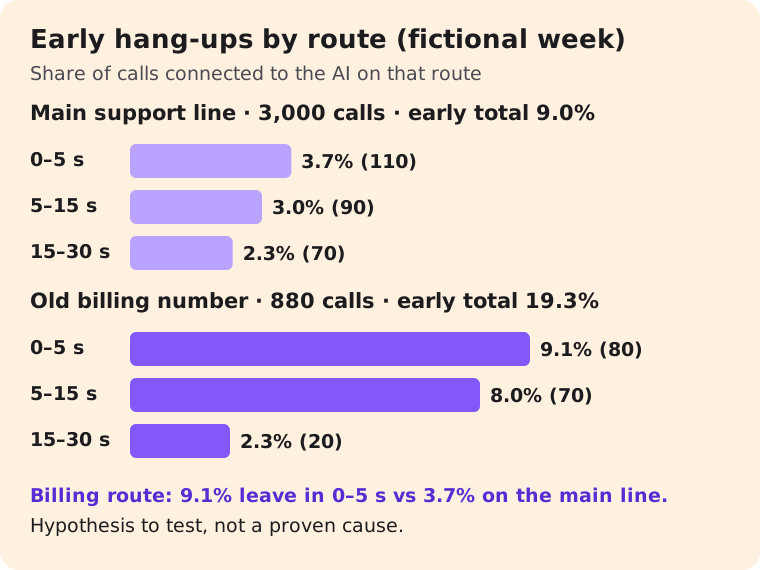
Here is a fictional week. Of 4,000 calls connected to the AI, 120 were ended by the system, which leaves 3,880 in the denominator. Applying the rule above, none of the short calls had evidence that it was not genuine, so none was removed. Two routes reach the same agent: the main support line, and an old billing number that was recently forwarded to it.
| Route | Calls | 0–5 s | 5–15 s | 15–30 s | Early total | Early rate |
|---|---|---|---|---|---|---|
| Main support line | 3,000 | 110 | 90 | 70 | 270 | 9.0% |
| Old billing number (forwarded) | 880 | 80 | 70 | 20 | 170 | 19.3% |
| All routes | 3,880 | 190 | 160 | 90 | 440 | 11.3% |
The overall 11.3% looks like one problem. The split shows two. On the billing route, 9.1% of callers leave in the first five seconds (80 of 880), against 3.7% on the main line (110 of 3,000). In the fictional data, 62 of the 150 billing-route callers who left within 15 seconds called the main line within ten minutes. That pattern points towards expectation or routing on one number, not a general dislike of AI. It is still a hypothesis until a test supports it.
Cause, evidence and test for each likely reason
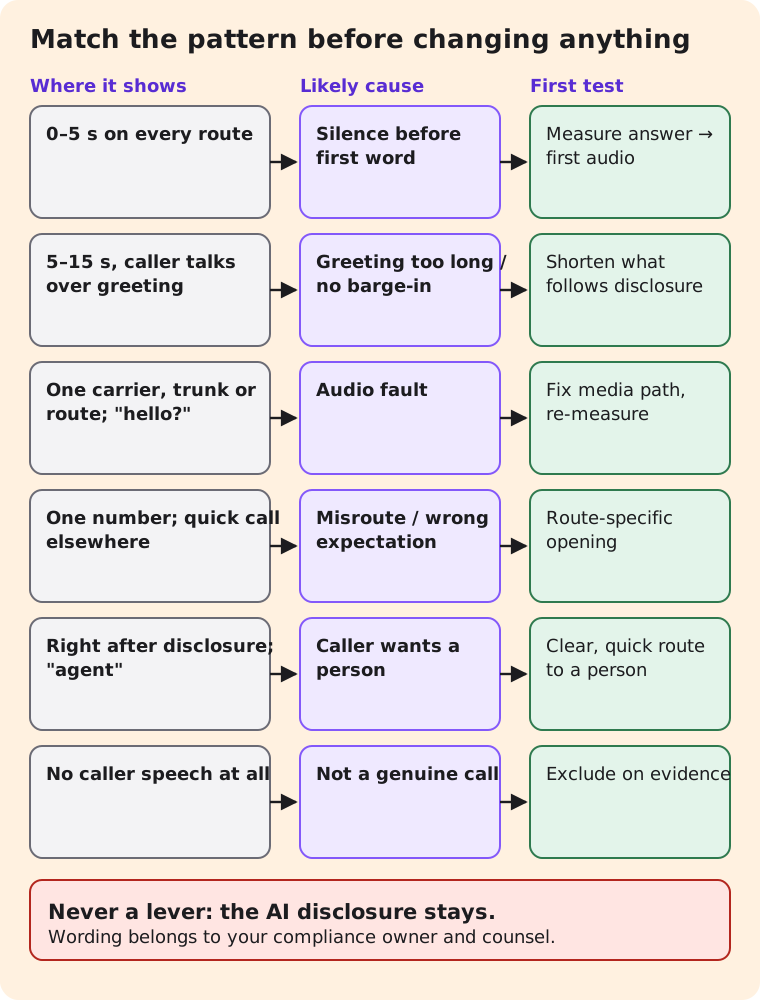
Each likely cause leaves a different trace. Match the pattern before you change anything.
| Likely cause | Where it shows | Evidence to pull | Test |
|---|---|---|---|
| Silence before the first word | 0–5 s, all routes | Time from answer to first agent audio; recordings with dead air | Reduce start-up delay; re-measure time to first audio |
| Greeting too long, or caller cannot interrupt | 5–15 s; caller speech overlaps the greeting | Turn timestamps; barge-in events | Shorten what follows the disclosure; allow interruption |
| Audio fault | One carrier, trunk or route; callers saying "hello?" | Recordings; media and codec logs | Fix the media path, then re-measure that segment |
| Misroute or wrong expectation | One number or route; quick call to another number | Route field; repeat-call join | Route-specific opening that names the purpose, or a routing fix |
| Caller wants a person | Hang-up right after disclosure; "agent" or "human" in transcript | Transcripts of the first turn | Make the route to a person clear and quick, if your service offers one |
| Not a genuine call | No caller speech at all | Speech-detected flag; known spam numbers | Remove from both counts only on evidence; report the number removed |
Silence before the first word. If hang-ups cluster in the first five seconds on every route, listen to twenty recordings from that bucket first. Dead air after the line connects can make a caller think the call has failed. NextLevel's voice AI latency guide explains how to measure the gap from a defined start event to the first audio rather than guessing at it.
Greeting length and interruption. When hang-ups cluster at 5–15 seconds and the transcript shows the caller speaking over the greeting, the caller has already decided what they want and the agent is not letting them say it. Keep the disclosure, shorten what comes after it, and check that the agent stops talking when the caller starts.
Audio faults. If one-way audio or very low volume is the cause, look for hang-ups concentrated on a single carrier, trunk or route. The call-quality guide covers the network side.
Misroute or wrong expectation. This is the billing-route pattern in the example. Callers dialled a number they associate with a particular team or menu, and an unfamiliar opening suggests they reached the wrong place. A quick call to another number is the strongest sign.
Wanting a person. Some callers will always prefer a person. That is a service decision about how easy you make that route, not a defect to be designed away. Count it honestly.
Non-genuine calls. Misdials and spam produce very short calls with no caller speech. Under the denominator rule, remove them from both counts only on evidence, and report how many you removed. Silence alone is not that evidence.
What not to change: the AI disclosure stays
The AI disclosure is not an optimisation lever. Do not remove it, bury it later in the call, or make the agent sound as if it might be a person. Whether and how a caller must be told they are speaking to an AI, and that the call may be recorded, depends on where you and your callers are and what the call is for. Treat it as a decision for your compliance owner and counsel, not for whoever is tuning the greeting. This guide is not legal advice. NextLevel's guide to consent and disclosure in call flows sets out the design questions.
You can still change what surrounds the disclosure: the purpose statement after it, the total length of the opening, and how quickly the caller can say what they need. If your data suggests the disclosure itself is linked to hang-ups, take that evidence to your compliance owner. Do not quietly edit the wording.
Change one thing and re-measure
Pick the cause your evidence supports most strongly, make one change on one route, and leave everything else alone for the measurement period. In the example, that means a billing-specific opening on the forwarded number, with the disclosure unchanged, and no other edits that week.
Before the change, write down which bucket you expect to move. Here it is the 0–5 second bucket on the billing route, and you would also expect fewer quick calls to the main line. Compare like with like: the same days of the week, the same hours and the same denominator rule.
Small changes on small routes are easy to misread. Before you call the change a result, look at how much the rate moved between the weeks before the change, when nothing changed. A shift smaller than that ordinary variation is not evidence.
Watch what happens later in the call as well. A change that cuts early hang-ups but raises abandonment at 60 seconds, or increases transfers and repeat calls, has moved the problem rather than fixed it. Keep verified resolution and repeat contact next to the early-abandonment rate in the same report.
Bring one week of call outcomes
If you are scoping a voice agent with NextLevel, bring a one-week summary of these outcomes to the scoping call: early hang-ups by bucket and route, which side ended the calls, and transfer events. A summary is enough; leave out recordings and anything that identifies a caller. The AI call center page is where to arrange that call.
FAQ
What is a normal early-abandonment rate for AI-answered calls?
This guide does not offer one. Published abandonment targets mostly describe queue abandonment in human-staffed centres and use different definitions, as the KPI guide notes. Use your own baseline and its usual week-to-week variation.
Is every short call an abandonment?
No. Count only calls the caller ended. Count system-ended calls separately. Calls with no caller speech stay in the count unless there is evidence they were not genuine; report any you remove as a separate number.
Would hiding that the caller is speaking to AI reduce hang-ups?
Do not test that. The AI must never be presented as a person, and disclosure wording belongs to your compliance owner and counsel.
How long should we measure after a change?
Long enough to cover the same days and hours as your baseline, and long enough to see how much the rate normally moves when nothing changes.