
Your outsourcing contract is up for renewal. The provider is proposing AI agents, your finance team expects a lower cost per contact, and nobody has yet written down what happens to the savings, the data or the accountability once some calls are handled by software rather than people. Most existing contracts weren't written for that. This guide covers the six terms that AI changes, shows the same month priced three ways, and ends with the questions to put to your counsel and procurement team before you sign.
This is general information for planning a negotiation, not legal advice. Contract wording, and how data-protection law applies to your arrangement, belongs with your own counsel.
Disclosure: NextLevel provides voice AI agents to enterprises and to outsourcing providers, so it can sit on either side of the contracts described here. The method below doesn't depend on which AI provider is used.
Why AI breaks the old pricing unit
Most outsourcing contracts price the thing that used to drive cost: people. That might be a rate per agent (FTE) per month, a rate per productive hour, or a rate per handled contact that assumes a person handled it. Minimum staffing commitments protect the provider's planning, and service levels measure how quickly people answer.
Once an AI agent handles part of the volume, those units stop tracking the work. A per-FTE contract with a staffing floor can absorb most of the savings: fewer people are needed, but the floor stays. A single per-contact rate charges AI-handled contacts at the human rate. A two-rate model shows the savings but pays for any contact the AI "handled", including one the customer has to call back about. And service levels built on speed of answer say nothing about whether the AI resolved anything.
So the renewal isn't really a question of how much cheaper AI is. It is a question of which unit you pay for, measured how, by whom, and with what happening when the measure is wrong.
Six terms to settle before signature
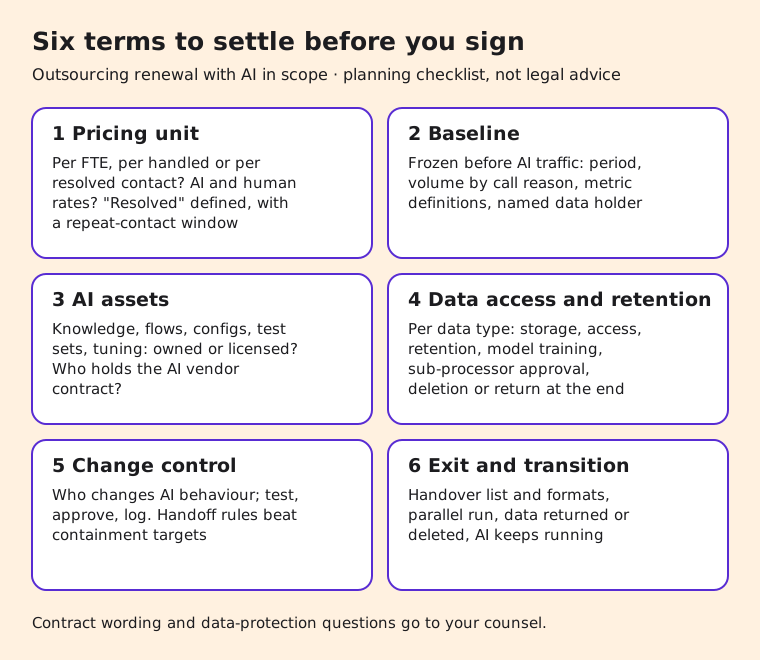
1. Pricing unit. Choose what you pay for: per FTE, per handled contact or per resolved contact, with a separate rate for AI and human handling or a single rate. Define "resolved" in the contract, for example no repeat contact on the same issue within seven days, and define how repeats are matched. If a staffing floor stays, tie it to forecast human volume after automation, not to today's headcount.
2. Baseline. Freeze a baseline before any AI traffic: the period, the volume by call reason, and the definitions of contact, transfer, abandonment, repeat contact and resolution. The new rates are only as fair as the baseline they were derived from. Name who holds the baseline data, because you will need it in month six.
3. Ownership of AI assets. An AI deployment produces things a staffing contract never covered: knowledge content, conversation flows and prompts, test sets, routing and handoff configuration, tuning made from your call data, and transcripts. Settle which of these are yours, which are licensed to you, and which stay with the provider or its AI vendor. Settle as well who holds the contract with the AI vendor: the outsourcer, you, or both. That one choice decides how hard it is to change outsourcer later without starting the AI again.
4. Data access and retention. List each data type, such as recordings, transcripts, AI logs and summaries. For each, set where it is stored, who can access it, how long it is kept, and whether it may be used to train or improve any model beyond your deployment. In the UK, where you are the controller and the outsourcer processes data for you, Article 28 of the UK GDPR sets out what the processing contract must contain. It covers prior written authorisation before another processor is engaged, which matters if the outsourcer brings in an AI vendor. It also gives the controller the choice to have personal data deleted or returned at the end of the services, and requires information to be made available for audits. In California, the CCPA regulations (§ 7051) require service-provider contracts to specify the business purposes and to limit retention, use and disclosure. Whether and how either applies to your arrangement is a question for counsel.
5. Change control. Who may change what the AI says or does? That covers knowledge, scripts, handoff thresholds and which call reasons it takes. How is a change tested and approved, and where is it logged? Put two things in writing. Containment targets never override the agreed handoff rules. And a change that affects customers, such as a new call reason or new wording about fees, needs your approval before release.
6. Exit and transition. Specify what is handed over at exit, in which formats, and over what period. That includes knowledge, flows, configurations, test sets, recordings and transcripts, or confirmed deletion. Specify how routing moves and whether the AI keeps running during transition. If the outsourcer holds the AI vendor contract, agree how licences or a direct contract can continue so customers don't lose the service on the day the outsourcing ends.
Worked example: the same month priced three ways
The figures below are fictional, chosen to show how the pricing unit changes the bill. They aren't market rates.
Baseline month: 40,000 contacts handled by 50 FTE at $3,600 per FTE-month, a total of $180,000. Of those contacts, 38,000 counted as resolved (no repeat on the same issue within seven days).
AI month: the AI agent handles 12,000 contacts and people handle 28,000. Of the AI-handled contacts, 2,400 come back on the same issue within seven days. Of the human-handled contacts, 1,600 do.
| Per FTE, 45-FTE floor | Per handled contact, two rates | Per resolved contact, two rates | |
|---|---|---|---|
| Rate basis | $3,600 per FTE + $9,000 AI pass-through | $4.50 human / $1.20 AI | $4.74 human-resolved / $1.40 AI-resolved |
| Billed units | 45 FTE (pro-rata need: 35) | 28,000 human + 12,000 AI | 26,400 human + 9,600 AI resolved |
| Month total | $171,000 | $140,400 | $138,576 |
| Change vs $180,000 baseline | −$9,000 | −$39,600 | −$41,424 |
| Pays for contacts that came back? | Hidden in headcount | Yes: 4,000 repeat contacts billed | No |
How the rates were derived: $4.50 is the baseline cost divided by 40,000 contacts, and $4.74 is the baseline cost divided by 38,000 resolved contacts, rounded. The AI rates and the pass-through are fictional negotiated figures.
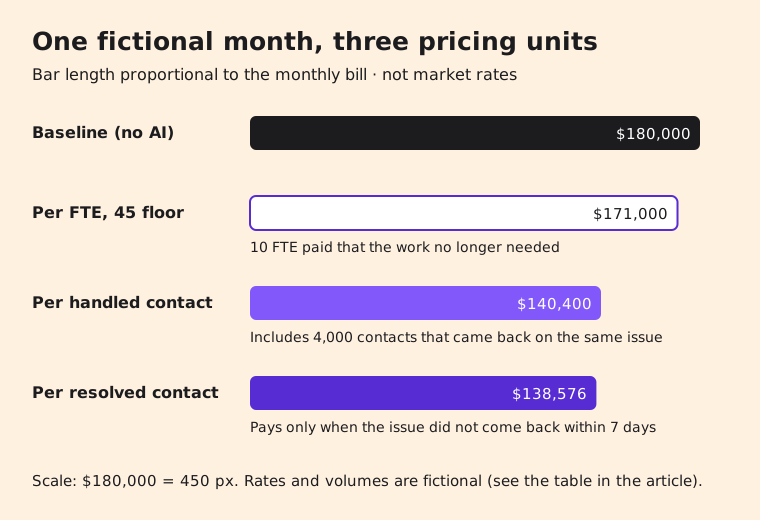
The headline lesson is that the staffing floor kept most of the savings with the provider. With a floor of 45 FTE against a need for 35, the client paid for 10 people the work no longer required.
The second lesson is less visible. The two per-contact models land within $2,000 of each other this month. But the handled-contact model pays for 4,000 contacts that didn't solve the customer's problem, and the more contacts the AI contains at this repeat rate, the more of the bill goes to contacts that came back: 20% of AI-handled contacts came back in this example (2,400 of 12,000), against about 6% of human-handled ones (1,600 of 28,000). The resolved-contact model pays only when the problem went away. That gives both sides a reason to send hard cases to a person early. It also costs more to measure, which is the next term.
Baseline, measurement owner and monthly reconciliation
A resolved-contact price is only as good as the count behind it. Three systems usually hold part of the truth: the AI platform's logs, the outsourcer's contact-centre and workforce data, and your CRM or ticketing system. Agree in the contract:
- Who owns the count. You, the outsourcer, or a report both sides can query, with the other side able to audit.
- How repeats are matched. Same customer identifier, same issue category, within the agreed window. What happens when the identifier is missing.
- Monthly reconciliation. Totals from all three systems, unmatched records listed, a dispute window, and who decides.
- Quality sampling. A fixed number of AI-handled and transferred contacts reviewed each month against an agreed form. Results are reported separately from the billing count, so quality can't be traded for volume.
- Baseline re-set rules. When a new product launch or policy change shifts the call mix, how the baseline is adjusted, and who signs off.
If you can't measure resolution reliably yet, start with the two-rate handled-contact model plus a repeat-contact report, and agree a date to move to resolved-contact pricing once the measurement has run cleanly for a set number of months.
Exit and transition of knowledge, recordings and configurations
Exit terms get the least attention at renewal and cost the most later. Write down:
- The handover list: knowledge content, conversation flows and prompts, routing and handoff configuration, test sets with expected results, and the change log.
- Data at exit: recordings, transcripts and AI logs returned in a stated format or deleted, at your choice, with written confirmation. Any copies the provider must keep by law are named.
- Transition period: how long the outgoing provider supports a parallel run, the rate for that period, and who answers callers if the AI is switched off mid-transition.
- The AI vendor relationship: whether your organisation can contract directly with the AI vendor, or take over the existing configuration, without rebuilding it.
A useful test is to ask the outsourcer to walk through what would happen if you moved to a different provider on the last day of the term. If the answer is "the AI stops and you start again", the exit terms aren't finished.
Questions for your counsel and procurement team
- Who is the controller and who is the processor for each data type, and does the AI vendor need written authorisation as a sub-processor?
- Which assets in term 3 are owned by us, licensed to us, or retained by the provider, and does the licence survive exit?
- Does the definition of "resolved" hold up when the customer identifier is missing or shared?
- Is any minimum staffing commitment tied to forecast human volume after automation?
- Which changes to AI behaviour need our approval, and is the change log auditable?
- What is our right to audit AI logs and quality samples, and on what notice?
- What happens to recordings and transcripts at exit, and in what format?
If you want to test the numbers before you commit, run a capped pilot on one call reason alongside the renewal, with the baseline and resolution definitions above written into its acceptance criteria. The AI call center page describes how NextLevel scopes enterprise pilots and production rollouts. Commercial terms are agreed per scope.
FAQ
Should we pay per FTE or per contact once AI is involved?
Per-FTE pricing with a staffing floor tends to hide automation savings. Per-contact pricing shows them. Pricing per resolved contact aligns incentives most closely, but only if both sides agree how resolution is measured.
Who should own the AI configuration and knowledge?
Decide it explicitly at renewal. If the outsourcer owns or holds everything, changing provider later can mean rebuilding the AI from scratch.
Is this legal advice?
No. It is a planning checklist. Contract wording and data-protection questions go to your counsel.