
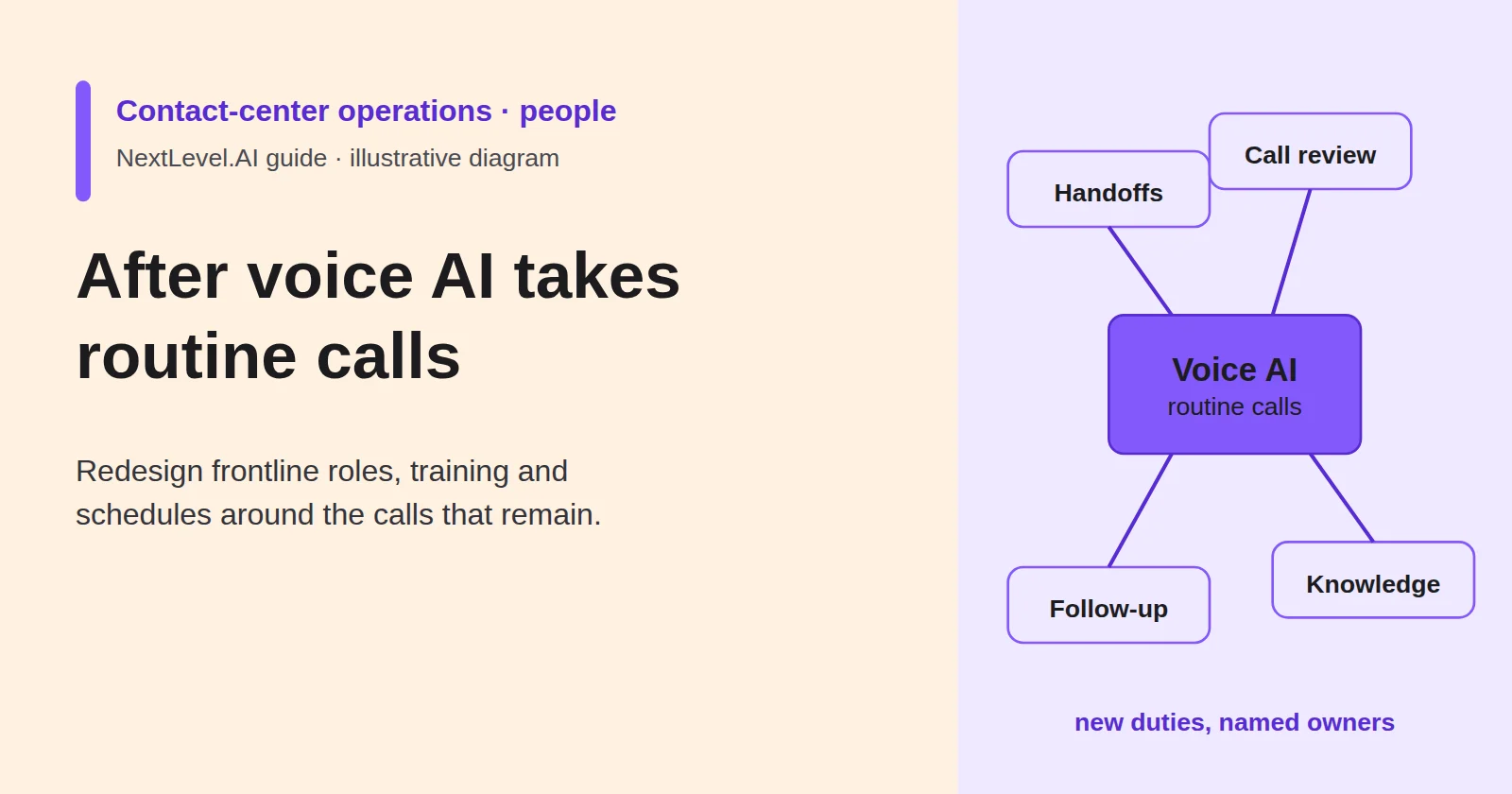
The pilot is approved. From next month, a voice agent will answer two of your most common call reasons, such as order status and password resets, and pass anything it cannot finish to your team. Your agents are already asking what that means for them. Your workforce planner wants to know whether the schedule changes. You have no clear answer yet, because nobody has described what the remaining human queue will look like.
Start there. Describe the calls people will still take, name the new duties and who owns them, train for those duties, and re-plan capacity from the new call mix rather than from a percentage of calls removed. This guide works through each step with a fictional 40-agent contact center. It does not give labour-law, union or redundancy advice, and it does not promise that automation reduces headcount. NextLevel sells voice agents for contact centers.
What the remaining queue looks like after automation
When routine calls move to the AI, the calls left for people are not a smaller copy of the old queue. They fall into four groups, and it helps to tag a sample of pilot-period calls by how each one arrived:
- Direct calls for reasons the AI does not handle: complaints, disputes, sensitive situations and anything outside its scope.
- AI handoffs, where the agent started the call and passed it on with a summary.
- Failed automation, where the AI could not finish and the caller reached a person without a useful summary.
- Requested a person, where the caller asked for a human early on.
The mix changes the work in three ways. Average handle time per human call rises, because the quick calls have gone. Emotional load rises, because more of what remains involves a problem or a frustrated caller. And some calls now arrive mid-conversation, so the first job is to read the summary and avoid asking the caller to repeat themselves.
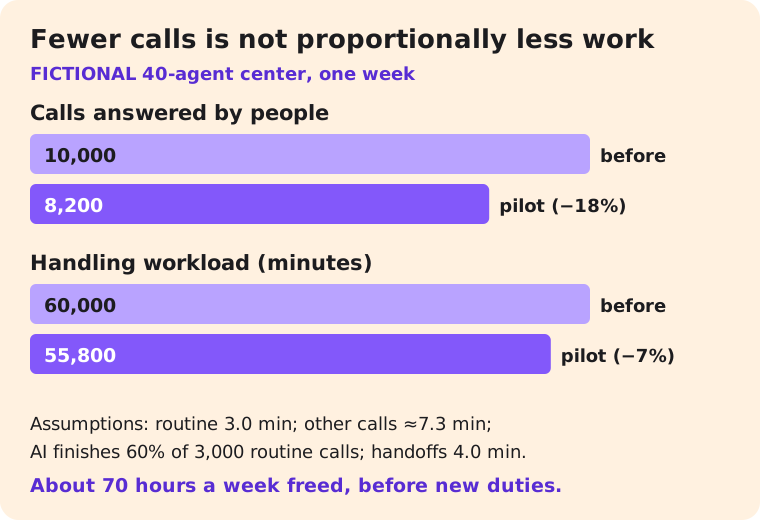
The arithmetic matters more than people expect. In the fictional center below, the pilot moves 3,000 routine calls a week to the AI. The AI finishes 60% of them and hands 40% to people. All figures are invented to show the method.
| Fictional week | Before pilot | During pilot |
|---|---|---|
| Calls answered by people | 10,000 | 8,200 (7,000 direct + 1,200 AI handoffs) |
| Average handle time per human call | 6.0 min | 6.8 min |
| Human handling workload | 60,000 min | 55,800 min |
| Change | −18% calls, −7% workload |
The assumptions: routine calls took 3.0 minutes, all other calls about 7.3 minutes (which is what makes the old average 6.0), and handed-over calls take 4.0 minutes because part of the work is already done. With those inputs, 18% fewer calls frees only about 7% of handling time, roughly 70 hours a week. Your own numbers will differ. What carries over is the shape: removing the short calls shrinks the call count much faster than it shrinks the workload.
Duties that appear and who owns them
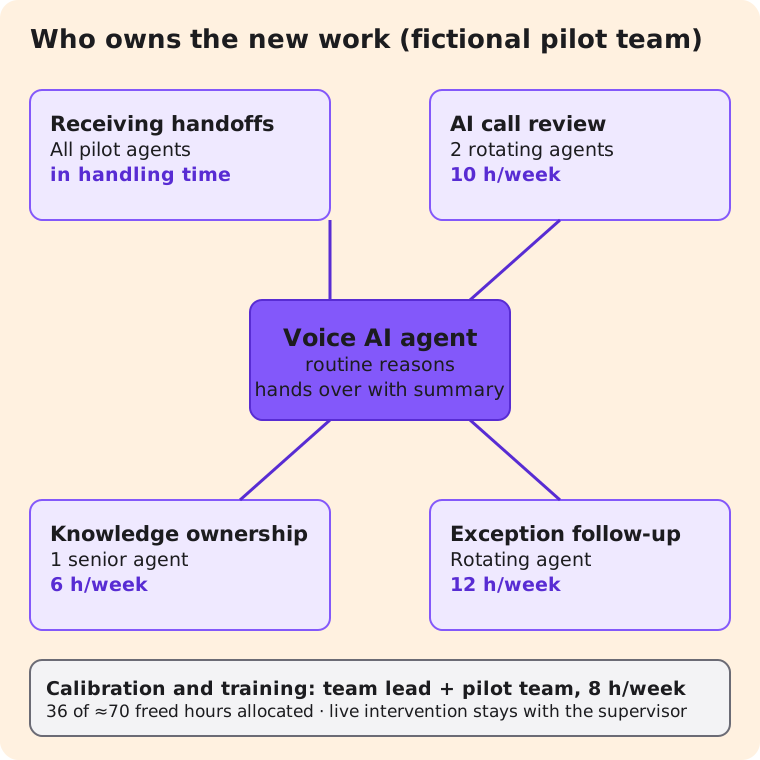
The roughly 70 freed hours do not sit idle. A working AI agent creates its own duties, and each needs a named owner and a time allowance, or it will be done in spare minutes or not at all.
| Duty | What it involves | Owner (pilot team) | Fictional allowance |
|---|---|---|---|
| Receiving AI handoffs | Read the summary, confirm rather than re-ask, finish the call | All pilot-team agents | within handling time |
| AI call review | Listen to a sample of AI-handled calls, tag errors, raise fixes | Two rotating agents | 10 h/week |
| Knowledge ownership | Keep answers and procedures current; approve changes | One senior agent | 6 h/week |
| Exception follow-up | Call back failed actions, close loose ends | Rotating agent | 12 h/week |
| Calibration and training | Align review tagging with QA; practise new skills | Team lead + pilot team | 8 h/week |
That is 36 of the 70 freed hours in the example, before any change in absence, training or attrition. The remaining 34 hours are real capacity, but that is roughly one full-time agent's week, not the seven or so agents that an 18% fall in calls might suggest in a 40-agent team.
Rotate the review duty rather than giving it permanently to one person. Listening to AI calls all day is tiring, and a rota spreads familiarity with what callers hear before they reach a person. Feed the review from the failed-automation calls first. They show where the AI's scope or knowledge needs to change, and they are the calls that cost your agents the most time.
Two boundaries keep the duties clear. AI call review is quality work done by frontline agents. It is not the supervisor's authority to stop or re-route live traffic, which NextLevel's AI agent supervisor guide covers. Knowledge ownership means approving what the AI says, so the person who owns it needs authority to change it, not just to report problems.
Skills and training plan
Each new duty implies a skill, and most can be practised before go-live using recordings and sample calls.
| Skill | Frontline (pilot team) | AI call reviewer | Knowledge owner | Team lead |
|---|---|---|---|---|
| Taking a handoff without re-asking | Required | Required | Required | Required |
| Calming a caller already frustrated by automation | Required | Useful | — | Required |
| Tagging AI errors consistently | Useful | Required | Required | Required |
| Writing answers that work when spoken | — | Useful | Required | Useful |
| Raising a change request with evidence | Useful | Required | Required | Required |
A practical plan for the fictional pilot team of eight agents, drawn from the forty:
- Before go-live: two sessions on reading handoff summaries and on the new call mix, using recorded or synthetic calls. Agree the error tags with QA.
- First two weeks: pilot-team agents listen to a small number of AI calls each day, so they know what callers hear before reaching them.
- Weekly: a short calibration in which reviewers tag the same five calls separately and compare.
- Assessment: observed behaviour on real calls, such as how many handoffs were finished without asking the caller to repeat details, not attendance at sessions.
Choose pilot-team members for the skills the residual queue needs, not only for seniority.
Not every agent will want review or knowledge work, and the plan does not need everyone in every duty. What everyone on the team does need is to keep the routine call skills current. If the AI is paused, those calls come back to people at short notice, and an agent who has not handled a password reset for three months will be slower than the staffing plan assumes.
Scheduling and capacity
Do not cut scheduled staff before the pilot has measured the new handle time and the new arrival pattern. The before-and-after table above is a planning estimate. The measured version comes from the first weeks of the pilot.
Re-run your staffing model with three changes. First, use the residual queue's own volume by interval and its own handle time. Handoffs arrive when the AI escalates, which may not match when routine calls used to arrive. Second, add the new off-phone duties as planned time, the same way you plan training and meetings, so review and knowledge work are not squeezed out at peak times. Third, keep a fallback plan. If the AI has to be switched off during an incident, people must be able to absorb the routine calls again for a while. Decide in advance how many agents that needs and how quickly they can be moved.
NextLevel's high call volume guide walks through the Erlang C calculation with shrinkage, and you can plug the residual-queue figures straight into it.
Communicating the change to the team
If agents hear about automation before they hear what it means for them, they fill the gap themselves. Close it early, and say only what has actually been decided.
- Explain which call reasons are moving to the AI, from when, and that this is a pilot.
- Describe the new duties and who will do them in the pilot team.
- Be clear about what is decided and what is not. If leadership has made a decision about roles or numbers, say it plainly. If it has not, say so. Do not offer reassurance that nobody has authorised.
- Where your organisation has HR, works-council or union processes for changes to roles, involve them through those processes. This guide does not advise on them.
- Ask agents to report AI mistakes they see in handoffs, and show them what changed as a result.
- Repeat the update once the pilot has real numbers.
Signals the plan is working
Watch a few indicators from the first week, each with a named owner:
- Handoffs finished without re-asking, checked on a weekly sample.
- Handle time on AI handoffs, which should be stable or falling as summaries improve.
- Review backlog, with sampled AI calls reviewed within the week.
- Knowledge changes made from agent reports, as a count of fixes, not of reports filed.
- Service level on the residual queue, measured on the calls that reach people.
- Agent confidence, from a short pulse survey.
- Absence and attrition, owned by HR and treated as lagging signals, not proof either way.
If handoffs keep arriving without usable summaries, fix that before anything else. It affects every other measure on the list.
Plan the pilot team with the pilot
Role design works best when it is planned alongside the pilot scope rather than after launch. If you are scoping a contact-center pilot, bring your current call-reason mix and the team you have in mind to a conversation about NextLevel's AI call center, and plan the duties, training and fallback staffing in the same piece of work.
FAQ
Will voice AI let us reduce headcount?
This guide does not promise that. In the fictional example, an 18% fall in human calls freed only about 7% of handling time, and new duties absorbed about half of that. Measure your own pilot before making staffing decisions.
Who should review AI-handled calls?
Frontline agents on a rota work well for review, because they know the calls. Authority to stop or re-route live traffic belongs to a supervisor role.
Do agents need technical skills to work alongside a voice agent?
Not deep ones. The main new skills are reading a handoff summary, tagging errors consistently and writing answers that work when spoken.
How long should the transition plan cover?
At least the pilot period plus the first weeks after a production decision. Revisit it whenever the AI's scope changes.