
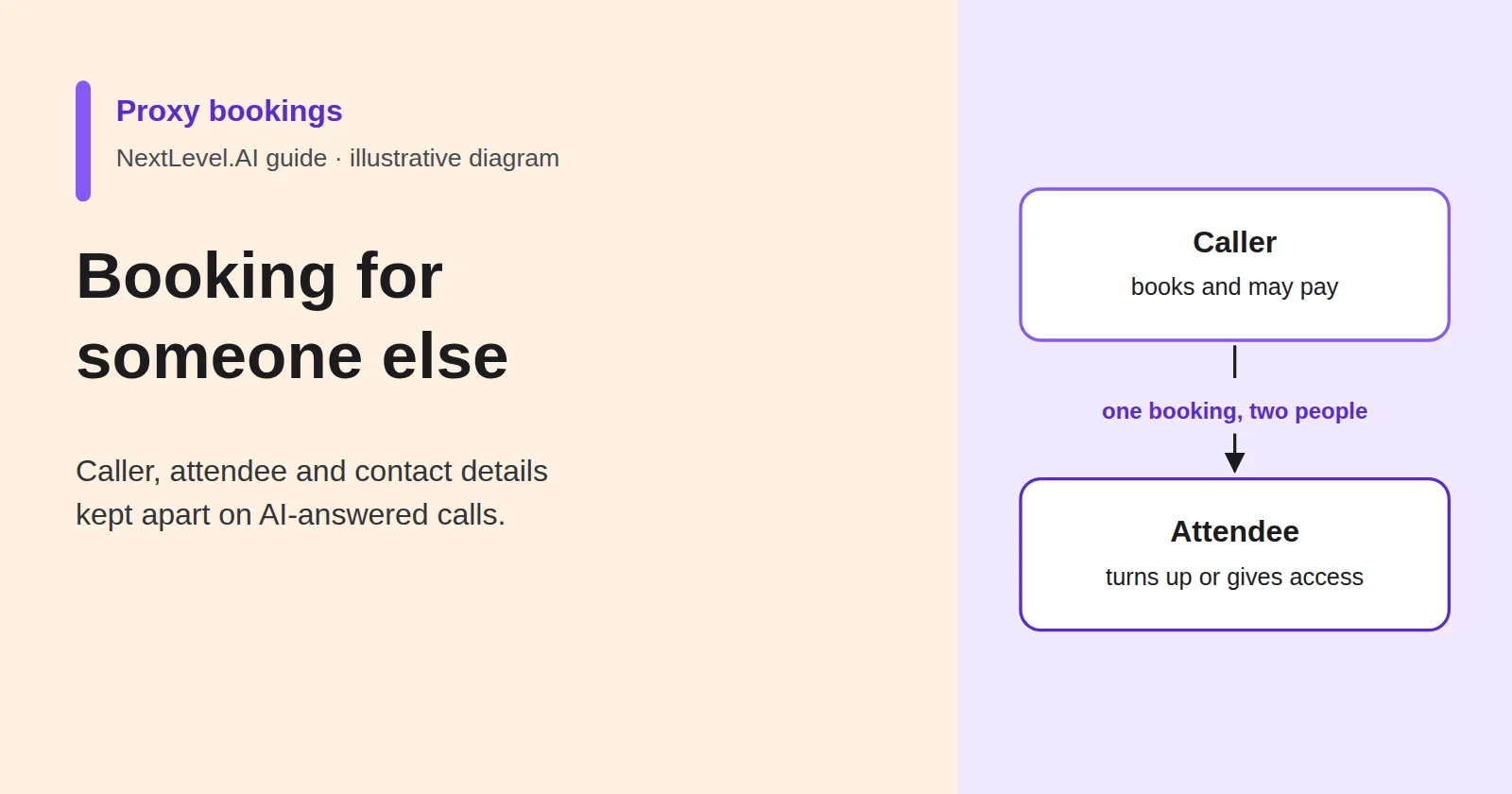
A daughter books a boiler service at her father's house. A letting agent or property manager books a repair for a tenant. An assistant books a car service for their manager. In each case the person on the phone is not the person who will open the door, sit in the chair or hand over the keys, and a booking form with one name and one number cannot tell the difference.
This guide is for service businesses whose phone is answered by an AI agent. It sets out the fields a proxy booking needs, who may change it later and when the agent should hand over to a person, with a filled example and six test calls. It does not cover healthcare, legal or financial appointments, which carry their own rules. NextLevel sells voice agents; the examples are fictional.
Four common proxy calls and why one name field fails them
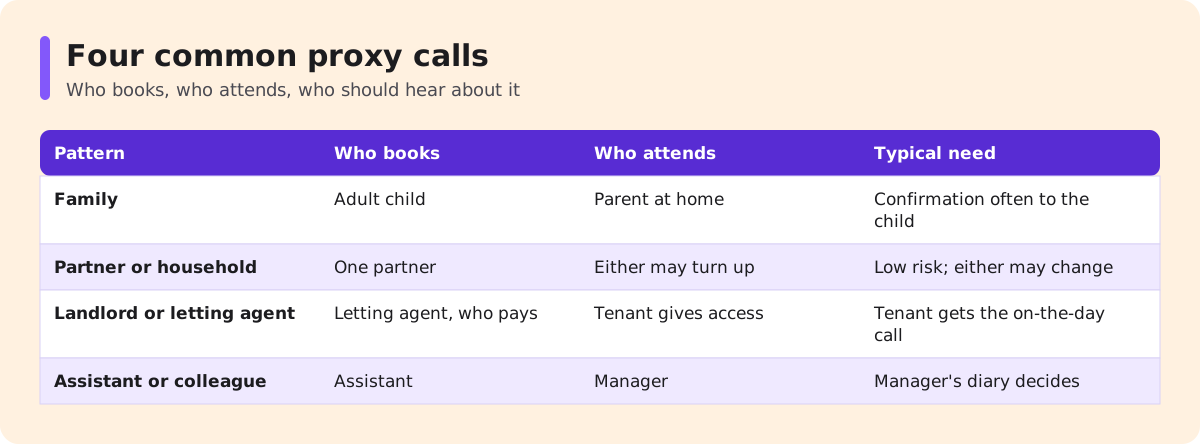
Most proxy bookings fall into four patterns:
- Family: an adult child books a repair or a visit at a parent's home. The parent lets the engineer in; the child often wants the confirmation.
- Partner or household: one person books a service for another, such as a haircut, a car valet or a pet appointment. Either may turn up.
- Landlord or letting agent: the letting agent books and pays; the tenant gives access and knows the problem best.
- Assistant or colleague: someone books for their manager, who attends and may never have heard of your business.
With one name field, the agent records whoever spoke. The confirmation text goes to the caller, not the person who needs to be home. The engineer rings the caller on the morning of the visit and reaches someone in an office across town. When the attendee calls to move the time, there is no booking in their name and the agent either cannot find it or, worse, changes a booking for someone it has not identified. Each failure looks like a small admin slip. Together they produce missed visits and wasted trips, and the agent took the call perfectly well.
The fix is not a smarter agent. It is a booking record that keeps the caller and the attendee apart and says which contact is used for what.
The field set: caller, attendee, confirmation contact
Ask one question early in the call: "Is the appointment for you or for someone else?" Early matters, because the answer changes every question after it: whose name to spell back, whose address to confirm, whose diary sets the time. Asked at the end, it forces the agent to go back over details it has already written to the wrong person. If the appointment is for someone else, the agent collects a short set of extra fields.
| Field | What it holds | Asked when |
|---|---|---|
| Caller name and number | The person on the phone | Always |
| Relationship | Daughter, letting agent, assistant, partner | Proxy bookings |
| Attendee name | The person who will attend or give access | Proxy bookings |
| Attendee contact | A number for the attendee, if the caller offers one | Proxy bookings, optional |
| Service address | Whose address the work is at | Visits |
| Confirmation goes to | Caller, attendee or both | Proxy bookings |
| On-the-day contact | Who your staff ring when they are on the way | Visits |
| May change or cancel | Who may move or cancel the booking later | Proxy bookings |
Two of these are easy to merge by mistake. The confirmation contact is who hears that the booking exists; the on-the-day contact is who your staff ring when they are ten minutes away. For a letting agent's repair they are usually different people: the letting agent gets the confirmation, the tenant gets the call from the van.
Keep the attendee contact optional. The caller may not have it or may not want to share it, and the booking should still work through the caller. Only send confirmations to a contact the caller has said may receive them. If you text the attendee, check that your messaging consent covers that number.
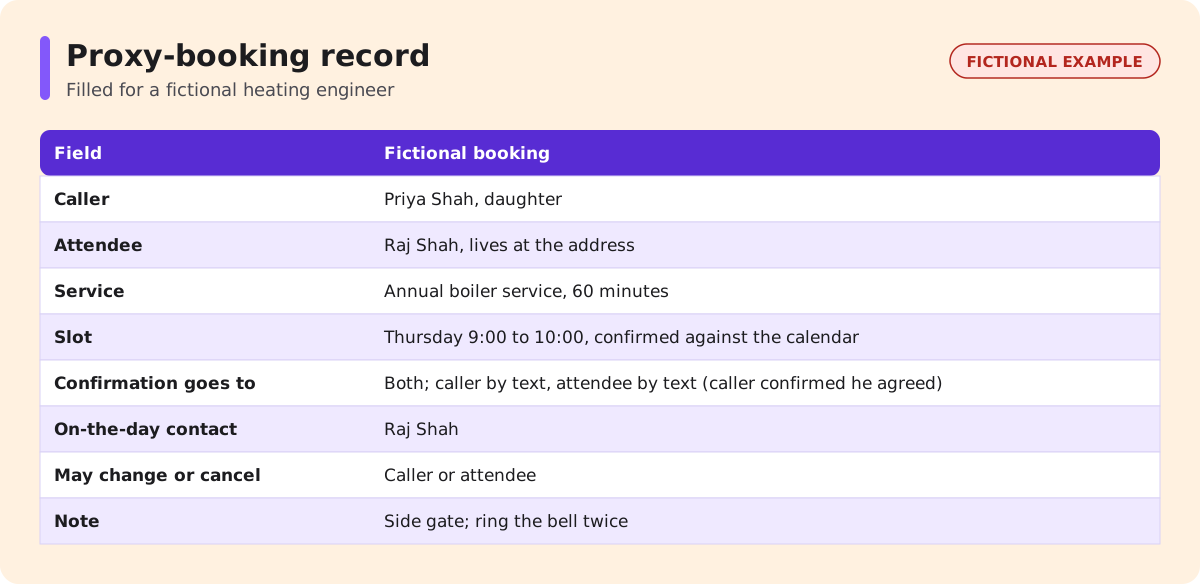
Here is a filled fictional record for a heating engineer:
| Field | Fictional booking |
|---|---|
| Caller | Priya Shah, daughter |
| Attendee | Raj Shah, lives at the address |
| Service | Annual boiler service, 60 minutes |
| Slot | Thursday 9:00 to 10:00, confirmed against the calendar |
| Confirmation goes to | Both; caller by text, attendee by text (caller confirmed he agreed) |
| On-the-day contact | Raj Shah |
| May change or cancel | Caller or attendee |
| Note | Side gate; ring the bell twice |
NextLevel's booking agent page says the agent checks configured availability and applies your booking rules before writing the result. Which of these fields your calendar or booking system can store, and where the rest go, is confirmed during setup. Read the record as your engineer would on Thursday morning: who to ring, where to go, who may move it. If any answer is missing, the record is not finished.
Who may reschedule or cancel later
The second call is where proxy bookings go wrong. Someone rings to move or cancel, and the agent has to decide whether that person may do it. Write the rule per situation instead of leaving it to the agent's judgement.
| Situation | May reschedule | May cancel | Reason for the rule |
|---|---|---|---|
| Family | Caller or attendee | Caller or attendee | Both have a stake; neither is acting against the other |
| Partner or household | Caller or attendee | Caller or attendee | Same household, low risk |
| Landlord or letting agent | Tenant may move the access time within your rules; letting agent may move or cancel | Letting agent only | The letting agent ordered and pays for the work |
| Assistant or colleague | Caller or attendee | Caller or attendee | The attendee's diary decides |
These are example rules, not the only reasonable ones. A business that takes deposits may let only the payer cancel. "Within your rules" for the tenant might mean within the same week, so a repair the letting agent ordered for Tuesday cannot drift into next month. What matters is that the rule exists before the call does.
A change from someone the table entitles to make it applies, and both contacts are told. If the father moves Thursday's visit to Friday, the visit moves. Treat an instruction as a disagreement only when it reverses or contradicts a change the other entitled person made less than 24 hours earlier (an example window; set your own), or when someone explicitly objects to the booking or a change. If the daughter rings that afternoon to move it back to Thursday, keep Friday, tell both contacts and let a person resolve it; the last instruction does not win.
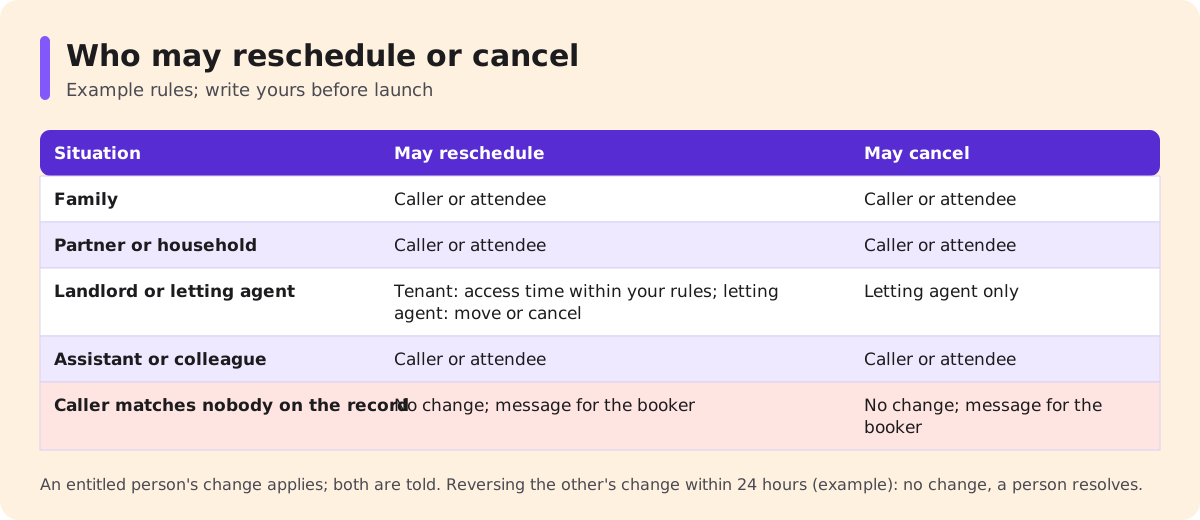
To apply it, the agent needs to find the right booking and know who is calling. Match the request against the names and numbers on the record and the booking reference if you issue one. The booking page says the agent can verify the booking, apply your change or cancellation policy, update connected calendars, offer a replacement slot and notify the relevant people. When the caller matches nobody on the record, take a message for the booker instead of making the change.
Every change should notify whoever receives confirmations, so a tenant who moves a repair does not leave the letting agent with an out-of-date diary.
When to stop and hand over (account changes, payments, sensitive services)
Some proxy requests go beyond booking a slot, and the agent should pass them to a person.
- Account changes: adding someone to an account, changing the billing address or contact details on the account. NextLevel's guide to caller authentication covers why identity checks come before account actions.
- Payments: a deposit or prepayment for someone else's booking. Use your normal payment route with the payer; do not take card details as part of the voice booking.
- Sensitive services: appointments where the attendee's own agreement matters, such as a service for a child or for an adult who may need support to decide. Your policy, not the agent, sets what happens.
- Disputes: a disagreement under the rule above, or someone without the right to cancel wants a booking cancelled.
The agent's job in each case is to say clearly that a member of the team will deal with it, record what was asked and route it to the owner.
Test six proxy bookings
Run these before launch and after any change to the booking rules. Have colleagues play the caller and the attendee.
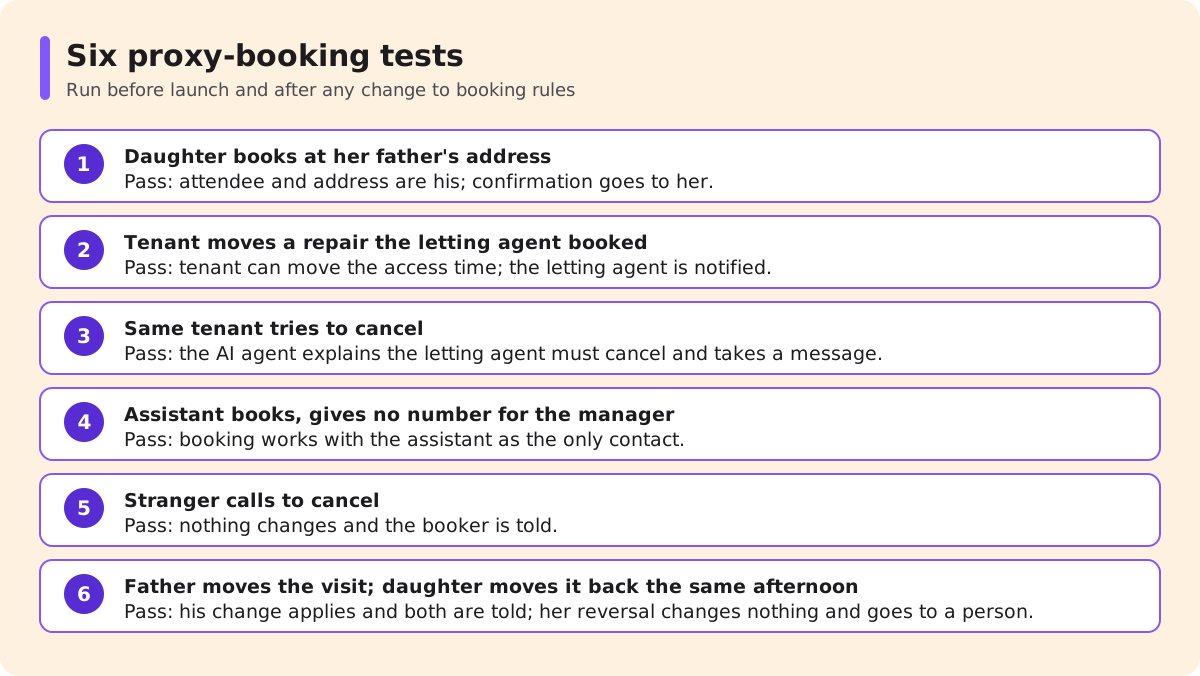
- A daughter books a visit at her father's address and asks for the confirmation herself. Pass if the attendee and address are his and the confirmation goes to her.
- A letting agent books a repair; the tenant later calls to move the time. Pass if the tenant can move the access time and the letting agent is notified.
- The same tenant calls to cancel. Pass if the AI agent explains that the letting agent must cancel and takes a message.
- An assistant books for a manager and gives no number for the manager. Pass if the booking works with the assistant as the only contact.
- A stranger calls to cancel a booking and matches nobody on the record. Pass if nothing changes and the booker is told.
- The father moves his daughter's booking to Friday; the same afternoon she calls to move it back. Pass if his change applies and both are told, and her reversal changes nothing and goes to a person.
FAQ
Should the agent always ask whether the booking is for someone else?
Yes, early in the call. It costs one question and prevents a wrong record.
What if the caller doesn't know the attendee's number?
Book with the caller as the only contact and say so on the record.
Can the attendee change a booking someone else made?
If your rule allows it for that situation, yes. Write the rule before launch.
Does this work for regulated appointments?
Healthcare, legal and financial bookings are outside this guide and need their own review.
What if the caller and the attendee want different times?
A change by either applies and both are told. If one reverses the other's change within your window, keep the booking as it stands, notify both and let a person decide.
Will the agent avoid double bookings?
It checks live calendar availability before confirming. Test it on your own calendar before relying on it.
Next step
If you take bookings by phone, book a 30-minute call with the NextLevel team from the pricing page and bring the field set and change rules above. Qualified prospects can get a working prototype on their own calendar, typically in about 2 weeks and set up with NextLevel's help; NextLevel then tunes it to their business. This is a typical time, not a guarantee. For what the agent does, see the Voice AI booking agent page.