
- Labor Cost Burden Mid-sized contact centers handling 500,000 annual interactions incur $28-35 million in direct labor expenses at $35 per hour, compounded by 75% annual employee turnover.
- Quality Blind Spots Accenture research shows 20% of insurance and healthcare interactions contain errors, while traditional quality programs monitor just 2-5% of interactions.
- 70% Cost Cuts Enterprise clients report cutting operational costs by up to 70% through automation, with 60-70% of customer inquiries resolved autonomously without human intervention.
- Faster Deployment AI platform deployment takes 1-4 months versus 6-12 months for traditional setup, with break-even within 6-12 months and 3-5x ROI within two years.
- Resolution Speed NextLevel.AI's benefits and provider network agent reduces average resolution time from 8 minutes to under 2 minutes, matching customer demands for 2-3 minute resolutions.
- Agentic Future Gartner predicts that by 2029 agentic AI will autonomously resolve 80% of common customer service issues, drastically cutting costs.

The call center industry is under real, measurable cost pressure.
The numbers behind it are less mysterious than the vendor slide decks make them sound. Costs keep climbing on the labor line. Turnover keeps bleeding trained agents out the door. And customers keep expecting faster answers than a phone queue can deliver. Meanwhile, artificial intelligence call center platforms have moved from pilot projects to a standard line item in the budget. That shift rests on advanced AI technologies. Generative AI and natural language processing let a system hold a genuine conversation. There's no more routing a caller through the rigid interactive voice response menu of a traditional contact center.
Gartner isn't hedging on where this goes. Its March 2025 forecast is specific. By 2029, Gartner predicts, agentic AI will autonomously resolve 80% of common customer service issues without human intervention. That same shift is expected to cut operational costs by roughly 30%. This isn't a vague "AI will change everything" prediction. It's a dated, sourced, five-year forecast from the analyst firm most contact center leaders already read.
This guide breaks down what traditional call centers actually cost today. It covers what an ai voice call center actually costs, too. And it shows where the two genuinely diverge, and where vendor marketing — including ours — tends to round up. NextLevel.AI builds AI voice agents for call centers. (Vendor materials also call them virtual agents, AI agents, or conversational AI.) Read the vendor-specific sections with that in mind.
Why Traditional Call Centers Are Under Cost Pressure
Labor Economics That Don't Scale
Labor is still the dominant line item in any contact center budget — typically 60-70% of total operating cost. The headline wage numbers look modest: call center agents earn roughly $16-$25 an hour in base pay across most U.S. markets. But base pay isn't what a seat actually costs. Add benefits, typically 25-40% on top of salary. Add management overhead, software licenses, and equipment. Add recruiting and training. Once you do, the fully loaded cost of a U.S.-based agent runs $25-$50 an hour — or roughly $66,000-$101,500 a year per seat. Tier-1 urban markets sit at the high end; remote or tier-2 metro providers sit at the low end. Per seat, that works out to $5,500-$8,500 a month, before counting turnover.
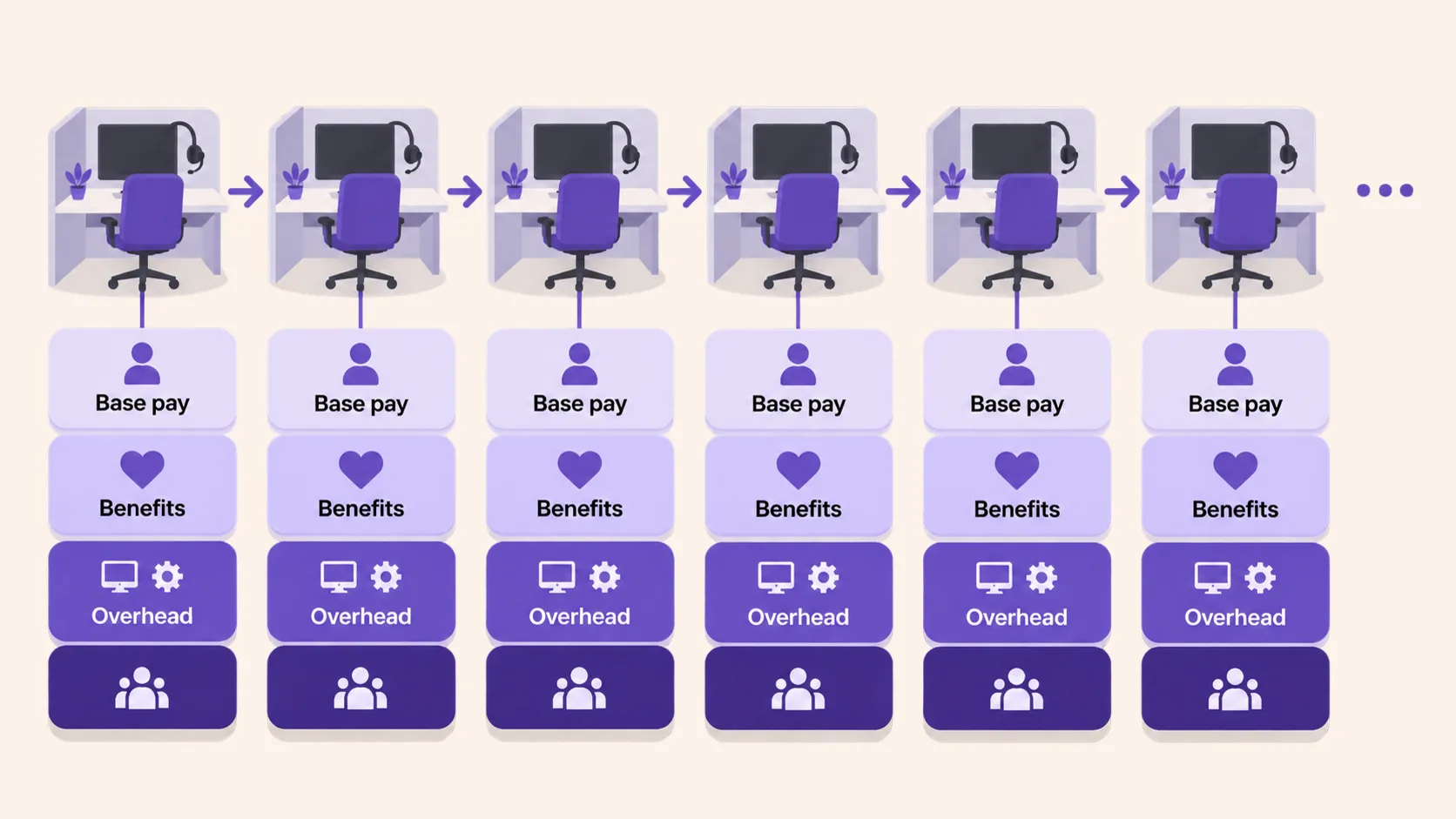
And turnover is the part that compounds everything else. QATC (the Quality Assurance & Training Connection) tracks this industry-wide. Its benchmark: average annual call center attrition of 30-45% for U.S. onshore operations. That climbs to 45-60% for offshore floors in the Philippines and India. Much of that churn tracks with occupational burnout in a repetitive, high-pressure role, not just base pay. Replacing a single agent means recruiting, background checks, training, and ramp time. That runs $10,000-$20,000 in direct cost — before counting the lost productivity while the seat sits empty or a new hire ramps up. A center running at the high end of that range isn't occasionally backfilling a seat. It's running a permanent, expensive hiring pipeline just to stay staffed.
Costs compound further. Hardware runs roughly $1,500-$3,000 per workstation. Facility buildout costs $2,500-$10,000 per seat, depending on the space. (General commercial build-outs price at $50-150+ per square foot, before furniture and network infrastructure.) Staffing adds more: one supervisor for every 10-15 agents, plus separate QA and workforce-management staff. And most centers carry 20-30% excess capacity, just to absorb volume spikes without their average speed of answer collapsing.
Quality and Consistency Gaps
Human agents are good at empathy and judgment. They're inconsistent at nearly everything else. That's not from a lack of training. Agent performance naturally varies by shift and day, as much as by the individual person answering the phone. Most quality programs can only afford to review a small sample of total interactions. Often, a problem is only flagged well after the fact, by sentiment analysis on a recording, rather than caught in the moment. That means most calls are never checked for accuracy or compliance at all.
Speed matters more than most centers assume, too. J.D. Power's customer-care research spans wireless and utility sectors. It consistently shows the same pattern: customer satisfaction tracks resolution speed and single-channel completion, not which channel handled it. In J.D. Power's wireless satisfaction research, satisfied customers spent an average of 8.1 minutes on the call. Dissatisfied customers spent 21.1 minutes. Problems bounced across multiple contact channels took 21.7 minutes to close out on the last channel used. A single channel handling the issue start to finish took just 14.9 minutes. The lesson isn't "AI is faster than humans" in the abstract. It's that fragmented systems and repeat-yourself handoffs quietly inflate call resolution times. That cost shows up first in satisfaction, and eventually in churn.
Ready to see what your own call volume actually costs against a working alternative? **Book a call** and bring a sample of your real call types — that's a more useful conversation than another projection.

How AI Voice Agents Change the Cost Structure
What Actually Moves When You Automate
The honest version of the AI pitch isn't "replace every agent." It's a hybrid model that divides the work between AI and human agents. AI voice agents absorb the high-volume, low-complexity, repetitive share of calls. Think balance checks, appointment scheduling, order status, routine troubleshooting. Anything requiring judgment, empathy, or an exception gets handed off to a live agent, with full context attached. That's a very different claim from "thousands of simultaneous conversations." No deployed platform we're aware of, including ours, actually operates at that number. NextLevel.AI's real concurrency ceiling runs 3-5 simultaneous conversations for SMB deployments. It's 50-100 for a managed enterprise pilot, and up to 100+ for full enterprise deployment. There's no cap on total dial attempts or daily call volume — just on how many conversations run at the exact same instant.
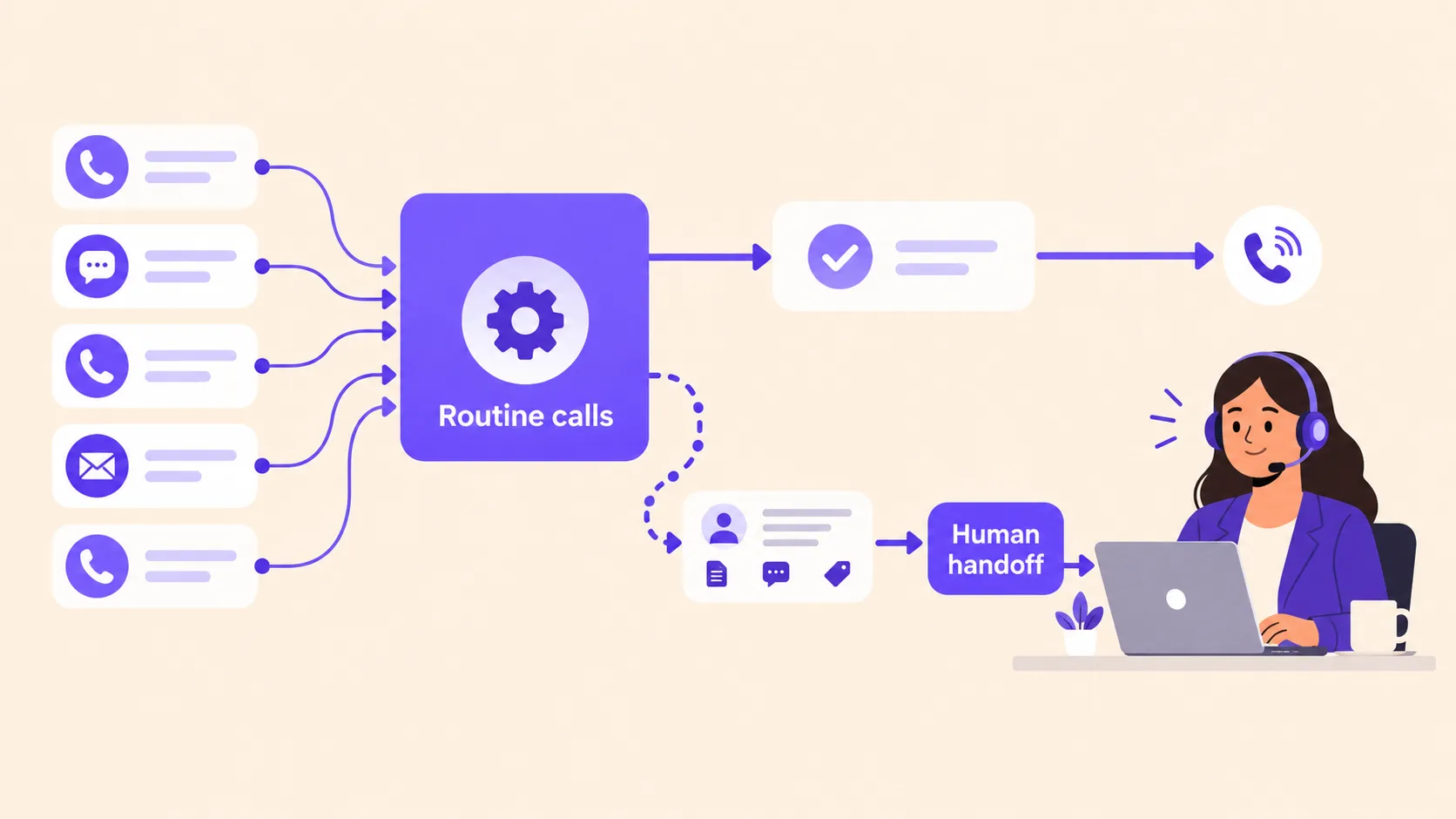
Inside that real ceiling, the call center cost savings are still substantial. Zero recruiting or training cost per agent. No facility overhead. No shift premiums, no overtime, no peak-time overstaffing — capacity scales up and down with actual volume instead of headcount. The goal isn't just fewer humans on the phone. Done right, it's meant to improve agent productivity for the humans who remain, since they inherit only the calls that actually need a person. Look across the AI-call-center vendor market broadly, not just NextLevel. Published cost analyses and case studies converge on a wide but consistent range. Per-interaction costs typically drop 70-90%: from roughly $5-$25 per traditional interaction, to $0.50-$5 for an AI-handled one. Total operating-cost reductions land in the 30-70% range, depending on call mix, volume, and how much of the workload is genuinely automatable versus still requiring a human. Treat anything above that range, from any vendor, as a claim that needs a named case behind it, not an average.
Consistency, Compliance, and What We Can Actually Prove
Where AI outperforms categorically, not just economically, is consistency. The same script, the same policy adherence, the same tone — on interaction number one, and on interaction number ten thousand. There's a full transcript for every one of them, not a 2-5% sample. An ai voice call center built this way doesn't just answer faster. It answers the same way every time. That's what makes it auditable in a way a rotating shift of human agents structurally can't be. NextLevel's platform supports natural conversation in 30 languages, including native voice models rather than machine-translated scripts. That's available at the Business tier and above.
For regulated industries, compliance posture matters more than the sales pitch. Here's ours, stated plainly rather than rounded up. NextLevel.AI holds an independently attested SOC 2 Type I report. That's an attestation report, not a certification — and the distinction matters. NextLevel also holds genuine ISO/IEC 27001:2022 certification, valid to February 2028. HIPAA, GDPR, and PDPL alignment carry business associate agreements where applicable. ISO 42001 (AI management systems) is in progress, not yet achieved. Evidence is available under NDA. Any vendor who answers a compliance question with a flat "we're compliant" and nothing more specific is worth a second, harder question.
What Things Actually Cost: Software, Hardware, and Facilities
Traditional Infrastructure Investment
Call center costs break into a few clear categories. On one side is the fixed overhead of running call center operations. On the other is the variable, per-interaction cost. Call center software licensing alone runs $10-$50 per agent monthly for basic voice-only tools. Mid-tier omnichannel platforms run $75-$150. Add AI-assisted QA, workforce management, and predictive analytics, and it climbs past $200 per agent monthly. Hardware runs $1,500-$3,000 per workstation. Facility costs scale with the build. A functional buildout runs $2,500-$10,000 per seat. General commercial build-out costs add $50-150+ per square foot, on top of network infrastructure and ongoing utilities. Training-program development for a mid-sized operation is its own five- or six-figure exercise, separate from per-agent onboarding cost.
Add it up per seat, fully loaded. That's salary and benefits, software, hardware amortization, facility allocation, and management overhead. You land close to the $66,000-$101,500 annual figure cited earlier — before counting the 30-45% of those seats that turn over every year.

The AI Platform Investment Model
NextLevel.AI's pricing runs on a completely different axis: platform license plus usage, not per-seat. A web-chatbot-only deployment starts at $49/month. Inbound voice for a small or mid-sized business runs from $49/month (1 phone line, 300 voice minutes) and $175/month (3 concurrent conversations, 1,000 voice minutes, 5 languages), up to $385/month (5 concurrent, 2,500 voice minutes, 30 languages). Outbound/outreach deployments start at $500/month, scaling to $1,250/month at higher volume tiers. Enterprise pilots run $1,000/month for up to a 3-month managed pilot (50-100 concurrent conversations, 100 voice hours, 30 languages). That auto-converts to a $2,500/month ($30,000/year) managed tier, at up to 100+ concurrent conversations and 3,000 voice hours. Private cloud deployment is for data-residency-sensitive institutions. It starts at $50,000/year, plus a one-time deployment cost. Pay-as-you-go voice usage runs roughly $10-$10.50 per hour on top of a platform tier — about $0.17-$0.18 per minute. That's in the same range as the per-minute rates competing voice AI platforms publish. The platform connects to what you're already running: customer relationship management (CRM) software such as HubSpot, Pipedrive, and Zoho on the SMB side. It also connects to enterprise telephony, like Avaya, Genesys, Cisco, Five9, and Ziwo. In all, there are 100+ integrations via n8n and Zapier, rather than requiring a system replacement first.
Deployment timelines follow the same usage-based logic. A working prototype is typically ready on a test line in 2 days. SMB inbound or outbound deployments generally go live in 1-2 weeks. A website chatbot can go live in as little as a day. Enterprise deployments run a 2-4 week managed pilot before full rollout, landing at 1-3 months depending on integration scope. Two engagement models exist. In done-for-you, NextLevel builds and keeps tuning the agent at no setup cost — you're billed once it's live. In software-only, you get full dashboard access from day one and configure it yourself.
Where This Actually Runs in Production
Most vendor pages describe capability as a list of narrowly named bots: a claims bot, a renewals bot, a benefits bot. That's as if a business needs five separately branded products stitched together. It's not how NextLevel's deployment works. The AI Insurance Agent, for example, is a single configurable agent. It's built around a carrier's or broker's actual call types. Think benefit and network questions, prior-authorization and claim-status inquiries, renewal outreach, and onboarding logistics. All of it runs on shared context, so a caller isn't re-explaining themselves on a follow-up. Anything touching a coverage decision, a denial, or a recommendation still routes to a licensed human. That's a regulatory line, not a UX preference.
The same agent runs across channels: inbound and outbound phone calls, website chat, mobile app, SMS, and WhatsApp. Conversation context carries across all of them, through a shared memory layer. So a customer who starts on the website, and later calls in, doesn't start over. That omnichannel continuity — not any single channel — is usually where the real handling-time savings show up. An agent, human or AI, working from full context resolves a call faster than one starting cold. That's a straightforward efficiency gain, not a magic trick.
For outbound-heavy operations specifically, the AI Call Center use case covers this. Telemarketing costs drop for a structural reason, not a magic one. The platform dials, qualifies, and routes at whatever pace the campaign needs. There's no adding headcount for a seasonal push, and no paying overtime for an after-hours run. Dave, CEO of a national UK oven-cleaning brand running outbound lead response on NextLevel, put it this way: "Every lead now gets a call within minutes — even at 9pm on a Sunday… books the job before a competitor ever picks up the phone."
Talk through your actual call mix and see where the real numbers land for your volume. **Book a call** — bring your call logs, not just your assumptions.
Call Center Rates and Pricing Models: The Real Numbers
Call center pricing models fall into a handful of recognizable patterns, whether the vendor is a traditional BPO or an AI platform. Here's what each one actually charges.
What Traditional Centers Actually Charge
Outsourced call center pricing in 2026 gets quoted four different ways. It's worth knowing all four before comparing anything to an AI platform's rate card: per agent-hour ($6-$45, depending on onshore, nearshore, or offshore location), per dedicated seat ($1,600-$7,500 monthly), per inbound call ($0.50-$1.50), and per talk-minute. On the per-minute cut specifically, U.S. onshore rates typically run $0.75-$1.75 per minute. Offshore rates (Philippines, India) run $0.45-$0.80 per minute. Offshore is the cheaper option, not domestic — worth correcting, since it's a common mix-up in cost comparisons. Layer on after-hours premiums (roughly 20-40%) and hidden fees or surcharges (15-25% on top of the quoted rate). The effective call center price climbs well past the headline number on the sales sheet.
How AI Voice Agent Pricing Actually Differs
Usage-based AI pricing removes the per-seat floor entirely. Instead of paying for a dedicated seat whether it's busy or idle, you pay for platform access plus the conversations that actually happen. NextLevel's channel metering, for reference, runs $0.15/$0.12 per email and $0.05/$0.04 per SMS or WhatsApp message (tier-dependent). Connected voice calls are billed in 30-second increments. And here's a genuinely useful detail buried in the fine print: unanswered, busy, or rejected call attempts cost $0. A campaign that dials aggressively and gets voicemail half the time isn't paying full rate for that half.
There's no single call center price that applies across the industry. Any vendor who hands you one exact savings number, without asking about your call mix first, is guessing. Reducing call cost is ultimately about total cost per resolved interaction, not the per-minute number in isolation. What you can do honestly is run your own volume against real unit costs. Take your actual monthly interaction count. Multiply by your real blended cost-per-interaction (most traditional centers land somewhere in the $5-$25 range cited earlier). Compare that against a usage-based platform quote, scoped to your actual concurrency and language needs. It's a five-minute exercise with your own numbers — and a more honest answer than a marketing slide.
NextLevel.AI vs. Bland AI and Instantly AI: What's Actually Public
Is NextLevel.AI a Bland AI Alternative?
Here's a quick Bland AI company overview, based entirely on what's public. Bland is a developer-first voice AI API, priced per minute plus a monthly platform fee. Plans run: Start (free, $0.14/min, 10 concurrent calls, 100/day cap), Build ($299/month, $0.12/min, 50 concurrent, 2,000/day cap), Scale ($499/month, $0.11/min, 100 concurrent, 5,000/day cap), and a custom Enterprise tier with on-prem/VPC deployment. On Bland AI revenue: the company is privately held and doesn't publish revenue figures. So any specific number attributed to them is someone's estimate, not a disclosed fact — including in this article. What is public and verifiable is its funding trajectory. That's a $16 million Series A in August 2024 (Scale Venture Partners, Y Combinator). It's a $40 million Series B in January 2025 (Emergence). And it's a $50 million Series C in June 2026 (Dell Technologies Capital, HubSpot Ventures, and others). Together, that's total disclosed funding above $100 million. That's real investor confidence in the voice-AI category broadly. It isn't the same thing as a specific product being the right fit for a regulated enterprise call center.
The actual difference isn't "better" or "worse." It's what each platform is built for. Bland's pricing and documentation are built for developers assembling their own voice workflows on top of an API. NextLevel.AI is built for a different buyer. That's one who wants the call flows, the compliance posture, and the CRM/telephony integration already mapped to their industry: healthcare, insurance, financial services. It comes with a done-for-you build option, so nobody has to staff prompt engineering internally just to keep an agent working. If you're evaluating a bland ai alternative, that's the actual axis to judge on. Do you want to build the flows yourself? Or do you want them built around your specific call types from day one?
Instantly AI: A Different Category, Not a Direct Competitor
Instantly AI cost comparisons come up in the same searches as call center pricing. But Instantly's own pricing page tells the real story. It's a sales-engagement and cold-email platform, not a voice or call center product. Plans run from Growth at $47/month through Lightspeed at $358/month, for outreach sending alone. Lead-database credits and CRM are sold as separate add-ons. A fully-equipped stack (sending, leads, CRM) typically runs $150-$275+/month in practice. Nowhere on Instantly's pricing page is there any mention of voice, phone calls, or call center capability. For teams running email cold outreach, that's a reasonable, well-priced tool. But for anything requiring an actual phone conversation — inbound support, outbound calling, voice-based qualification — it's simply not built for the job. That makes it a non-comparison, rather than a competitive one.
Choosing a Vendor: Questions That Matter More Than the Demo
A polished demo call proves a script works once, on a good connection, with a friendly test caller. It doesn't prove much about your actual deployment. Maybe you're comparing call center AI solutions from three vendors. Maybe you're deciding whether to implement AI at all. Either way, five questions matter more:
Can they show a specific, named deployment with real numbers, not just an industry-average statistic? Do they separate what the conversational model handles from what a governed, rules-based layer actually decides and executes? Which compliance attestations exist today, with a date, versus which are in progress? Do they integrate with the specific CRM and telephony systems you already run? Or does the pilot quietly require replacing something first? And what actually happens when the system doesn't know the answer? Is there a defined, generous escalation path to a human — or does the demo just not show you that part?
A vendor with specific, sometimes-unflattering answers to all five is more trustworthy. A uniformly polished pitch is a warning sign. That's true of us too.
Why NextLevel.AI
We won't manufacture a call-center-specific case study we don't have yet. Here's the real evidence instead, drawn from deployments that share the same cost and complexity profile as a high-volume contact center. UXE, a UAE services group, rebuilt its entire technical-support operation on this platform. It runs multilingual, with mid-call switching. It integrated directly over its existing Ziwo telephony via SIP, rather than a rip-and-replace. It went live in 11 days, with first-call resolution doubling afterward. SMSA Express runs a 30-language voice-and-text agent across shipment tracking and complaint intake. That's for a logistics operation handling the same shape of high-volume, repetitive inquiry that fills most call center queues. And a Fortune 500 data-management provider's outbound BDR deployment generated 30+ qualified enterprise leads a month. That's more than double its pre-automation website capture rate, with consistent month-over-month volume.
Platform-wide, here are the honest numbers behind those deployments: 2.0-second average AI response time, 99.9% system availability, and near-zero monthly escalations to a human across the accounts we monitor. These are cross-industry figures, labeled as such on purpose. We'd rather show real numbers from adjacent industries than dress up a projection as a call-center-specific result.
If your center's cost structure looks anything like the numbers in this article, you probably want to know what changes. The fastest way to find out is a working prototype against your own call logs — not another slide deck. **Book a call** and bring your actual numbers — we'll bring ours.
Frequently Asked Questions
How much does an artificial intelligence call center actually cost compared to a traditional one?
Traditional call centers run $5,500-$8,500 per agent monthly, once you fully load salary, benefits, software, hardware, facility, and management overhead. And that's before the 30-45% of agents who turn over annually. AI-powered call center platforms typically run on a platform-plus-usage model instead of a per-seat one. NextLevel.AI's tiers range from $49/month for a small inbound deployment, to $2,500/month for a full enterprise tier, plus usage. The real comparison depends on your volume and call mix, not a single headline number from either side.
What's included in call center software pricing for an AI platform versus traditional software?
Traditional call center software cost alone (before agents, hardware, or facilities) runs $10-$50 per agent monthly for basic tools. Mid-tier omnichannel platforms run $75-$150. Enterprise AI-assisted platforms run past $200. NextLevel.AI's pricing bundles the AI software, integrations, and ongoing maintenance into one usage-based tier. There's no separate per-seat software license on top.
Is the "thousands of simultaneous calls" claim you sometimes see from AI vendors real?
Not for any deployed platform we're aware of, including ours. NextLevel.AI's real concurrency ceiling is 3-5 simultaneous conversations for SMB deployments, 50-100 for a managed enterprise pilot, and up to 100+ for full enterprise. There's no cap on total call volume across a day — just on how many conversations run at once. Treat any vendor claiming unlimited or "thousands" of simultaneous conversations with suspicion. Ask to see that number proven live.
How do call center rates compare between traditional and AI-powered operations?
Traditional per-minute rates run $0.75-$1.75 domestically (U.S. onshore) and $0.45-$0.80 offshore, before after-hours premiums (20-40%) and surcharges (15-25%). AI voice platforms typically price per minute in the $0.10-$0.20 range, plus a platform fee. Or they price on a channel-metered basis, like NextLevel's, where unanswered or rejected call attempts cost nothing.
Is NextLevel.AI a real Bland AI alternative?
It depends what you need. Bland is a developer-first API, priced per minute ($0.09-$0.14 depending on tier) plus a platform fee. It's built for teams assembling their own voice workflows. NextLevel.AI is built for regulated and complex enterprise use cases — healthcare, insurance, financial services. It comes with call flows, compliance posture, and CRM/telephony integrations already mapped to your industry, plus a done-for-you build option. If you want to build your own flows on an API, Bland fits that job. If you want the flows, compliance, and integration already built around your call types, that's the gap NextLevel is built to close.
Does Instantly AI compete with NextLevel.AI on cost?
Not really — they're different categories. Instantly AI cost runs $47-$358/month for email outreach sending alone (more with lead and CRM add-ons). Its own pricing page makes no mention of voice or call center capability. It's a cold-email tool. For any use case requiring an actual phone conversation, Instantly isn't in the comparison set.
How quickly can an AI call center actually be deployed?
A working prototype is typically ready in 2 days. SMB inbound or outbound deployments generally go live in 1-2 weeks. Enterprise deployments run a 2-4 week managed pilot before full rollout, landing at 1-3 months depending on integration scope. That's considerably faster than the 3-12 months a traditional facility build-out or software rollout typically takes.
What can AI actually handle in a contact center today, and what still needs a human?
The AI tools built into a modern call center absorb high-volume, low-complexity interactions best. Think balance and status checks, scheduling, routine troubleshooting, benefit and claim-status questions, and basic call routing. The answer already lives in a system of record, so AI handles it. Anything requiring judgment, a coverage or financial decision, or a caller who explicitly asks for a person, routes to a human with full context attached. That's a deliberate design boundary, not a current limitation to apologize for.
About the Author

Michael Lazor is Founder and CEO of NextLevel.AI. He writes and reviews content about the economics, engineering, evaluation, and production deployment of voice AI.