

Transform Customer Engagement with
AI Voicebot
Automates customer support, appointment scheduling, and issue resolution through intelligent voice conversations with seamless system integration.
Check Our Other Voice AI Phone/Call center solutions
Our Voice Ai Agent solutions
Choose Your AI Call Center Deployment Path

For IT Teams and Technical Decision Makers
Total control over your call center AI implementation, instant deployment, no lengthy sales cycles.
- Deploy AI call center agents in weeks, not months
- SDKs & APIs for conversational AI call center integration
- Launch via telephony (including SIP-trunk), web chat, or mobile channels
- Configure AI-based call center workflows for your use cases
- Handle 30+ concurrent calls with sub-second latency
For Enterprise Contact Center Operations
Expert guidance, compliance support, and production-ready AI call center solutions designed for scale.
- Strategy-to-deployment partnership for call center automation AI
- Custom voice AI for healthcare call center and insurance implementations
- SOC2, HIPAA, PCI-DSS, GDPR compliance built-in
- Dedicated support for agentic AI call center deployment
- Multi-department rollout with change management
AI Voicebot Features
Intelligent Customer Support Automation
Handles customer inquiries, troubleshooting, and support tickets automatically via voice with 24/7 availability—resolving common issues instantly while routing complex cases to human agents with full context.
Natural Conversation Flow
Conducts human-like voice conversations using conversational AI that understands intent, context, and sentiment—adapting responses in real-time based on customer needs and conversation history.
Multi-System Integration
Two-way integration with CRM, ticketing systems, knowledge bases, and business applications enables the voicebot to access customer data, update records, and trigger workflows automatically.
Intent Recognition & Smart Routing
Analyzes customer requests in real-time to determine intent and urgency—routing calls to appropriate departments or specialists while handling routine inquiries autonomously without human intervention.
Omnichannel Voice Engagement
Operates across phone systems, mobile apps, IVR platforms, and web-based voice interfaces—providing consistent voice experiences regardless of how customers choose to engage.
Continuous Learning & Optimization
Leverages conversation analytics and machine learning to improve response accuracy, reduce handling time, and optimize conversation flows based on successful interaction patterns.
Get Your Tailored AI Voicebot Free of Charge!
AI Voicebot prototyping with 5 hours of voice conversations, 5M tokens for text interactions, and no limitations on the number of managed appointment calls/chats

80%
Reduction in call handling time for routine inquiries

24/7
Availability for customer support without staffing constraints

95%
Accuracy in intent recognition and response relevance
AI Voicebot Key Capabilities:
Specific
Natural language understanding
Comprehend customer intent, context, and sentiment in real-time voice conversations
Multi-turn dialogue management
Maintain context across extended conversations with dynamic question adaptation
Knowledge base integration
Access enterprise knowledge repositories to provide accurate, up-to-date information
Call routing & escalation
Intelligently transfer complex cases to human agents with complete conversation context
Appointment scheduling
Book, reschedule, and confirm appointments through voice interaction with calendar sync
Payment processing
Handle secure payment transactions via voice with PCI-DSS compliance
General
Voice authentication
Verify customer identity using voiceprint biometrics for secure access
Voice & text support
Available through phone calls, IVR systems, mobile apps, and web interfaces
Multilingual & accent aware
Supports 30+ languages with native accent recognition
Enterprise-grade performance
Built to handle thousands of concurrent voice conversations
Custom conversation design
Tailor dialogue flows, personality, and responses to match brand voice
Analytics & insights
Track conversation metrics, customer satisfaction, and operational efficiency
Get Your Tailored AI Voicebot Free of Charge
AI Voicebot prototyping with 5 hours of voice conversations, 5M tokens for text interactions, and no limitations on the number of managed appointment calls/chats

Smart Greeting & Intent Detection
Greets callers using CRM data while analyzing their request in real time to detect intent and urgency.

Information Retrieval & Intelligent Response
Retrieves relevant data from systems and delivers accurate, context-aware answers.

Dynamic Resolution or Routing
Resolves requests autonomously or routes them to the right specialist with full context.

Action Execution & Workflow Integration
Completes actions like scheduling, sending confirmations, or updating records across systems.

System Sync & Continuous Learning
Syncs conversation data to your systems and continuously improves performance from interaction insights.
Integrations
We provide over 100 out-of-the-box integrations using n8n and Zapier services.


AI Voice Agent Pricing
We provide over 100 out-of-the-box integrations using
n8n and Zapier services.
Compare plansChoose your workspace plan according to your organisational plan | Saver +From $89/ mChoose Plan | StandardFrom $175/ mChoose Plan | BusinessFrom $385/ mChoose Plan | EnterpriseLet’s talkChoose Plan |
|---|---|---|---|---|
| Total monthly voice conversation time included (minutes) | 500 | 1000 | 2500 | Custom |
| Extra minutes | ~$0.15 / Minute | ~$0.15 / Minute | Custom | |
| Recommended website traffic | up to 1,000 | up to 10,000 | up to 25,000 | over 100,000 |
| Website pages scanned | up to 20 | up to 100 | up to 1,000 | 100,00+ |
| Customer Support | Basic (via email) | Advanced (via calls & emails) | Advanced (via calls & emails) | Advanced (via calls & emails) |
| AI Video Avatar | V | 100,00+ | ||
| Internal Page Links in Answers | V | V | V | |
| MultiLanguage Support | 1 | 5 | 30 | 45+ |
| Agent conversation concurrency | 3 | 5 | 25 | 100-1000 |
| Text conversations | 500 | 1000 | 3000 | 7500 |
| Integrations | Email reports, no calendar integration | Email reports, CRM, calendar sync (Google/Calendly) | Custom Integrations | Custom Integrations Plus |
| External AI integrations | V | V | ||
| Communication channels | Website or phone line | Both | Both | Both |
Request Your Tailored AI Voicebot
Now for Free
Request Your Tailored AI Voicebot
Fill out and submit the form and we’ll start creating your tailored AI Voicebot right away, free of charge.
Activate Your 14-Day Free Trial
Get access to your tailored AI Voicebot and client portal, and start your 14-day free trial. We’ll email you the agent page link, portal credentials, the one-line installation script, and setup instructions. Delivery usually takes up to 2 business days.
Continue or Wrap Up After 14 Days
Become a customer of the AI Voicebot or chat soon about other products. After the 14-day free trial, we’ll send you a payment link — feel free to process it, or simply end the trial and we’ll see you later.




Learn how your AI Agent performs
Analyze AI Agent success rate, errors, gaps, trends, inquiry topics & much more
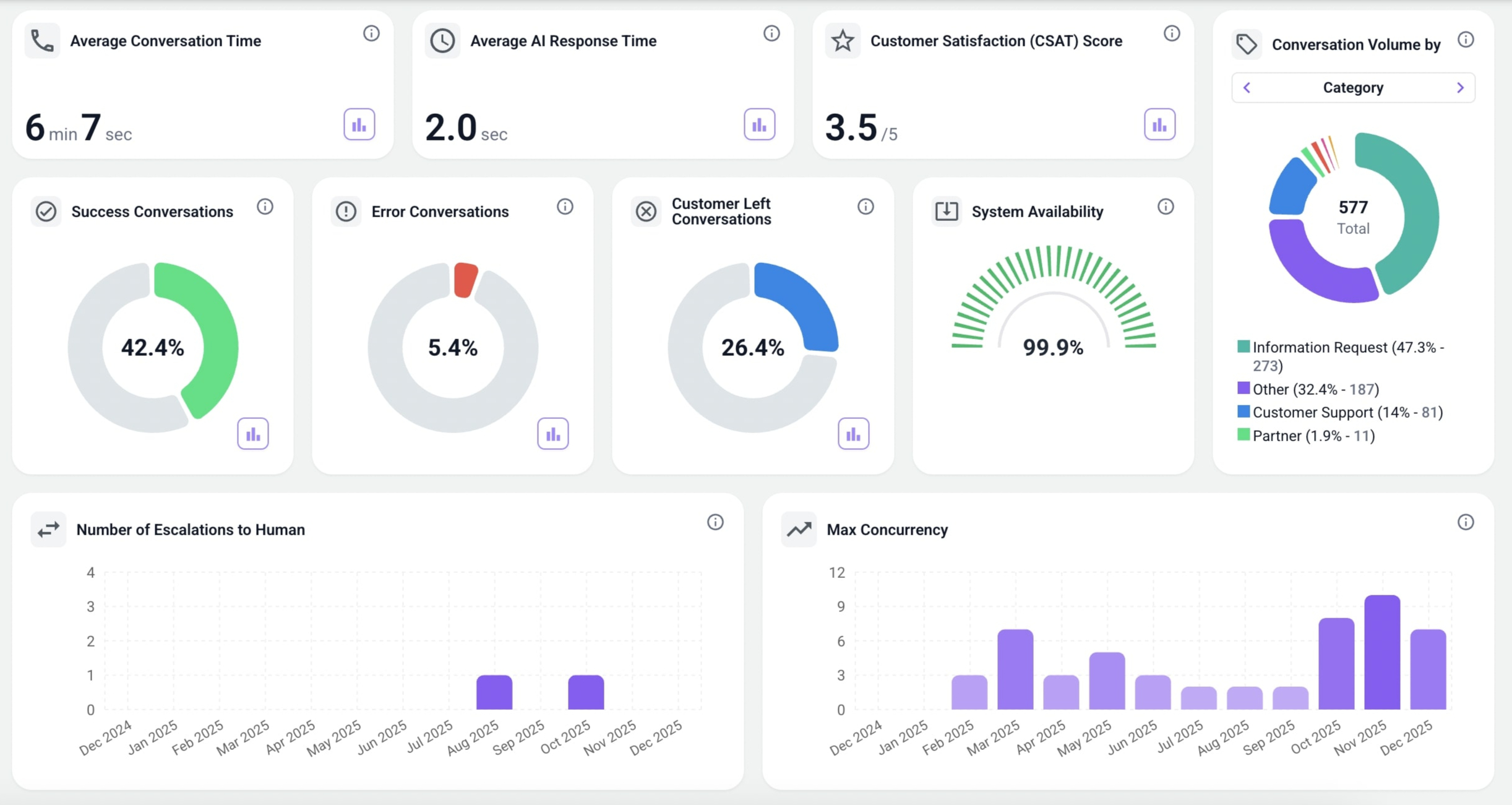

Performance Insights
View Success, Error, and Abandoned conversation rates to identify gaps and improve agent performance.

Smart Categorization
Categorize conversations by topic, inquiry type, and sentiment for deeper insights.

Transcript Review
Drill down from flagged or categorized conversations to actual transcripts directly from the dashboard KPIs.

Continuous Optimization
Track trends and continuously refine your agents — either independently or with our expert support.

For Customer Support Teams:
- Automate repetitive inquiries and common issues to focus on complex, high-value customer interactions
- Reduce call volume by 60-80% for Tier 1 support through autonomous issue resolution
- Scale support capacity without proportionally increasing headcount or costs
- Maintain consistent service quality across all shifts, holidays, and peak demand periods
- Free agents from routine questions to focus on building customer relationships and solving complex problems

For Operations Managers:
- Improve operational efficiency with 24/7 coverage and instant response times
- Get complete conversation analytics for quality assurance and process optimization
- Reduce average handle time while improving first-call resolution rates
- Track AI voicebot performance with comprehensive metrics on resolution rates and customer satisfaction
- Deploy solutions that decrease support costs by up to 70% while improving service levels

For Customers:
- Experience immediate assistance without waiting in queue or navigating complex phone menus
- Get accurate, consistent answers regardless of time of day or call volume
- Resolve simple issues instantly without repeating information or transferring between agents
- Receive personalized service based on account history and previous interactions
- Engage through preferred channels with seamless voice experiences
Compliance
Our platform adheres to the highest compliance standards, ensuring full regulatory alignment.

AICPA SOC2

Hitrust

ISO 27001

HIPAA

GDPR

ISO 42001

CCPA

CPRA

CPA
What clients say about NextLevel.AI

Made The Trade
Working with Michael and his team has been an incredible experience.
They developed a cutting-edge AI solution that has truly revolutionized our business operations. We’ve been able to promote and showcase the technology with confidence, and the team has been highly receptive to feedback, making continuous improvements.
We’re excited to implement it into our day-to-day processes and look forward to the ongoing impact it will have on our business.

SalonHQ
The NextLevel. ai team has successfully developed the first advanced prototype of our Stylist AI agent in under a week.
This innovation allows our web shoppers to receive personalized beauty product recommendations directly on our web store through an engaging voice conversation with our AI Stylist. This enhanced customer interaction has not only improved the shopping experience but also attracted significant investor interest, recognizing its potential to revolutionize beauty retail.
Collaborating with NextLevel.ai has truly been a game-changer for SalonHQ.
Thank you, Michael and the NextLevel!

Digital Innovation
Teaming up with NextLevel AI to create our Voice AI BDR agent has been a game-changer for us.
Now, our AI BDR agent takes care of the first touch—engaging website visitors, understanding their needs, and passing qualified leads to our sales team. It even books meetings and seamlessly syncs everything into our CRM, saving us a ton of time.
What really sets it apart is how it adapts in real-time, personalizes conversations, and even identifies high-value enterprise prospects for targeted engagement. NextLevel AI absolutely nailed it. Their team has been incredible—super responsive, always open to feedback, and constantly pushing the technology forward.
Ready to innovate your business?
Looking to transform your business? Let’s collaborate to
create innovative solutions that drive success.
Call Us: +13233105315
Book a meeting
* Schedule a conversation with our team and explore how we can help your business thrive.
Have questions about AI Voicebot?
What is AI voicebot and how does it differ from traditional bots?
AI voicebot refers to artificial intelligence-powered voice automation software that conducts natural language conversations with customers via phone or voice interfaces. Unlike traditional bots that rely on rigid menu navigation, AI voicebots engage in dynamic, human-like voice conversations using speech recognition, natural language processing, and conversational AI to understand spoken requests, provide intelligent responses, complete transactions, and resolve customer inquiries.
The voicebot is an AI-powered system that uses natural language processing to comprehend intent and context, enabling it to handle complex voice interactions autonomously—performing tasks traditionally handled by human call center agents but with 24/7 availability and unlimited scalability.
How do conversational AI and gen AI voicebots enhance customer service and customer experience?
Conversational AI voicebots and gen AI powered systems revolutionize customer service by conducting natural, multi-turn voice conversations that understand context, intent, and sentiment in real-time. These AI technologies enable customer inquiries to be handled instantly through voice interactions that feel genuinely helpful rather than robotic, dramatically improving customer experience and customer engagement. Gen AI voicebots leverage advanced AI models to generate contextual responses dynamically, adapt communication style to individual customers, and handle unexpected questions with human-like reasoning.
This approach helps improve customer satisfaction, enhance customer relationships, and boost customer loyalty while enabling businesses to scale customer service operations efficiently. The result is seamless customer experiences in contact center that feel personalized while operating at scale impossible for human teams alone.
What types of voice bots and voicebot solutions are available for different use cases?
Modern AI-powered Voicebot and AI bot technology encompass several types designed for specific applications: customer service bots for support automation, voice assistants for hands-free interactions, interactive voice response systems enhanced with conversational AI, virtual voice assistants for personal assistance, and enterprise-focused voice platforms for business operations. AI voice bots work across use cases including appointment scheduling, payment processing, account inquiries, technical troubleshooting, and information requests.
Voice bots for customer engagement handle both inbound calls (responding to customer-initiated contact) and outbound campaigns (proactive notifications, surveys, renewals). The voicebot technology adapts to industry-specific needs—healthcare voice bots handle HIPAA-compliant patient interactions, conversational AI voicebot insurance implementations manage policy inquiries and claims, and customer service bots automate retail support. Voice bot AI capabilities continue expanding as advanced AI technologies evolve.
How do voice conversations, voice commands, and voice recognition work in AI voicebot systems?
Gen AI voice bot systems process voice conversations by converting spoken voice inputs into text using advanced voice recognition technology, then analyzing the text with natural language understanding to comprehend customer intent and extract key information. The system interprets voice commands naturally—customers don’t need specific phrasing or menu navigation, they simply speak their request in natural language. Voice technology handles various accents, speech patterns, and even background noise to accurately understand what customers say.
The voicebot uses AI to understand context across multi-turn voice interactions, remembering earlier parts of the conversation and adapting responses accordingly. Advanced systems employ generative AI that can detect emotion and sentiment from tone, pitch, and speaking patterns, allowing the bot to adapt its approach when customers sound frustrated or confused. Using voice this enables businesses to automate voice interactions while maintaining conversation quality that rivals human agents.
Can AI voicebots provide human-like voice responses and natural voice interactions?
Yes, modern AI voicebots deliver remarkably human-like voice responses through advanced text-to-speech synthesis that produces natural voice output with appropriate intonation, pacing, and emotion. The voicebot uses sophisticated AI models trained on human speech patterns to generate digital voice responses that sound conversational rather than robotic. Simple voice bots may use pre-recorded phrases, but advanced AI voicebots dynamically generate responses tailored to each customer’s specific situation, creating unique voice conversations every time.
The technology supports natural voice flow including conversational fillers, appropriate pauses, and contextual tone adjustments. Voice bots understand natural language including colloquialisms, incomplete sentences, and implicit requests—customers can speak naturally without memorizing specific commands. This combination of natural language understanding and human-like voice synthesis enables the voicebot to provide seamless customer interactions that feel genuinely helpful and engaging.
How do AI voicebots integrate with existing systems like AI platforms, voice channels, and text or voice interfaces?
AI voicebots integrate comprehensively with enterprise systems through APIs and connectors linking to CRM platforms, ticketing systems, knowledge bases, payment gateways, and business applications. The conversational AI platform orchestrates connections across voice channels (phone systems, IVR, mobile apps) and supports both voice and chat interfaces for omnichannel consistency. Modern voicebot solutions offer voice and chat capabilities through a unified AI platform, allowing customers to switch between text or voice interaction modes seamlessly.
Integration with AI chatbots enables consistent responses across modalities—the same underlying conversational AI powers both voice agent and chat experiences. The AI system syncs bidirectionally with backend platforms, both retrieving customer data to personalize interactions and updating records based on conversation outcomes. This enterprise-focused voice architecture ensures the voicebot operates as an integrated component of your customer engagement ecosystem rather than a siloed tool.
What benefits of AI voicebot technology can businesses expect?
Benefits of AI voicebot implementation include 60-80% reduction in call handling costs, 24/7 customer support availability without staffing constraints, instant response to customer inquiries eliminating wait times, unlimited scalability during peak periods, consistent service quality across all interactions, improved first-call resolution rates, comprehensive voice conversation analytics for optimization, freed human agent capacity for complex issues, multilingual support without additional staffing, and enhanced customer satisfaction through immediate assistance.
The AI automation enables businesses to handle thousands of concurrent calls without quality degradation, maintain operations during holidays and after-hours, and scale customer service economically. Organizations also benefit from complete conversation transcripts for compliance and training, sentiment analysis revealing customer pain points, and continuous improvement through machine learning on successful interaction patterns.
How can voicebot be implemented and what does deployment involve?
A voicebot can be implemented in 2-4 weeks for standard use cases through a phased approach: initial planning defines target use cases and success criteria, technical integration connects the conversational AI platform to telephony systems and backend applications, conversation design maps dialogue flows and response strategies, knowledge base integration provides the bot with accurate information sources, voice technology configuration optimizes speech recognition and synthesis, pilot testing validates performance with sample scenarios, and gradual rollout expands to full call volume.
Implementation requires defining when the voice bot uses autonomous resolution versus escalation to humans, establishing voice bots can handle thresholds for confidence and complexity, and training staff on working alongside AI. The voicebot understands customer needs through continuous optimization during initial deployment, learning from real interactions to improve accuracy. Organizations should plan for ongoing refinement as call patterns evolve and new use cases emerge.
How do voice bots leverage AI to understand customer intent and enable businesses to improve service?
Voice bots leverage sophisticated AI technologies including natural language processing, machine learning, and intent classification to analyze what customers say and determine what they actually need. The AI to understand customer requests works by extracting entities (names, dates, account numbers), detecting sentiment and urgency, and mapping requests to known intents in real-time. Voice bots offer continuous learning capabilities—analyzing thousands of voice interactions to identify patterns, optimize responses, and expand capabilities automatically.
This enables businesses to improve service quality systematically through data-driven insights into common customer needs, pain points, and successful resolution strategies. The bot detects emerging issues before they become widespread problems, identifies knowledge gaps requiring new content, and reveals opportunities to streamline processes. Voice bots help organizations optimize resource allocation by handling high-volume routine inquiries autonomously while routing complex cases to specialized agents, ensuring each interaction receives the most appropriate resource.
Can voice bots handle complex customer scenarios and what are the limitations?
Modern voice bots can handle increasingly complex scenarios including multi-step transactions, conditional logic based on customer responses, integration with multiple backend systems, and nuanced conversations requiring context awareness. AI voicebots are designed to manage common support issues, appointment scheduling with constraints, payment processing with verification, account updates with security protocols, and information requests requiring data synthesis from multiple sources.
However, limitations exist: voice bots often struggle with highly emotional situations requiring empathy, novel scenarios outside their training, requests involving policy exceptions or judgment calls, and conversations with background noise or unclear speech. The bot also may not match human creativity in problem-solving unique situations or building rapport with frustrated customers. Best practice establishes clear escalation paths—when the voicebot can be implemented detects complexity beyond its capabilities, uncertainty in understanding, or customer frustration, it should transfer seamlessly to human agents with complete context rather than attempting to force resolution.
How does AI automation through voicebots enable voice bots to provide better service than traditional systems?
AI automation through voicebots enables dramatically superior service compared to traditional IVR by allowing customers to speak naturally rather than navigate menu trees, understanding intent from conversational language rather than requiring specific keywords, adapting responses based on customer context and history, learning from interactions to improve continuously, and operating with genuine intelligence rather than rigid scripting. Voice bots provide personalized experiences by accessing customer data in real-time, referencing previous interactions, and tailoring responses to individual situations—something menu-driven systems cannot achieve.
The processing and voice technology work together to comprehend what customers mean even when they phrase requests differently than anticipated. This flexibility means the same voicebot understands thousands of variations of the same request, whereas traditional systems require exact phrasing. Additionally, AI voicebots offer rich analytics revealing why customers call, where conversations succeed or fail, and how to optimize both automated and human-assisted interactions.
What makes AI experience with voicebots different from other customer service approaches?
The AI experience with modern voicebots differs fundamentally through natural conversation flow that feels interactive rather than transactional, instant access to information eliminating the need for callbacks or research delays, consistent quality regardless of time or call volume, and proactive assistance that anticipates needs based on context. Customers experience frictionless service—they describe their issue naturally, receive immediate understanding and response, complete transactions without transferring between departments, and get accurate answers without repeating information.
The voice bots often provide faster resolution than human agents for routine inquiries since they access information instantly without navigating systems manually. Advanced voicebots adapt their communication style and pacing to match customer preferences, creating personalized interactions at scale. This combination of speed, accuracy, availability, and natural interaction quality represents a significant evolution beyond traditional customer service models.
How do voice bots work with human agents and what role does each play?
Voice bots work alongside human agents in an optimized partnership where AI handles high-volume routine inquiries (account status, appointment scheduling, password resets, common FAQs) autonomously, while humans focus on complex scenarios requiring judgment, empathy, creativity, or policy exceptions. When the voice bot detects a situation beyond its capabilities—through explicit customer request, low confidence in understanding, or complexity indicators—it transfers seamlessly to an appropriate human agent with complete conversation transcript, customer context, detected intent, and recommended next steps.
This ensures agents receive only pre-qualified calls where they can add maximum value, entering conversations fully briefed without forcing customers to repeat information. The bot also assists agents during calls by surfacing relevant information, suggesting responses, and handling post-call follow-up tasks. Organizations typically maintain human coverage for escalations while allowing the voicebot to manage 60-80% of total call volume, creating sustainable efficiency without sacrificing service quality on complex issues.
What are the key considerations when voice bots can handle your use cases?
When evaluating whether voice bots can handle your specific use cases, consider conversation complexity (simple transactional vs. nuanced advisory), information availability (can required data be accessed via API), transaction volume (high-volume repetitive scenarios benefit most), customer tolerance for automation (some demographics prefer human contact), regulatory requirements (compliance constraints in healthcare, finance), security needs (authentication and data protection), integration requirements (system connectivity for resolving requests), and success measurement criteria (clear metrics for effectiveness).
Voice bots excel with structured workflows, predictable inquiries, and scenarios where information access drives resolution. They struggle with highly emotional situations, complex negotiations, creative problem-solving, and interactions requiring significant human judgment. The voicebot understands its limitations through confidence scoring—when uncertainty exceeds thresholds, it should escalate rather than guess. Successful implementations start with clear use cases where automation delivers obvious value, then expand capabilities based on performance data and customer feedback.
How do modern voice bots and AI voicebots are designed for continuous improvement?
Modern voice bots and AI voicebots are designed with built-in learning capabilities that enable continuous improvement through multiple mechanisms: analyzing successful vs. unsuccessful conversation patterns to optimize dialogue flows, identifying customer questions lacking good answers to expand knowledge bases, detecting phrases causing recognition errors to improve speech models, tracking which responses drive satisfaction vs. escalation, gathering agent feedback on transferred calls to understand limitations, and using machine learning on conversation datasets to enhance intent recognition.
The system automatically identifies optimization opportunities—common questions requiring new content, conversation paths leading to abandonment, and terminology requiring better handling. Voice bots help organizations improve systematically by providing detailed analytics on performance across dimensions like resolution rate, handling time, customer satisfaction, and escalation frequency. Leading implementations establish regular review cycles where experts analyze voicebot performance data, identify improvement opportunities, and implement refinements—creating a continuous improvement loop that enhances capabilities over time while adapting to evolving customer needs and business requirements.